
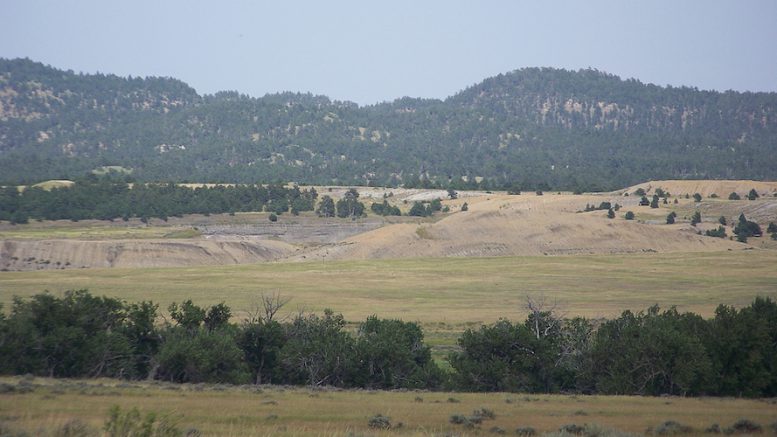
After more than a decade of local opposition, enCore Energy (Nasdaq: EU; TSXV: EU) has received federal approval to start building its Dewey Burdock project in southwest South Dakota, advancing what would become the state’s first in-situ recovery (ISR) uranium mine.
The Bureau of Land Management (BLM) this week authorized enCore subsidiary Powertech to start construction of initial infrastructure such as access roads, monitoring wells and power lines on 97 hectares of BLM-managed public land, enCore said Thursday. Dewey Burdock, located in the historical uranium mining district of Edgemont, is about 300 km northeast of state capital Pierre.
“Securing the BLM’s approval to commence construction on BLM lands marks a significant milestone for the Dewey Burdock Project,” enCore Executive Chair William H. Sheriff said in a release.”
“Our team’s efforts at the federal level to coordinate permitting within the Fast 41 program have greatly enhanced enCore’s ability to move forward,” Sherriff said, citing the U.S. government initiative that last August added Dewey Burdock to its list of projects for accelerated permit reviews.
US uranium drive
EnCore’s construction step marks a crucial federal uranium project authorization this year amid a wider U.S. push to develop more domestic uranium capacity. While the state’s Edgemont district has had open pit and underground uranium mines in the past, enCore would pioneer ISR mining in South Dakota. With ISR mining, a solution is injected underground through wells, separating uranium from ore. Uranium is later recovered from the solution in a surface facility.
It also comes after more than a decade of permit reviews and legal challenges from environmental and Indigenous groups that paused Dewey Burdock’s progress. The Nuclear Regulatory Commission granted Dewey Burdock’s ISR licence in 2014, which authorized construction and operation of the project.
The Environmental Protection Agency last September waived a petition by the Oglala Sioux Tribe, Black Hills Clean Water Alliance and NDN Collective who had challenged the project’s permits.
28-year life
Dewey Burdock hosts 17.1 million measured and indicated lb. of uranium grading 0.12% uranium oxide (U₃O₈) and 712,600 inferred lb. at 0.06% U₃O₈, according to a 2024 resource. Dewey Burdock is expected to process 1 million lb. of uranium per year, recovering more than 14 million lb. over its 28-year life.
Discounted at 8%, the project has a post-tax net present value of $133.6 million, a post-tax internal rate of return of 33% and initial capital costs of $264.2 million, according to a 2025 preliminary economic assessment.
Neighbouring Wyoming has emerged as the U.S.’ dominant uranium output jurisdiction, with the state hosting most of the country’s producing ISR uranium mines.
EnCore’s currently producing ISR operations include Rosita and Alta Mesa in Texas.
Company shares fell 4% to C$2.21 apiece on Friday morning in Toronto, valuing the company at C$429.3 million. The stock has traded in a 12-month range of C$1.76 to C$5.88.
Be the first to comment on "EnCore OK’d to build South Dakota’s first uranium mine tapping underground brine"