
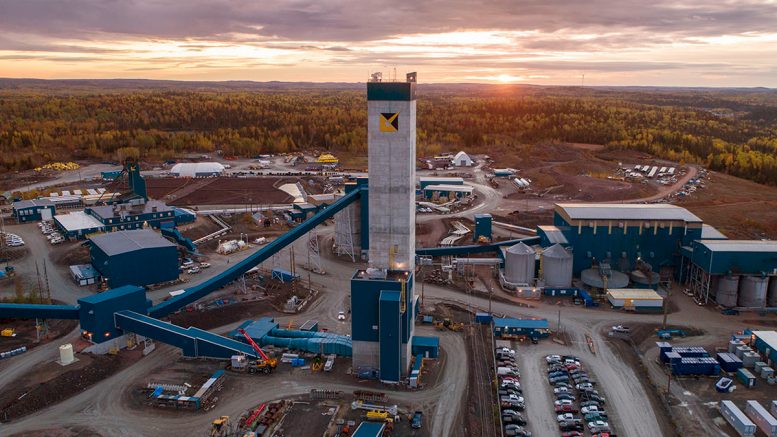
Alamos Gold (TSX, NYSE: AGI) says it’s expecting lower production in the second quarter following a series of disruptions at the Young-Davidson mine in northern Ontario.
In an update on Thursday, the Canadian gold miner said the mine operation experienced two seismic events last week, including one “at an active mining front.” Those were after three-day power outage due to storm-related damage to a regional power line in late May.
While no injuries were reported, the earthquaked affected infrastructure, limiting access to two higher-grade stopes that were scheduled to be mined during the second quarter.
BMO Capital Markets said Friday that 2026 consolidated production is now expected to be below Alamos’ guidance of 570,000 to 650,000 oz. while this year’s all-in sustaining costs could be above the company’s forecast of $1,500 to $1,600 per ounce.
Shares of Alamos Gold closed Thursday 2.5% lower and fell a further 17% by mid-Friday to $42.76 apiece for a market capitalization of $17.9 billion.
“We are disappointed with the operational challenges at Young-Davidson, and are working diligently to review and optimize the mining sequence to support higher mining rates going forward,” CEO John McCluskey said in a release. “The first half has been challenging, but we expect stronger production into the second half of this year.”
12% lower output
Given those disruptions, the company now expects Young-Davidson production to be lower than anticipated for the second quarter, and in-line with the first quarter. Its quarterly production has been revised down to 130,000-135,000 oz., a 12% drop from the midpoint of its previous guidance range, while costs are also expected to rise.
Alamos also said its consolidated gold production will fall below its full-year guidance, and costs will exceed forecasts. A revised guidance is expected in July, when the company releases its Q2 results.
Young-Davidson, located approximately 60 km west of Kirkland Lake, is one of two major gold mines that Alamos operates in Northern Ontario. The underground mine has a rich production history dating back to the 1930s. Modern mining began in 2013 under the ownership of AuRico, which later merged with Alamos.
Island improvements
For the remainder of the year, Alamos expects production to be anchored by its other Canadian operation — the Island Gold District — as it continues to perform well and is expected to remain a key driver of production growth this year.
The underground mine, one of the highest grade in Canada, is set to see its mining rate increase further from 1,500 tonnes per day to 2,000 tonnes by the end of this year, the company said. At the Magino open pit, the mill ram-up is also proceeding as planned, expected to average 10,000 tonnes per day by the third quarter, it added.
Last year, the Island Gold District contributed nearly half of Alamos’ gold output, equaling that of Young-Davidson and the Mulatos operations in Mexico combined.
Be the first to comment on "Quakes, storms knock Alamos Gold output"