
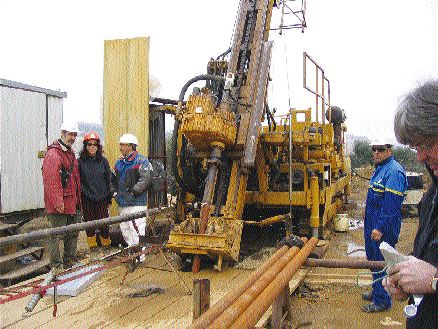
Geologists are a rugged bunch, usually working without many of the amenities we commonly take for granted and in places where most of us would fear to tread. Well, that’s true of most geologists. Then there are the lucky ones, who have the chance to do field work in Sardinia.
Situated in the Mediterranean Sea, off the western coast of Italy, and famous for its sub-tropical-to-temperate climate, Sardinia is better known as a Mecca for tourists and fishing enthusiasts than as a place to find the next mother lode. And yet the island has a long mining history dating back more than 3,000 years to Phoenician times. Archeological evidence shows that Sardinia has produced a variety of base metals and industrial minerals, though there has been little evidence of precious metals.
Until recently, that is.
GMS put the Furtei mine into production in 1996, following eight years of exploration, which included more than 78,000 metres of reverse-circulation and 43,000 metres of diamond drilling. Situated 40 km northwest of the city of Cagliari, the property is underlain by Tertiary volcanic and volcanosedimentary assemblages that form part of a 5-km-diameter volcanic complex. Eight separate oxide zones and associated upper-level sulphide zones were mined from open pits to produce 138,000 oz. gold.
Despite the early success, Furtei closed down in 2002 as a result of depletion of oxide reserves. At the time of the closure, the property encompassed a 5.3-sq.-km exploitation permit and a 7.6-sq.-km exploration and research permit, in addition to a million-tonne-per-year processing plant. Reserves and resources in 2000 amounted to 9.3 million tonnes averaging 2.08 grams gold per tonne and included an estimated 15,000 tonnes copper.
Initially, GMS held a 90% interest in each property in its portfolio. The remaining 10% interest in all the projects is held by Progemisa SpA, a mining and research company owned by the Sardinian government. However, with dwindling revenue and low commodity prices, GMS began searching for joint-venture partners.
The first Canadian junior to strike a deal with GMS was
Sargold has started a 25-hole, 7,500-metre program consisting of channel sampling and reverse-circulation and diamond drilling on the Sa Perrima zone — one of four established targets at Furtei. A bulk-tonnage target measuring 500 by 350 metres, Sa Perrima is 1.2 km from the sulphide-ore heap-leach plant.
Sargold adheres to the theory that mineralization is controlled by northeast-trending structures. Previous drilling was oriented parallel to this trend, and therefore assay results may not be representative of true value. Sargold believes that grades intersected in more recent drilling could be as much as 50-70% higher than those reported by GMS.
Encouraging results from four holes drilled on the eastern margin of Sa Perrima are as follows:
— 16 metres grading 2 grams gold per tonne and 18 metres of 3 grams gold per tonne in Hole CAR401;
— 16 metres of 1.2 grams gold per tonne in hole CAR402;
— 48 metres of 3 grams gold per tonne in hole CAR403; and
— 25 metres of 1.2 grams gold per tonne in hole CAR404.
The holes were drilled on 50-metre centres, and assays were completed by Progemisa.
Sargold has so far reported results from nine drill holes and numerous channel samples, all of which are in the 2-to-4-gram-per-tonne range over similar widths. Four rigs are now testing induced-polarization, geochemical and structural targets, as well as targets defined by channel sampling at Sa Perrima.
Sargold says there is potential for finding additional high-grade diatreme deposits, bonanza-grade mesothermal deposits, and bulk-tonnage gold deposits in favourable horizons, as well as copper-gold porphyry systems at depth.
Besides Furtei, Sargold entered into negotiations to acquire GMS’s Osilo gold-silver property, 160 km to the north. Based on historical data, independent consultants estimate the property hosts indicated mineral resources of 800,000 tonnes averaging 6.5 grams gold and 38 grams silver per tonne, as well as an inferred mineral resource of 860,000 tonnes grading 7.5 grams gold and 21.8 grams silver.
The Sargold agreements are not the only GMS deals reported in recent months.
In October 2003, GMS and
Previously, GMS had optioned Monte Ollasteddu to Homestake Minerals, and subsequent to that company’s merger, the option was with
Exploration at Monte Ollasteddu, led by GMS geologists, began in 2000. Precious metal mineralization is associated with stockwork quartz veining, pervasive silicification and arsenopyrite. The property is underlain by a 3.5-by-1-km soil geochemical anomaly, the eastern end of which is open and possibly covered by younger sandstones. Selective chip samples have assayed up to 10 grams gold per tonne over widths typically between 1 and 20 metres.
Under the terms of the proposed Bolivar-GMS letter-of-intent, Bolivar can earn a 15% direct interest in the project on receipt of all research and access rights, an additional 40% on completion of a prefeasibility study, and another 15% on completion of a bankable feasibility. Two Bolivar executives currently sit of GMS’s board of directors.
Following the announcement of the Bolivar-GMS letter-of-intent, Bolivar signed a subsequent letter-of-intent with
Ownership breakdown
If definitive agreements are signed, permits are acquired, and Gold Fields earns in fully, Monte Ollasteddu will be owned 60% by Gold Fields, 20% by GMS (participating interest), 10% by Progemisa (free-carried interest), and 10% by Bolivar (participating interest).
But that’s not the end of the story, as there is proposed business combination between GMS and
GMS will contribute its property interests to the new company. For GMS shareholders, who will wind up with a 50% interest in the new company, there will be numerous benefits if the business combination is completed — among them, a new management team that has established relationships with Italian government officials, and a stocked-up treasury (FRI recently completed a US$10-million financing and has a US$1.5-million interim facility).
A third and critical component of the proposed combination is the announcement that FRI has brought forward a third-party joint-venture partner to operate and finance all future exploration in Sardinia, excluding areas under the current agreement. The partner is Gold Fields, and the proposed business combination should be approved in early March.
All of this proves that if the markets conditions are right and money can be raised, any project of merit can be revived — and a few lucky geologists may get a chance to do field work in Sardinia.
— The author is a Toronto-based geologist and freelance writer.
Be the first to comment on "Island of Sardinia wakes up to mineral exploration"