
Three drilling programs by
A calculation by Zimbabwe-based consulting firm Digital Mining Services puts Lufua’s measured and indicated resource at 87.6 million tonnes grading 1.17% copper and 0.017% cobalt, based on a cutoff grade of 0.5% copper. The result is based on 86 air core drill holes, 73 reverse-circulation holes, and 14 diamond drill holes.
The resource is divided into an oxide and mixed zone, with 22.5 million tonnes grading 1.24% copper and 0.035% cobalt, and a primary sulphide zone with 65.1 million tonnes grading 1.14% copper and 0.01% cobalt. The oxide-mixed material would probably be recoverable by leaching, but the sulphide material would have to be concentrated.
A second calculation from the same data base, made to delineate the deposit’s most cobalt-rich zones separately, yields an indicated resource of 5.6 million tonnes grading 1.14% copper and 0.17% cobalt. This calculation used a 0.5% copper grade and a 0.025% cobalt grade as a cutoff.
The mineralization is mainly concentrated in the hinge of an overturned anticline that plunges to the northeast. The host rocks are metamorphosed fine-grained sediments of the Katangan series, of late Proterozoic age (about 880 million years).
Copper-cobalt deposits in the Katangan series are mainly in strongly deformed sedimentary rocks, chiefly those close to the contacts between the Roan and Kundelungu stratigraphic groups and between the Roan and pre-Katangan basement rocks. The folding is often linked to faulting along an arc-shaped thrust system (the Lufilian Arc), whose faults dip gently to the southwest. Most maps place Lufua near the Roan-Kundelungu contact.
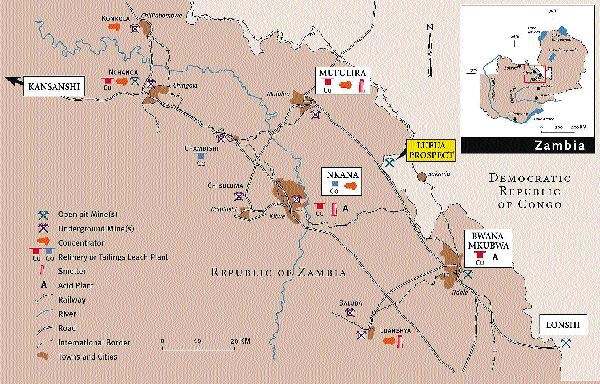
Lufua was discovered in a grass-roots exploration program in 2002, when geochemical surveys turned up a zone of soils with copper contents of 200 to 500 parts per million. The property is near the town of Sakania, and is about 2 km from the Zambian border. It is also a 45-km drive, mainly on paved roads, to First Quantum’s Bwana Mkubwa solvent extraction and electrowinning plant near Ndola, Zambia.
Metallurgical testing is under way on Lufua mineralization, with initial acid-soluble copper grades in the oxide and mixed material running about 70% of total copper. Another 15,000 metres of diamond and reverse-circulation drilling should be complete by year-end, with the goal of providing a resource estimate for use in a final feasibility study.
The Lufua property is part of a permit held by Compagnie Minire de Sakania, First Quantum’s wholly-owned Congo subsidiary. The new permits are held under the modernized Congolese mining code, which dates to June 2003. Minire de Sakania already operates the Lonshi open-pit copper mine, which currently feeds the Bwana Mkubwa plant.
Be the first to comment on "First Quantum proves up resource at Lufua"