
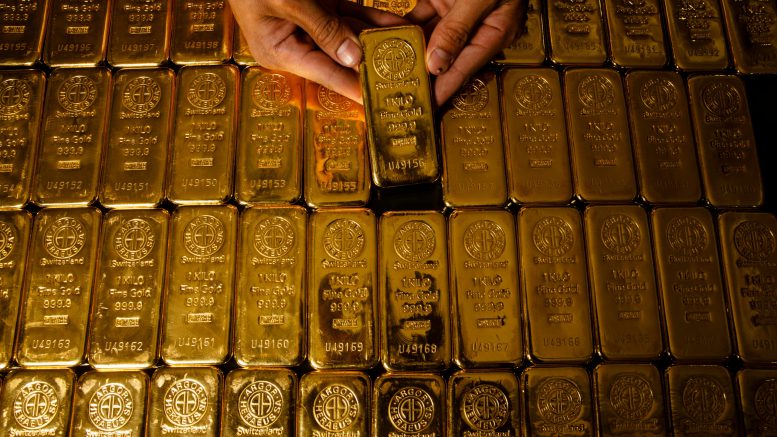
Gold and silver jumped on Wednesday as a sharp escalation in the United States war on Iran sent oil surging and investors scrambling back into havens, with buyers willing to overlook the highest long-term borrowing costs in years, normally poison for precious metals.
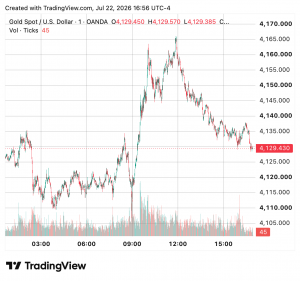
Gold for August delivery hit a session high of $4,171 an oz. in New York, up 2.3%, while September silver rose as much as 4.3% to $61.27, two sessions after touching an eight-month low. By early afternoon both metals had lost some steam, with gold changing hands at $4,137.16 and silver at $59.86.
An ounce of gold now buys about 69 oz. of silver, down from just under 71 on Monday, a measure of silver’s outperformance this week. Platinum and palladium also pared early gains.
Attacks between the U.S. and Iran are widening into a second week of renewed fighting that has killed four American soldiers. President Trump warned the U.S. would “bomb and destroy one bridge or power plant” around Tehran each time Iran attacks shipping in the Strait of Hormuz, while Iranian outlet Tasnim countered with threats against energy infrastructure across the region.
Yemen’s Houthis, allied with Tehran, declared an embargo on vessels passing through the Bab el-Mandeb strait, leaving oil markets facing blockages at two of the world’s most important chokepoints. Brent crude briefly topped $95 a barrel and WTI rose 2.9% to $86.78.
Wednesday’s rush into bullion came even as 30-year Treasury yields held above 5% for the longest stretch since the financial crisis. It was exactly that combination of war-driven energy inflation and rising rate expectations that made June gold’s worst month since 2008 and rekindled rate-hike bets as recently as last week. Swap traders still see only around a 10% chance of a hike at the Fed’s meeting this month, but at least one increase remains priced in by year-end.
Rising oil prices “have fuelled concerns over global inflationary pressures and, in turn, reinforced hawkish monetary policy expectations,” Tony Sage, CEO of rare-earths developer Critical Metals (Nasdaq: CRML), said Wednesday in e-mailed comments. “A hawkish tone from policymakers could place selling pressure on gold, while a softer stance could provide some relief.”
“Despite the near-term headwinds, gold continues to draw structural support from sustained central bank purchases, which could help limit downside risks over the longer term and support a recovery once conditions improve globally,” he added.
Stocks respond
The rally lit up mining stocks — a group that is still trading, on a median basis, about a third below its 52-week highs. U.S.-traded shares of China’s Zijin Mining led the majors with an 8.1% gain, while Newmont (NYSE: NEM; TSX: NGT) added 3.1% and Barrick Mining (TSX: ABX; NYSE: B) rose 2.4%. Even after Wednesday’s gain, Barrick sits about 32% below its high of the past year. The company this week bought a 9.9% stake in Canada’s Kingfisher Metals (TSX-V: KFR), a bet on British Columbia’s Golden Triangle.
Agnico Eagle Mines (NYSE, TSX: AEM), up 3.5%, remains the hardest hit of the big-cap precious metals stocks, trading more than 40% below its 52-week peak. Among silver producers, Coeur Mining (NYSE: CDE) climbed 3.8% and Hecla Mining (NYSE: HL) 2.7%, though the pair still sit 43% and 54% below their respective highs.
Despite the bounce, gold remains about 26% below January’s record near $5,600 and down 4% in 2026, though still up more than 20% over the past 12 months. Silver is off 16% this year and worth half of January’s record $121.64 an oz., but its 52% gain over 12 months is the best of any precious metal.


Be the first to comment on "Gold, silver prices rebound as US-Iran war spreads"