
The U.S. Department of Defense is putting $450 million (C$626 million) into The Elmet Group (Nasdaq: ELMT), with $150 million earmarked for Blue Moon Metals’ (TSXV: MOON; Nasdaq: BMM) Springer tungsten complex in Nevada as Washington pushes to rebuild a domestic supply chain for the strategic metal.
Under a binding agreement with Elmet and Australia’s EQ Resources (ASX: EQR), Blue Moon would receive a $50-million tungsten concentrate prepayment facility and a $25-million equity investment, while Elmet would put another $75 million into a joint venture to restart Springer’s ammonium paratungstate, or APT, plant. Elmet and EQ have set aside a further $25 million if needed for the plant.
“This is a major validation event,” Haywood Securities analyst Pierre Vaillancourt said in a note Monday, maintaining his buy rating and C$15 target for Blue Moon. Haywood said the financing substantially de-risks Springer while allowing Blue Moon to retain full ownership of the mine and mill.
Scotiabank analyst Eric Winmill also called the transaction positive and maintained a sector outperform rating and $14 target. He said the combination of strategic offtake, downstream participation and government support reduces Blue Moon’s financing and market-access risk while leaving it with the mine and mill and a 20% interest in the APT operation.
Shares in Blue Moon Metals gained 6.5% to C$8.08 apiece by mid-afternoon Monday in Toronto, valuing the company at C$807 million.
US stakes
The agreement ties Blue Moon’s Springer plans directly into Washington’s widening use of public money and equity stakes to secure critical-mineral supply chains. The Trump administration has also taken or pursued positions in MP Materials (NYSE: MP), Lithium Americas (TSX, NYSE: LAC) and Trilogy Metals (TSX, NYSE-A: TMQ), making government ownership an increasingly common part of U.S. minerals policy.
China dominates both tungsten mine supply and processing, leaving the U.S. heavily dependent on foreign sources for a metal used in missiles, aircraft, submarines, electronics and other defence and industrial applications. The Pentagon estimates China controls about 85% of global tungsten supply.
Blue Moon will keep complete ownership and operation of Springer’s mine and 1,200-tonne-per-day mill. Elmet will own 70% of the APT joint venture, Blue Moon 20% and EQ Resources 10%, with Elmet operating the plant.
The $50-million prepayment facility is to be advanced in two $25-million tranches. The first is expected within 45 days, while the second depends on construction milestones at the mine, mill and flotation circuit and potentially an ore-sorting program.
The facility is to be repaid through a 25% credit against future Springer concentrate sales rather than cash payments before production begins. Haywood said the $75 million available directly to Blue Moon could cover about $50 million of mine and mill redevelopment, $20 million of drilling and resource work and $5 million for ore sorting.
Elmet is also to buy 3.5 million Blue Moon units for $25 million, or C$10 per unit, a 32% premium to Blue Moon’s Friday closing price. Each unit carries one share and a three-year warrant exercisable at C$10.80, subject to TSX Venture Exchange approval.
Springer restart
Blue Moon is targeting a restart of the Springer mine and mill in the fourth quarter of 2027, followed by APT production in the second half of 2028. The first stage of the APT operation is designed for 4,000 tonnes a year.
Springer, near Imlay in northwestern Nevada, was historically one of the largest U.S. tungsten operations. It has a 1984 historical estimate of 10.7 million tonnes grading 0.45% tungsten trioxide, although Blue Moon cautions that it isn’t a current NI 43-101 resource. Drilling this year and next is intended to produce an updated estimate.
The company has increasingly positioned Springer as the hub of a western U.S. critical-minerals business. In August it acquired 33 projects prospective for tungsten and antimony, including several properties that could eventually supply the Springer processing complex.
The government-backed financing also answers one of the larger questions hanging over Springer. Blue Moon said last month it was seeking $150 million to $200 million for Springer and its U.S. projects after a short-seller report challenged its financing plans and wider development strategy.
Pentagon slice
The Springer funding forms part of the Defense Department’s $450-million investment in Elmet, a U.S. manufacturer of tungsten materials and components used in more than 100 defence programs.
The government is to make an initial $200-million investment at closing followed by further drawdowns. In return, it will receive redeemable preferred equity and warrants representing as much as 19.9% of Elmet’s common shares after the transaction, along with the right to name one independent director and one non-voting board observer.
Elmet plans to spend more than $165 million modernizing and expanding facilities in Maine, Michigan and Ohio in addition to its Springer investment. It is also building a network of tungsten supply arrangements involving EQ’s Mt Carbine mine in Australia and Barruecopardo mine in Spain.
The Pentagon says the investment is intended to establish North America’s only independent APT facility, addressing what it calls one of the largest bottlenecks in the domestic tungsten supply chain.
$2B stockpile contract
Separately, Elmet Technologies has secured an indefinite-delivery, indefinite-quantity contract from the Defense Logistics Agency worth as much as $2 billion.
The contract carries a guaranteed funded commitment of $150 million and covers tungsten ore, concentrates and sodium tungstate for the National Defense Stockpile. Elmet says it won’t start supplying the stockpile until additional material becomes available from new mines, offtake arrangements and processing expansions, including Springer.
The contract runs through Aug. 30, 2031, with an option to extend it for two years through August 2033.
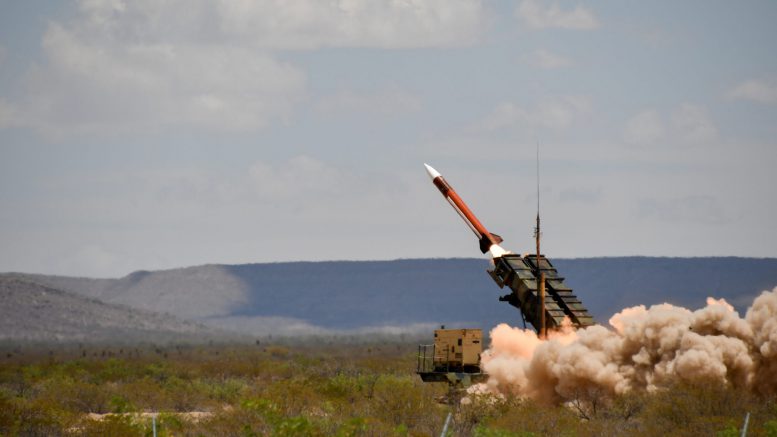
Elmet already supplies tungsten products to U.S. defence programs including Patriot, Javelin, AEGIS, Trident II and THAAD missiles and Virginia- and Columbia-class submarines.
Be the first to comment on "Pentagon backs $150M Blue Moon tungsten restart"