
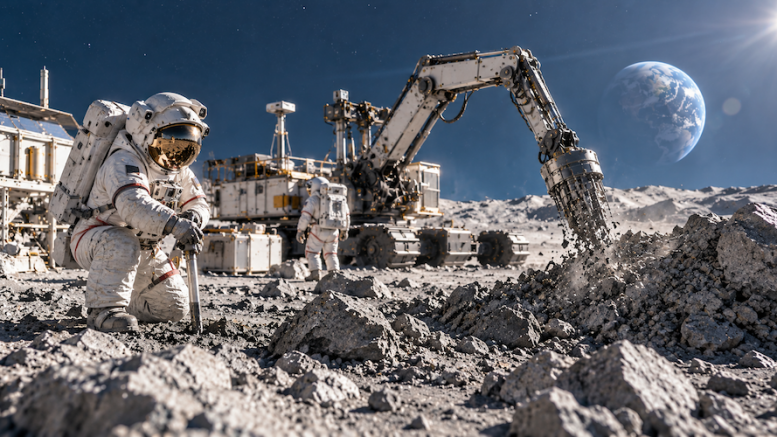
Miners may one day extract fortunes from the Moon and asteroids, but governments will have to figure out how to take their cut without killing the industry before it gets off the ground.
A February study co-authored by Petr Zimčík, head of the Center for Economics and Data Analytics at Newton University in Czechia, proposes a system that would account for inflation, exchange-rate movements and commodity-price volatility while distributing some revenue to countries without space-mining capabilities.
“The best approach is to divide overall space mining tax revenues for two different purposes,” Zimčík told MINING.COM, part of the Northern Miner Group. “The first is to create a global space resource dividend for countries.”
The framework seeks to address questions governments may eventually face as companies move closer to extracting resources from the Moon, asteroids and other celestial bodies: who collects taxes, when they become payable, how resources without market prices are valued and whether countries lacking space technology should share in the proceeds.
Taxing space
A central tax authority could be established through a multilateral treaty negotiated under the United Nations, following a process similar to the development of the Outer Space Treaty in the 1960s, Zimčík said.
The UN Committee on the Peaceful Uses of Outer Space, or COPUOS, would be a logical starting point because it is already the main multilateral forum for developing international rules governing space activities, he said. The committee has also established a working group on the legal aspects of space-resource activity, although it lacks an independent taxation or enforcement mechanism.
Participating countries could instead establish a separate Space Resources Tax Authority, with COPUOS providing technical and legal expertise. Enforcement would remain largely in the hands of national governments through licensing requirements.
Companies launching or operating mining missions would require authorization from participating states, which could make compliance with the international tax regime a condition of receiving and retaining licences. Interest in the broader space economy has already drawn attention from mining investors, with Morgan Stanley this year identifying five miners it considers important to the emerging space value chain.
“This approach is similar to international tax cooperation, where tax enforcement ultimately depends on domestic authorities,” Zimčík said.
When to tax
Determining when the tax becomes payable presents another challenge. Taxing material as soon as it is extracted would be relatively straightforward administratively, but could burden companies before they recover the large investments required to reach and mine resources in space.
Initially taxing economic rent — returns generated after a company has recovered legitimate investment and operating costs — would avoid that problem, Zimčík said.
“If the mining project is unsuccessful, the company would not face a large tax bill just because it extracted material,” he said. “Taxation would begin when the project generates extraordinary economic returns for the company.”
That model could evolve as an off-Earth economy develops. Resources extracted in space may eventually never reach Earth, instead supplying orbital construction, fuel stations or settlements on the Moon or Mars.
A mature system could therefore impose a small administrative levy at extraction, a larger tax when a resource is sold or consumed and a final settlement if it eventually enters an Earth-based market, Zimčík said.
The framework would also seek to insulate projects from currency and inflation swings by denominating tax thresholds in a stable international accounting unit linked to a basket of major currencies and commodities.
Inflation adjustments could occur automatically, while exchange-rate movements would affect conversion into national currencies rather than the underlying liability. Linking the principal tax to profitability would also cushion projects during commodity downturns: effective tax rates would fall when prices are weak or costs are high and rise when projects generate greater economic rents.
Sharing proceeds
The more politically difficult issue may be deciding who benefits when only a small group of wealthy countries and private companies initially possesses the technology and capital to mine beyond Earth.
A fixed portion of international space-resource tax revenue would finance a global space resource dividend distributed among participating countries using a formula based on population, development gaps and contributions to the global space ecosystem under Zimčík’s proposal.
Population would reflect the concept that extraterrestrial resources form part of humanity’s common interest, while the development component would direct more money towards lower-income countries. A third element would recognize nations contributing infrastructure, research, launch capabilities or scientific expertise.
Another portion of the revenue could flow into a global development fund financing public goods including climate adaptation, clean-energy infrastructure, planetary defence and developing countries’ access to space infrastructure.
Countries without mining capabilities would consequently retain an economic stake in the emerging industry, potentially reducing the risk that technological leadership in space further widens disparities between nations.
Governing body
Governance of the fund should remain separate from both mining companies and individual national governments, Zimčík said. One model could give participating states, independent scientists, economists and legal experts representation in a new governing body.
That separation could also help address a fundamental unresolved issue: whether collecting money from companies exploiting extraterrestrial resources could be interpreted as recognizing ownership claims.
Contributions should be explicitly classified as fiscal payments rather than payments conferring property rights, Zimčík said.
“Paying into this fund would therefore not establish or recognize ownership over an asteroid, mineral deposit or space territory,” he said.
The distinction matters because the Outer Space Treaty bars countries from claiming sovereignty over the Moon and other celestial bodies. Whether and under what conditions companies or individuals can acquire property rights over resources once they have been extracted remains the subject of international debate.
Be the first to comment on "Space miners may face an Earth-sized tax problem"