
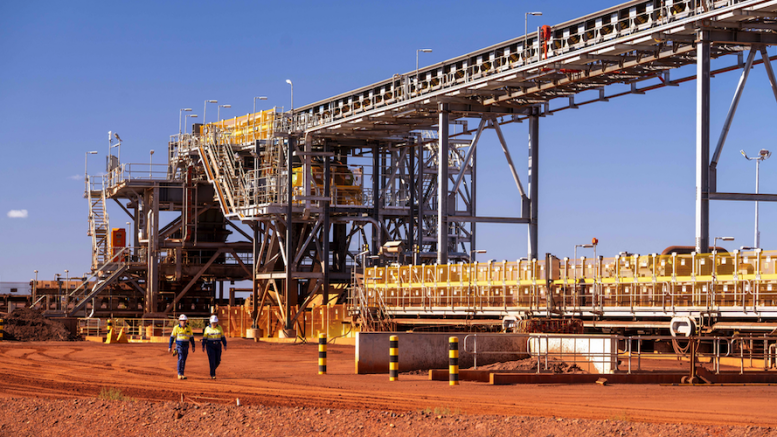
Rio Tinto (NYSE, LSE, ASX: RIO) this month opened its new Western Range iron ore mine, the first part of the company’s $13.3-billion (C$18.1-billion) investment plan to rejuvenate Australia’s Pilbara region by 2030.
The $2-billion capex Western Range is a newly constructed mine in a joint venture between Rio (54%) and China’s Baowu (46%) designed to sustain the Australian miner’s Paraburdoo hub for the next 20 years. Output is forecast at 25 million tonnes a year of iron ore.
“It is for us as companies to make sure that the Pilbara ore remains relevant,” Rio Tinto CEO Jakob Stausholm said at the June 6 event. “We do that in partnership, like you see today, with Baowu, working on how we can decarbonize the supply chain. If we find the right solutions – and we will – then the Pilbara will be the source for many, many decades.”
Rio, the world’s second-largest miner by market capitalization, and cohorts BHP (NYSE, LSE, ASX: BHP) and Fortescue (ASX: FMG), are spending to shore up Pilbara where iron ore mining has been important for 60 years. BHP is pumping $10–11 billion into broader capital programs including upgrades in the Pilbara, with South Flank alone costing $3.6 billion. Fortescue has spent heavily on new mines Eliwana and Iron Bridge and has a $6.2-billion green‑energy roadmap.
In May, Fortescue chairman Andrew Forrest warned the Pilbara was at risk of becoming a “wasteland” if iron ore miners didn’t decarbonize.
Guinea
Iron ore market attention is shifting to Guinea where Rio is contributing $6.2 billion on the $11.6-billion Simandou block three and four joint venture (53% Rio Tinto, Chinalco 40%, Guinea 15%) due to produce first ore in November. Annual output for the entire $23.2-billion project, including blocks one and two controlled by China’s Winning Consortium Simandou, is forecast at 120 million tonnes.
But Rio’s Pilbara spend includes maintaining operations and developing new mines with an estimated total 130 million tonnes of annual output. The total capex for Simandou’s similar output is about 75% more expensive and carries greater geopolitical risk in junta-led Guinea.
The Pilbara’s established infrastructure – railways, ports, train car dumpers, and shiploaders – offers a decisive advantage. Despite Australia’s rising labour costs and shifting industrial relations landscape, the region remains the world’s lowest-cost source of large-scale iron ore supply.
Also in Pilbara, the company’s $1.8 billion Brockman Syncline 1 project was approved in March, while the Hope Downs 1 and West Angelas projects are progressing through approval stages. Last month, Rio awarded a $157-million contract to construction and mining firm NRW Holdings, a move widely seen as a precursor to formal board approval for the Hope Downs 2 and Bedded Hilltop projects. A final investment decision is expected as early as July.
New beginning
Stausholm said the opening of Western Range mine represented a new beginning following the scandal surrounding the company’s destruction of the culturally significant Juukan Gorge caves in 2020. It’s also Rio’s first project to feature a co-designed social, cultural and heritage management plan with an Aboriginal group.
“I could not be more proud of seeing how we have worked in deep partnership with the Yinhawangka People,” Stausholm said. “It’s a new way of working together, really taking the guidance from them on how we develop the mines of the future, applying new technology, applying our safe production system.”
The opening comes after Rio announced the shock departure of Stausholm last month. At the event, Stausholm disputed reports of a rift between him and chairman Dominic Barton.
“It’s very important to say, we in the management team and the whole board is absolutely aligned around the values of Rio Tinto, about pursuing the four objectives, about our strategy and the strategic choices, and about the assessment of our performance, so there is no dis-alignment,” he told reporters.
One of the major strategic changes during Stausholm’s tenure has been the move into the lithium sector. The CEO said the board was “absolutely aligned” on lithium, describing it as a “next pillar” for Rio.
“Think about it,” he said. “Some visionary people 50, 60 years ago said Rio Tinto should go into iron ore.”
Be the first to comment on "Rio’s $2B mine keeps Aus iron ore relevant: CEO"