
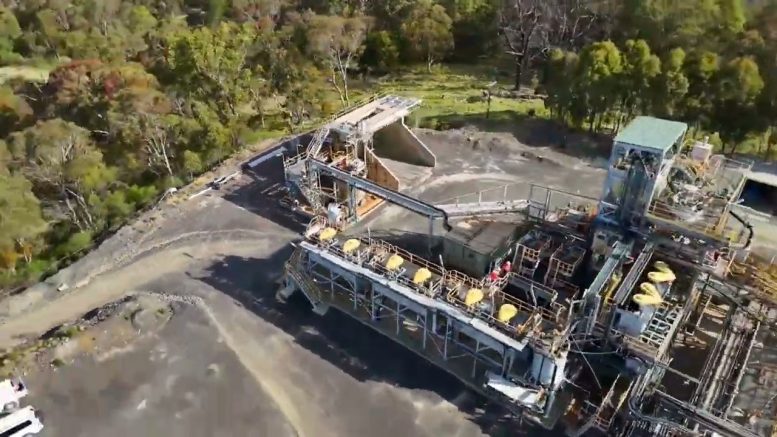
Larvotto Resources (ASX: LRV) is preparing for first production of antimony next year at its Hillgrove project in New South Wales, believed to be the largest deposit of the critical metal in Australia and one of the largest in the world.
The Australian company aims to produce 5,400 tonnes of antimony annually at Hillgrove, representing 7% of global production, which managing director Ron Heeks said could start in the second quarter of 2026.
“We’re the only project, in all honesty, that is going to be producing significant amounts of antimony in the next four years, arguably more,” Heeks told the Northern Miner Group in an interview.
As Larvotto’s production start date approaches, Hillgrove ranks in the top three contained sources of antimony in the Western world, with Trigg Minerals’ (ASX: TMG) Antimony Canyon project in Nevada topping the list at 100,000 tonnes of stibnite, the mineral that hosts antimony. Perpetua Resources’ (Nasdaq, TSX: PPTA) Stibnite Gold project in Idaho is second, with 67,000 tonnes of stibnite.
Hillgrove hosts proven and probable reserves of 3 million tonnes grading 3.1 grams gold per tonne and 1.2% stibnite for 304,000 tonnes contained gold and 35,800 tonnes of stibnite, according to a 2012 JORC estimate.
By grade, Hillgrove is number one, above Antimony Canyon with 0.79% stibnite and Stibnite Gold’s 0.064% stibnite.
‘Strategic asset’
After China’s export limits on antimony last year, the Hillgrove project “has become a strategic asset being one of the world’s top 10 antimony deposits with material near-term production potential in a Western jurisdiction”, analysts at Blue Ocean equities said in a note in September.
The company’s ASX-listed stock is up 123% over the last year, and traded for A$1.15 apiece on Monday in Sydney, for a market capitalization of A$574.1 million.
Antimony has multiple applications, with its main end-use as a flame retardant, but it is also manufactured into solar panels and lead-acid batteries. The United States’ Department of the Interior has designated it a critical mineral for its essential role in armour-piercing ammunition, infrared sensors and precision optics.
China, Russia, and Tajikistan control a significant portion of global antimony production, with China being the largest producer and refiner.
Moving fast
Larvotto’s expected production start of such a big resource has come at a relatively fast pace, after it acquired Hillgrove in 2023, then released an initial resource, reserves, a pre-feasibility study and then a feasibility study in May.
“We started the financing project in January this year. It was quite a unique thing that we did, but that shows you the strength of it,” Heeks said. “Eight weeks after the DFS we funded the project, we did 100 U.S. bonds and a $60 million capital raise on top of that, and we’ve effectively been in build since that time.”
Hillgrove could produce 40,600 oz. of gold annually over an eight-year period, at a post-tax net present value (at an 8% discount) of $694 million and an internal rate of return of 102%, with a payback period of 11 months, according to the feasibility study.
Last year, Larvotto signed a binding offtake agreement with trading house Wogen Resources for sales of its first seven years of antimony output at Hillgrove.
Last month, it rejected a non-binding indicative offer from United States Antimony (NYSE-A: UAMY), which valued the miner at about A$722.9 million ($469 million).
Historical production
The Hillgrove mine produced antimony intermittently since its discovery in 1857, with significant modern production from 1969 until a temporary closure in 2014 due to low antimony prices.
“The perpetual story is that antimony has been mined here from World War I, World War II, Vietnam, Korea,” Heeks said.
While the antimony price is always affected by ammunition demand, its price is currently being driven by the fact that 30% to 40% of antimony goes towards solar panel use.
“And then you’ve got the military uses of it, so every bullet and anything with military lead in it has somewhere between 2.5% and 6.5% antimony in it, which is why the U.S. military is getting desperate,” he said.
“Then you’ve got the unique thing that around the world, most of these ore bodies are very similar, that at the top of the system [are] higher mercury grades,” Heeks said.
At Hillgrove, the mercury withered away long ago, but underneath that is strong antimony mineralization for 200 or 300 metres, and then antimony gold, where most of the resource sits.
“There’s been zero interest in antimony for 20, 30 years. So, there’s nothing ready to go. So, you’ve got this perfect storm of production decreasing by 60%, demand going up by 60%. The whole Western world, including us, has shut down all their refineries – China – they’re the only ones with the refineries.”
Destination markets unclear
The company plans to sell 100% of its concentrate to Wogan at Rotterdam pricing.
The traders will sell to whoever gives them the best price, and Heeks won’t know the destination when the trucks pick up product and leave the site, but he doesn’t believe the antimony would enter China.
“At the moment, that would never be China because China has created an artificial internal market, as they do occasionally. They tried this on Australia a few years ago on iron ore, and all they did was more than double the price that they ended up paying for it.
“Essentially, nobody is selling to China at the moment, which is causing China a spectacular amount of grief because they can’t produce enough to get their solar panels. And internally, it’s not like they can say, ‘let’s go do more with these old projects and restart them’, because it’s gone.”
But Heeks points out that even as miners in the Western world are starting to dig again for the minerals they left in the ground for decades, the grip China has on the refining market can’t be loosened any time soon.
“If we sold it to the U.S., they’d have to send it to China to refine it. We can’t refine it here. The only facility you’ve got in the United States is the US Antimony Corps smelter, which has got to be 70 years old and at full capacity can only do about 2,000 tons per annum,” Heeks said.
United States Antimony operates the only significant smelter for the metal in the U.S. which is in a “sold out” condition, according to the company’s website, and is at full capacity and can’t accept more feedstock.
“Wogan will sell to smelters in Asia, non-China, or Europe. India is probably the biggest smelting market at the moment outside China,” he said. “Nobody in the U.S. can treat this. Nobody in North America can treat an antimony concentrate.”
“We’ve been awarded the underground mining contract. We have 15 km of underground development in place and about 12 months of ore ready to go,” he said.
Tungsten potential
Meanwhile, Larvotto has gained further critical metal momentum with the discovery of a useful amount of tungsten at Hillgrove. The company reported 90% tungsten recovery with a 16-fold increase in feed grade delivered in recent metallurgical test work, which it said also indicates a simple and cost-effective processing circuit would produce a saleable tungsten concentrate.
An initial resource for the tungsten deposit outlined 8.7 million tonnes at 0.05% tungsten trioxide (WO3) for 4,774 tonnes contained WO3, according to the estimate released in May.
Tungsten is the material of choice for high-density, armour-piercing projectiles. As with other critical minerals key to defence applications, its production and refining are heavily dominated by China.
Be the first to comment on "Larvotto greets antimony demand crunch as output nears"