
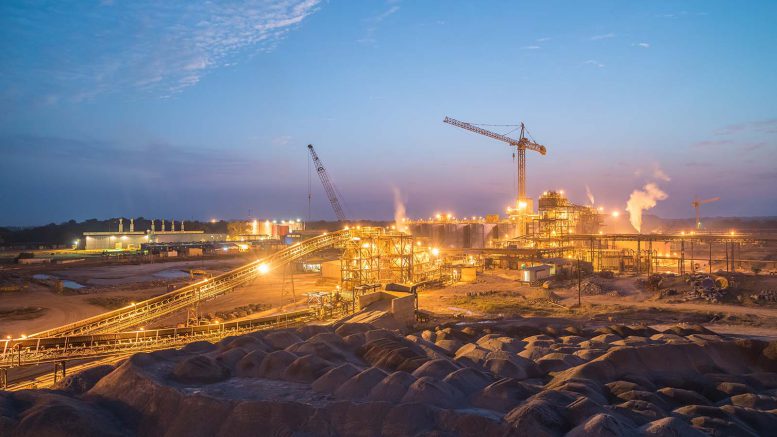
Rising gold and silver prices – and the resource nationalism they have fuelled in some African countries – are making North American mines and projects more attractive to global miners amid a search for stable operating environments, says Sprott Asset Management’s chief investment officer.
After taking power in recent years in bids to stop Islamic terrorism, military governments in West Africa’s Sahel region have worked to reallocate wealth using agreements with Western mining companies in the name of greater control to benefit their people, some of the world’s poorest.
“It seems like every month we see an announcement of a government in Africa wanting more royalties, renegotiating tax codes or mining codes. That’s why there has been more demand for stable jurisdictions such as Canada and the U.S.,” Sprott managing partner Maria Smirnova told The Northern Miner in an interview last month.
In Mali, this tug-of-war culminated in a yearlong dispute between the government and Barrick Mining (TSX: ABX; NYSE: B), which suspended operations at its mine, after Mali’s military government seized about three tonnes of gold over alleged unpaid taxes. The episode rattled investors and underscored the geopolitical risks that are prompting miners to favour more stable jurisdictions such as Canada and the United States.
High demand
A 20-year veteran of the Toronto-based firm, Smirnova runs funds such as the Sprott Silver Strategy portfolio, the Sprott Active Metals & Miners ETF and the Sprott Active Gold & Silver Miners ETF. Some of her funds have recently cut their exposure to companies with African assets as a result of the trend, she said without providing details.
Mexican precious metals miner Fresnillo’s (LSE: FRES) agreement in October to acquire Probe Gold for $780 million (US$556 million) in cash illustrates the newfound interest from global miners in Canadian assets, Smirnova said.
“Canada has been in high demand,” she said. “There are deals that indicate that movement. You saw Fresnillo came and bought a Canadian asset.”
Sprott is also bullish on Mexico’s prospects, despite the January kidnapping of 10 Vizsla Silver (TSX; NYSE: VZLA) employees, Smirnova said. Efforts by the Claudia Sheinbaum administration to shorten permitting timelines should bear fruit and boost mining investment in the long term, she said.
“Of course [the kidnappings are] a very unfortunate situation. It gives you pause for thought,” she said.
“Overall we think the granting of the permits will be more important longer term. By and large, we think Mexico is heading in the right direction.”
Wealth protection
Global interest in gold and silver has skyrocketed in the last two years – driving up prices – amid rising concern over inflation and an unresolved U.S. fiscal situation, which has eroded global confidence in the dollar as a reserve currency. After gold jumped 65% in 2025 and silver more than doubled, both metals have since set new records in the first two months of the new year.
“We view gold and silver as tools to protect your wealth to protect against fiat [government] currency debasement,” Smirnova said. “Fiat currency is easy to print but metals are hard to find and produce. We just aren’t finding enough of any of this stuff. That’s why we’re getting these imbalances.”
Supply and demand dynamics mean silver is unlikely to fall back to earth anytime soon, Smirnova says.
Silver is projected to be in deficit for a sixth consecutive year as stronger investment demand balances out weaker demand from the industrial sector, according to the Silver Institute’s 2026 forecast report, published Feb. 10.
Industrial fabrication is expected to decline by 2% to a four-year low of 650 million oz. driven principally by silver thrifting in the solar sector – despite the fact solar installations are expected to keep rising.
Investment demand
While jewelry and silverware demand are expected to drop 9% and 17% respectively, a projected 20% rise in physical investment should offset the declines. Investment demand is expected to reach a three-year high of 227 million oz., the institute predicts.
“Silver has a good fundamental picture,” Smirnova said. “I don’t see it crashing to $40.”
As of Friday morning, silver was trading at about $81.25 per ounce. It has gained 141% in the past 12 months.
“This price rise has been building for a long time. The demand-supply picture for silver has been very strong for five to seven years,” Smirnova added. “Supply has been stagnant, demand has been growing, particularly electronic and solar demand. Now that investment demand has kicked in, that’s what’s driven up the price. Investment demand has always been seen as a swing factor. It’s lit the price on fire.”
Other metals should also benefit from sustained demand over the coming years, Smirnova said.
“Why are copper, uranium, gold, silver, other metals, even lithium, going up? Why is everything going up all of a sudden? The world has weaponized metals and mining,” she said.
“The world has realized that we need all these things to build stuff. We need these things to electrify. Electrification and power generation are big themes and they’re not going away.”



Be the first to comment on "Investors prefer North America to Africa: Sprott chief"