
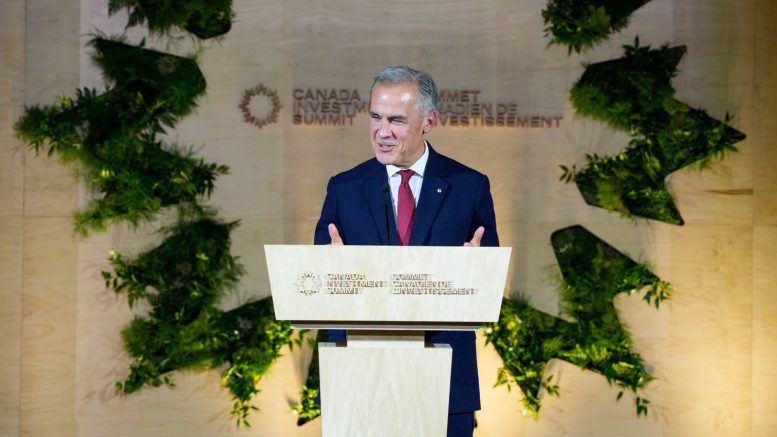
Ottawa says its Canada Investment Summit generated nearly $500 billion (US$358 billion) in commitments, but most of the headline sum isn’t tied to individual mines as Canada’s critical-mineral developers struggle to reach the scale large institutions seek.
Prime Minister Mark Carney used the Sept. 14-15 Toronto gathering, with the Canada Pension Plan and Public Sector Pension investment boards, to showcase 167 projects requiring more than $1 trillion over five years. Minerals and metals formed the largest group, with 63 projects.
The summit produced one project-specific commitment from the Canada Growth Fund, which pledged about $140 million to Generation Mining (TSX: GENM; US-OTC: GENMF) for its Marathon copper-palladium project, roughly 800 km northwest of Toronto.
“But if they have to cobble together a bunch of projects, they’re not going to do that,” ATB Cormark Capital Markets analyst MacMurray Whale told The Northern Miner Wednesday, referring to large institutional investors.
Mining’s scale problem reaches beyond any single mine. Battery-material projects often need processing plants, power, infrastructure and customers to advance on similar schedules. Coordinating those links could create supply chains large enough to attract global funds, while leaving each developer to solve them alone lets investors wait for permits, sales contracts and infrastructure before committing capital.
International funds?
Whale hadn’t identified new summit-driven financing for companies he covers and couldn’t determine how much of Ottawa’s $500-billion figure represented capital that wouldn’t otherwise have been invested. His assessment didn’t cover every project or sector, and it was unclear how much international money the summit attracted, one of its stated goals. Faster project approvals formed part of Carney’s pitch.
“For projects and supply chains, our standard will be simple: One project. One review. One year,” Carney told reporters on Tuesday.
Lengthy reviews give large investors another reason to push smaller projects down their priority lists, Whale said. Federal action alone won’t fix the problem because provinces control parts of the review process.
“Even if it’s a no, then get to a no faster,” Whale said, describing a concern he heard from both companies and investors.
Ottawa also proposed widening immediate tax write-offs to include mining property, pipelines, rail and other assets, while making the treatment permanent. The government says the measure would cut Canada’s effective tax rate on new business investment to 6.4% from about 13%.
Capital scale
The Prime Minister’s Office’s nearly $500-billion tally combines several kinds of capital rather than project-specific investments. It includes nearly $325 billion in bank financing, almost $100 billion from pension funds, insurers and other institutions, more than $14 billion to be invested or mobilized by investment funds and Bell Canada’s $52.5-billion Saskatchewan artificial-intelligence infrastructure plan. Some bank commitments stretch over five or 10 years.
A mining company seeking a few hundred million dollars may therefore matter greatly to its shareholders without ranking high on a fund trying to deploy billions, Whale said.
The scale sought by CPP Investments and Brookfield Asset Management (TSX, NYSE: BAM) shows the hurdle for mine developers. They plan up to $50 billion in equity investments through their joint Maple Fund, targeting opportunities involving more than $5 billion in project equity.
“If it was a billion or $2 billion, there would be much more sense of urgency,” he said.
Whale covers four developers invited to the summit: E3 Lithium (TSXV: ETL), Li-FT Power (TSXV: LIFT), Nouveau Monde Graphite (TSX: NOU; NYSE: NMG) and PMET Resources (TSX: PMET; ASX: PMT). ATB Cormark disclosed investment-banking relationships with all four.
Executives Whale spoke with after the summit described meetings not only among senior leaders but between company teams and the investor and government staff who assess projects and recommend where capital should go. That working-level contact was one tangible change from the gathering, he said.
Processing gap
Canada’s lithium industry shows why access to capital alone may not build mines. Hard-rock developers can produce spodumene concentrate, but the country lacks large-scale capacity to turn much of it into the lithium chemicals battery makers need. Shipping concentrate to China would put them in competition with Australian suppliers with shorter freight routes, according to Whale.
Some developers are trying to add their own chemical plants, but doing so pushes exploration and mine-development companies into businesses outside their expertise and could add five years to development, Whale estimated. Coordinating separate companies doesn’t require one miner to buy them all, but does require matching approvals, material supplies and construction schedules.
Market risk
Even a coordinated Canadian supply chain wouldn’t solve the question of who ultimately buys its output. Canada has long offered investors access to the much larger U.S. market, but trade tensions make that assumption less certain, Whale said.
That matters most for mines still years from production. Current tariffs may have little effect on their financial models, but investors financing them today still have to judge where their products can be sold once they start operating.
Over the next year, he’ll watch for coordinated federal-provincial environmental reviews and a firm investment from a foreign sovereign wealth fund in an advanced Canadian mining project. Approvals already moving through the system wouldn’t, by themselves, demonstrate that the summit had shortened development timelines, he said.
The harder question is whether Canada can diversify from the U.S. without weakening the economics that made Canadian projects attractive in the first place.
“Are we investing in Canada just to produce materials that end up in Europe?” Whale said.
Be the first to comment on "Carney summit touts $500B, exposes mining scale gap"