
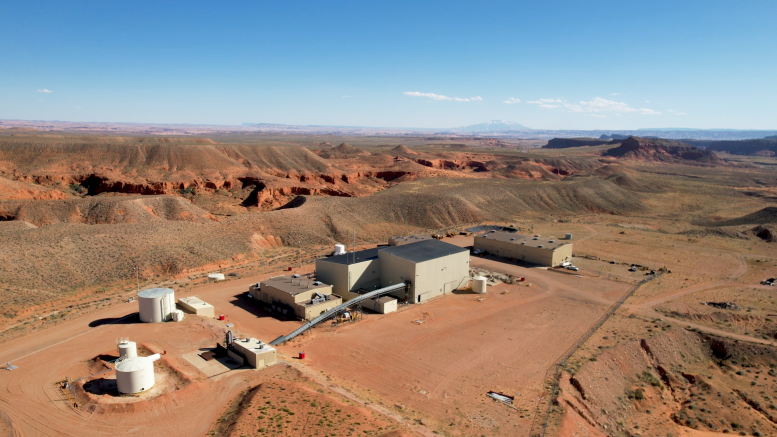
Developer Anfield Energy (TSXV, Nasdaq: AEC) will seek to raise at least $50 million (C$69.3 million) in financing over the coming months to refurbish and reopen Utah’s Shootaring Canyon mill – one of only three licensed, permitted and constructed uranium mills in the U.S.
Vancouver-based Anfield envisions Shootaring Canyon as the central processing hub for its portfolio of 25 uranium and vanadium mining claims and state leases in Utah, Colorado and Arizona, which target areas where past mining or prospecting occurred. It would initially process ore from two mines that Anfield is advancing: Velvet-Wood in Utah and Slick Rock in Colorado.
The mill, which is scheduled to reopen by early 2028, would primarily convert uranium ore into uranium concentrate, helping to cut the U.S.’s reliance on imported uranium concentrate. To boost revenue, Shootaring Canyon could also process vanadium, a critical metal that can be used in batteries or to strengthen steel and other alloys.
“We’ve had discussions, so probably we’d look to do something [on financing] this year, early next year,” Anfield CEO Corey Dias told The Northern Miner in an interview earlier this month. He didn’t name potential lenders.
Flexible model
Including 20% contingency, mill-related capital expenditures at Shootaring would probably amount to $80.1 million, Anfield said in June. The figure includes $31.1 million for general upgrades, $34.6 million to install a modern vanadium circuit and $14.4 million to update the tailings management facility.
“We have flexibility within our model,” Dias said. “We could compartmentalize and focus strictly on uranium for $50 million, with a contingency baked in there, and then add the vanadium circuit in a year once cash flow starts, or we could do it all at once. The financing options we’ve looked at have covered both.”
Imports supply a substantial share of the U.S. needs for both uranium and vanadium. In 2023, 99% of the uranium used by U.S. nuclear power plants was imported. Suppliers included Russia, Kazakhstan and Uzbekistan, though Canada was the largest. Almost half of the vanadium used in the U.S. in 2024 was imported.
Care and maintenance
Built in 1980, Shootaring Canyon began operations in 1982 and was put on care and maintenance about six months later because of low uranium prices. Anfield acquired the facility – which produced and sold 27,825 lb. uranium oxide (U3O8) during its brief operating life – from Russia’s Uranium One in 2015.
Anfield’s plans for Shootaring Canyon include expanding the mill’s throughput from 750 tonnes to 1,000 tonnes per day, Dias says. That would eventually allow Anfield to produce up to 3 million lb. uranium per year, he says.
Before the mill can resume operations, Anfield will need to remove several key elements – including wooden leach tanks and electrical generators – and replace them with the latest available technology. It will also need Utah to approve the company’s reactivation plan and upgrade the status of Shootaring Canyon’s radioactive materials licence from care and maintenance to operational.
“The generators have to be changed out, despite the fact that they’re essentially unused, because emissions standards have changed over the last 40 years,” Dias says. “There are a few big things which have to be changed out, but we can’t replace them until we have the licence in hand.”
Financing bottleneck
If all goes well, Anfield is hoping Utah will issue the licence by the end of this year or early in 2027, according to the CEO.
“The state has received everything from us,” he said. “Hopefully we’ll see a draft licence in the next few weeks, with ultimately the aim having the application go up for public comment by the end of the year.
“After that, we can start the refurbishment process, which we expect to take between nine to 12 months,” he says. “That should position us to be ready for production towards the end of 2027, early into 2028. In parallel, we’ll be working on advancing the mines.”
A mill-licence amendment for Shootaring Canyon “is still the bottleneck that unlocks financing and construction,” Red Cloud Securities mining analyst David Talbot said in a June note. He called the licence grant “a needle-mover for the stock.”
An updated preliminary economic assessment (PEA) for Shootaring Canyon, which was released in May and includes ore from Velvet-Wood, Slick Rock and six other Colorado mines, returned an after-tax net present value of $533 million and an internal rate of return of 97%. Payback was pegged at 1.3 years, with production forecast at 1.3 million lb. uranium oxide (U₃O₈) and 6.4 million lb. vanadium over 15 years.
Ore sources
Velvet-Wood, which is located about 322 km southwest of Salt Lake City, is the most advanced of the two proposed mines that would feed Shootaring Canyon. Anfield is targeting a start of production by the end of 2026.
Last year, Velvet-Wood became the first uranium mine to be greenlit by the United States Department of the Interior under a compressed 14-day environmental review timeline. The property includes the past-producing Velvet mine and the nearby Wood deposit.
Anfield estimates Velvet and Wood together hold 630,000 tonnes grading 0.34% uranium oxide equivalent (eU₃O₈) for contained metal of 4.3 million lb. eU₃O₈, according to the May PEA. Inferred resources are estimated to be 80,000 tonnes containing 544,000 lb. eU₃O₈, at a grade of 0.34% U₃O₈, with a vanadium-to-uranium ratio of 1.4 to 1.
Slick Rock, meanwhile, holds 800,000 indicated lb. of eU₃O₈, at a grade of 0.16% eU₃O₈ and 2.25 million inferred tonnes containing 9.1 million lb. at a grade of 0.2% U₃O₈. The vanadium-to-uranium-ratio is 6 to 1.
“In our model, Velvet-Wood runs for about seven years and Slick Rock runs for close to 15,” Dias says. “Ultimately, we would slot in other mines behind Velvet-Wood to match the time frame that we have for Slick Rock.”
Toll milling
Shootaring Canyon’s location near several multi-million-pound uranium deposits in Utah means that the mill could one day earn additional revenue by processing ore from other miners.
“It’s something that we’ve had many conversations about with miners in the area,” Dias said. “We certainly leave the door open for the potential of toll milling.”
That opportunity probably won’t materialize for a few years, the CEO cautions.
“Velvet Wood “is probably more advanced than a number of other mines that could potentially serve as toll-milling opportunities for us,” he said. “But once we’re at a steady state, then we would probably look to consider third-party material.”
Cost advantage
In the meantime, Dias says he’s thankful Anfield doesn’t need to build a mill from scratch.
“That’s a massive advantage for us from a cost perspective, from a time perspective,” he said.
Building a new uranium mill in 2026 would probably cost as much as $300 million, “assuming you can find a place to put it and that you can get a licence,” Dias added.
Getting a licence “is probably a five-to-eight-year undertaking. As a publicly traded company, it’s a long time for investors to stick around and wait for you to go through the licensing process.”
Be the first to comment on "SW US: Anfield wants $50M for Utah mill"