
The global copper market enjoyed one of its best years in 2025. The threat of United States tariffs on the industrial metal and its elevated status as a critical mineral, together with major supply disruptions globally, all played a part to help to lift prices 40% last year.
That run extended into 2026, as expectations of surging AI-driven demand and persistent supply constraints drove prices to a record of $14,500 a tonne in January. This week, copper is nearing another record.
The prospect of higher mining costs due to rising energy prices and a shortage of sulfuric acid, which is used in a fifth of the global copper production, is considered the next big catalyst for copper prices, a Sprott analyst said recently.
Goldman Sachs is also optimistic of copper surging higher again, due to the supply-side disruptions. The International Copper Study Group recently abandoned its previous surplus projections and is now forecasting a 150,000-tonne deficit for 2026.
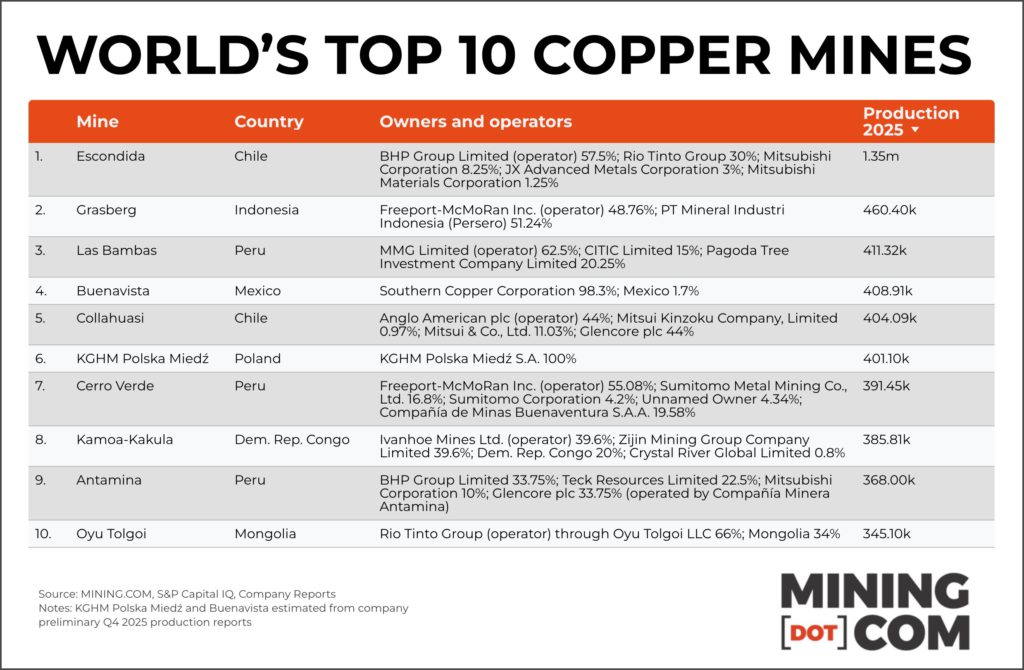
The top 10 mines, many of which have been in production for decades (some even trace roots back to the late 1800s) are responsible for more than a fifth of total global mined production – producing 4.9 million tonnes in 2025.
Surprisingly, after only recently being surpassed by BHP as the world’s number one copper producer on an attributable basis, Chile’s state owned Codelco does not have any of its operations qualify for the top 10.
As last year amply showed disruption at these giant operations – like the Grasberg and Kamoa-Kakula accidents that saw hundreds of thousands of tonnes taken off the market – can have a big impact on copper prices.
1. Escondida
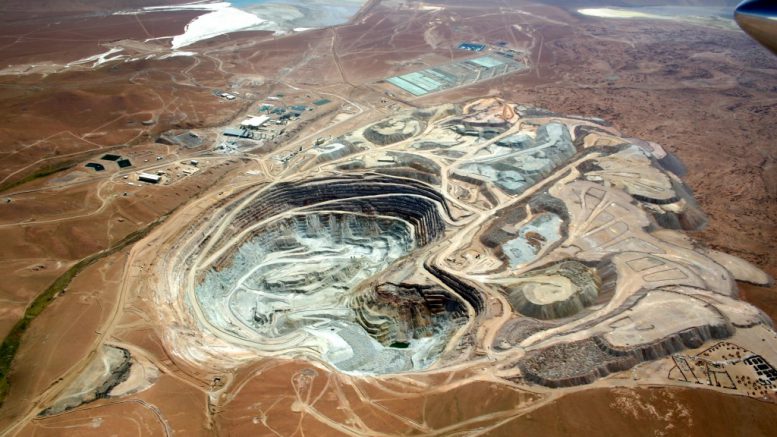
Escondida in Chile, a joint venture between BHP (ASX, NYSE, LSE: BHP), Rio Tinto (ASX, LSE: RIO), Mitsubishi, and JX Advanced Metals holds the top spot, producing 1.35 million tonnes of copper metal in 2025. Escondida has long ranked as the world’s biggest copper mine, but BHP’s operational review for the nine months to March 31 pointed to record material mined and concentrator throughput.
2. Grasberg
Grasberg in Indonesia, held jointly between Freeport-McMoRan (NYSE: FCX) and Indonesian state-owned enterprise Persero and operated by Freeport, produced 460,400 tonnes for the year. Freeport is still reeling from the effects of a deadly landslide last year that unleashed 800,000 tonnes of mud. The company expects the giant complex in Central Papua province to return to full capacity by early 2028.
3. Las Bambas
Las Bambas mine in Peru, owned jointly by China’s MMG, CITIC and Pagoda Tree Investment Company, churned out 411,300 tonnes in 2025. The mine was plagued by protests in 2024, but protesters agreed to lift a road blockade on a key Peruvian transport route, and operations resumed in April 2025.
4. Buenavista
Southern Copper’s (NYSE, LSE: SCCO) Buenavista mine in Mexico moves up in this year’s ranking to fourth place with 409,400 tonnes produced. Copper has been mined at the historic site, 22 miles south of the United States border, since 1899.
5. Collahuasi
Chile’s Collahuasi mine, a joint venture between Glencore (LSE: GLEN), Anglo American (LSE: AAL) and Mitsui produced produced 404,100 tonnes. In April this year, contractors finished building a system that will carry water from the coastal town of Punta Patache to the Ujina deposit, more than 4,400 meters above sea level, as part of a $1 billion infrastructure improvement project.
6. KGHM
KGHM in Poland, 100% owned by Polska Miedz, produced 401,100 tonnes. Last month, the company said it is looking to invest in mines in Europe and Morocco to secure ore supplies closer to its smelting base in Poland. KGHM also took top spot in Mining.com’s silver mines ranking.
7. Cerro Verde
Cerro Verde in Peru, a joint venture between Freeport-McMoRan, Sumitomo and Buenaventura, takes seventh place, producing 391,500 tonnes. The Peruvian government first mined Cerro Verde’s oxide ores and built one of the world’s first SX/EW facilities in 1972.
8. Kamoa-Kakula
The Kamoa-Kakula complex in the Democratic Republic of Congo, owned jointly by Ivanhoe Mines (TSX: IVN; US-OTC: IVPAF), Zijin Mining, Crystal River and the DRC government drops from third place last year, having produced 385,800 tonnes. Ivanhoe halted operations for three weeks in 2025 after seismic activity severely flooded the underground mine. In April, Ivanhoe slashed near-term production guidance, citing a shift toward underground development, rehabilitation and access work that will constrain ore delivery over the next 18 to 24 months.
9. Antamina
Antamina in Peru, co-owned by BHP, Glencore, Teck Resources (TSX: TECK.A TECK.B; NYSE: TECK) and Mitsubishi, moves up to ninth from 10th place, producing 368,000 tonnes. Last year, Antamina’s operators predicted an almost 20% boost in cooper output.
10. Oyu Tolgoi
Oyu Tolgoi, a joint venture between Rio Tinto and the Mongolian government, churned out 345,100 tonnes. The government, which holds a 34% stake through state-owned Erdenes Mongol LLC., this year demanded earlier profit payments and a larger share of revenue, reopening negotiations over the $18-billion project’s commercial terms.
Honorable mentions: Morenci in Arizona, USA (313,100 tonnes), Quellaveco in Peru (309,900 tonnes), Los Pelambres in Chile (295,400 tonnes)
Be the first to comment on "RANKED: The world’s top 10 biggest copper mines"