
Mining companies around the world are under growing pressure to use resources more efficiently and reduce waste.
Every truckload of ore that doesn’t end up as tailings means less impact on the environment, lower costs and better returns for investors. That’s where the idea of pre-concentration comes in – separating what’s valuable earlier in the process, before it even reaches the plant.
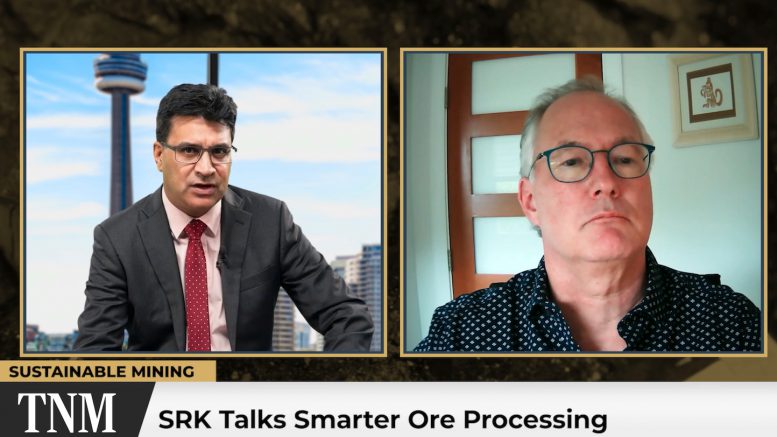
Mining.com anchor Devan Murugan sat down with Adrian Dance, Principal Mining Metallurgist at SRK Consulting, to understand how this works and why independent assessment matters.
Devan Murugan: Mining companies everywhere are talking about pre-concentration. For those outside the industry, what does that actually mean – and why does it matter for miners?
Adrian Dance: As a mineral processor who’s been in the industry for 30-odd years, I’m very aware of how things can be improved and how we need to change our mindset. For those who aren’t familiar with typical mineral processing, the first stage normally involves grinding material to a very fine size, which consumes a lot of power and water. Consequently, once the material is ground fine, any portion not recovered goes to a tailings storage area – the large tailings ponds we typically see. The idea behind pre-concentration, or coarse beneficiation, is to separate some of the waste before applying all that energy, power, and water to slurry it. By doing this, we aim to increase the grade of the material and reject waste, which reduces the size of the plant needed to produce the same amount of metal. What excites me is that this is one of the few tools available to reverse the growing trend of lower and lower grades being processed, as well as the more challenging metal recoveries that projects – and the wider industry – are facing.
DM: Right now, how are most companies handling ore material, and where do you see the gaps or inefficiencies in those approaches?
AD: The normal response from the industry to lower grades, and perhaps lower metal recoveries, is to increase the size of the plant – processing more material to achieve economies of scale. But this doesn’t really take advantage of the recent growth in orebody knowledge that we now have. We’re getting more and more measurements and data, potentially applied through AI, along with other detailed methods to better understand our orebodies. Should we be processing these materials through a single flowsheet, through a single plant, or should we in fact be doing it differently? We now have the high density of data we need. In fact, when we call material “ore” – which is sent to the plant and defined as any material that can be processed economically – it is not all created equal. It is a mixture of high-value material with a portion of dilution or waste that has made its way into the process. What we’re doing with pre-concentration is segregating and isolating these different value streams before we process them. By knowing the material more precisely, we are adding to the knowledge of the orebody itself. It’s about exploiting the information we have and creating a more nuanced, sophisticated way of processing – not simply sending everything to one plant and ultimately ending up in the tailings pond.
DM: SRK emphasises its independence in evaluating pre-concentration opportunities. Why is it so important for miners to have an unbiased assessment rather than relying solely on equipment vendors?
AD: SRK Consulting prides itself on being independent – a group of consultants with deep expertise across a wide range of disciplines. This independence is particularly valuable for clients exploring pre-concentration, bulk sorting, or particle sorting. At present, most of the expertise sits with equipment manufacturers. They have long experience in knowing what works and what doesn’t, but their background is not always rooted in mining. Much of their expertise comes from recycling or other sectors where similar sensors have been applied. That’s why we see real value in offering mining projects and operating mines an independent perspective – experience and knowledge that puts the client’s interests first. Our approach is to assess whether there is any economic opportunity before moving to testing. Pre-concentration does not always add value, and in many cases it simply isn’t the right fit. So, the first step is to ask: is there a chance to add value here? Only once that’s clear do we recommend testing. We call this “sizing the prize.” With that understanding, mining companies can then move forward confidently to work with equipment manufacturers – now with the context and insight that allows the technology to be applied far more effectively.
DM: Ore grades are falling and metallurgical recovery is getting harder. From your perspective, what are the biggest challenges miners face when upgrading ore, and how does pre-concentration help address them?
AD: It’s something I’ve been very passionate about through my involvement in past mine-to-mill projects and looking at how feed to the plant can be improved. Traditionally, that has focused on the size of the material. Now we’re approaching it from a different perspective – the grade of the material by size. What we don’t have much information on as processors, despite doing this for hundreds if not thousands of years, is where the metal of interest actually occurs at a coarse size – say 2 inches or larger. At that scale, is the metal present in only some of the particles, or is it in all of them? We usually don’t know, because to determine grade we pulverise the sample – and in doing so, we destroy that information. That’s why we are now focusing on how the material presents itself right after it’s crushed to the coarsest size possible. Is the gold concentrated in the fines? Is it associated mainly with the softer material? Truly understanding how the material presents itself at a coarse fraction is new territory. And with advances in sensors such as X-ray transmission technology, we can now see inside particles to determine where the metal is.
DM: How is SRK incorporating less-intrusive sensor-based testing into its toolkit – and what are the trade-offs?
AD: What we’ve done is look at the types of samples typically available to the industry – and in early-stage projects, that’s often very limited. Usually, only half drill-core samples are on hand. The question is: how can we work within those constraints to deliver reliable information on ore characteristics in the most economic way possible? We’ve developed a lab technology that can take relatively small samples and still reveal a great deal – how hard the ore is, how it will break, where the metal goes, and whether it’s amenable to sensor sorting. Importantly, this approach is not disruptive to the normal metallurgical evaluations or how companies currently study their orebodies. By removing hurdles, we make this type of evaluation practical and accessible. Traditionally, sensor-sorting tests require anywhere from 500 kg to 2 tonnes of material. While this produces excellent technical results, it often adds little value for companies because the sample is too large and composite to provide meaningful insight. Our focus is different: instead of one massive test, we run dozens of smaller-mass samples. This approach highlights variability within the deposit and gives companies a much clearer picture of their orebody.
DM: Adrian, that’s where we’ll leave it. Thanks for your time.
AD: Thank you, Devan.
Watch the full interview below:
The preceding joint venture is PROMOTED CONTENT sponsored by SRK and produced in co-operation with The Northern Miner. Visit. www.srk.com for more information.

Be the first to comment on "Q&A with SRK: How SRK brings an independent lens to ore processing"