
As 2026 gets underway, mining companies are confronting a new reality: Environmental, social and governance (ESG) issues are no longer just about disclosure – they are influencing permits, financing and project timelines.
That shift is putting fresh scrutiny on how ores are processed, particularly across gold and base metals, as regulators and lenders weigh project risk more closely. These pressures are moving processing decisions earlier in the project lifecycle and reshaping how viability is assessed.
For developers, this means metallurgical choices are no longer isolated technical decisions, but central to how projects are approved, financed and ultimately built. In some jurisdictions, processing risk is now being flagged before construction even begins, adding new layers of complexity to project planning.
As a result, companies are being forced to reassess traditional approaches and consider alternatives sooner than in the past.
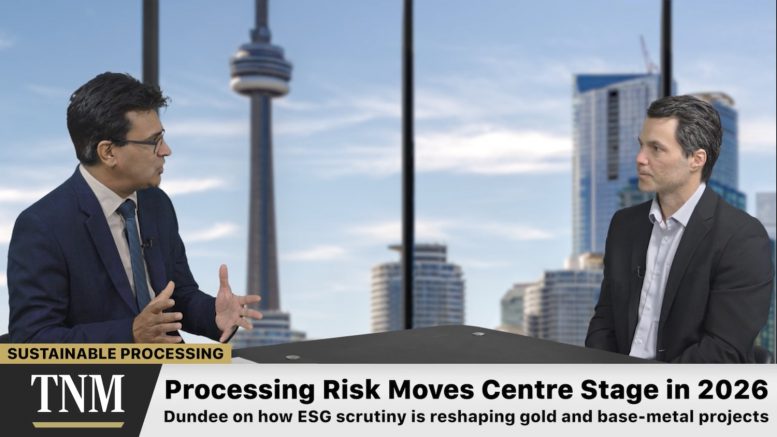
The Northern Miner’s Devan Murugan speaks with Jean-Philippe Mai, CEO of Dundee Sustainable Technologies, about what that shift means for miners.
Devan Murugan: As 2026 gets underway, what is different about the conversations you’re having with miners these days compared with a year ago?
Jean-Philippe Mai: I wouldn’t say the conversations have changed drastically, but we are seeing continuity and momentum. There’s been consistent interest in our processes over the years. We’ve been very focused on educating and informing the industry about what our processes can do and where they apply.
Now, with more results coming out from various clients and companies, that success is attracting additional interest. Things are moving in the right direction as a continuation of where we left off in 2025.
Arsenic management
DM: Let’s take two steps back for a moment. Where does Dundee fit into the arsenic management and processing risk space? What do you actually do when you get involved in a mining project?
JPM: No two projects are the same, so there’s always a level of custom application when it comes to our processes. Specifically with arsenic, we’ve developed a niche expertise where we can remove arsenic from sulphide-bearing metal concentrates and stabilise it into an insoluble, permanent glass product. That product can be safely disposed of. By removing a contaminant like arsenic from a concentrate, we’re generating value for the project.
DM: Are miners coming to you earlier now – before project design and permitting – or is it still later in the process?
JPM: That has evolved over time. A few years ago, people typically came to us at a later stage, when they had already encountered hurdles, whether in permitting or metallurgy.
Today, we’re seeing many more early-stage projects. Developers want to understand the numbers and see how our process could benefit their project. We still work with advanced projects that need to reassess or revise their flow sheets, but we’re definitely seeing more early-stage engagement, which is encouraging.
Pilot testing
DM: Looking ahead to the end of this year, what does success look like for Dundee in practical terms? Is it pilots, commercial deployments, or repeat customers?
JPM: It’s really all of the above. We’re fortunate to have a strong base of repeat customers, some of whom are on their second, third, or even fourth mandate with us. As projects evolve, we continue test work at the lab level or move into pilot-scale testing, where we can generate more data and produce material at larger scale for downstream use.
At the same time, we’re actively pursuing commercial implementations. It’s project-specific, but all of those elements are part of our success in 2026.
DM: Cost pressures have been significant over the past year. How are miners viewing costs right now and how does that affect adoption of alternative processing technologies?
JPM: Cost has always been a key driver and it remains critical. Our process development has always focused on cost. What we’re asking the industry to do is assess the trade-offs – to test our processes, see how they integrate into their projects and evaluate the costs relative to the benefits. Cost will always be central to adoption and that hasn’t changed.
Competitive advantage
DM: Is 2026 the point where alternative processing shifts from being a competitive advantage to becoming an operational necessity?
JPM: It’s really a spectrum. In some cases, it remains a competitive advantage; in others, it becomes a necessity. It depends on the project. Sometimes alternative processing allows a project to move to market faster or produce better by-products. In other cases, jurisdictional or regulatory requirements force developers to consider different processing routes.
Our role is to respond to both scenarios. We focus on project-specific data and encourage developers to test our processes so we can demonstrate where value can be created.
DM: Finally, by the end of 2026, what would tell you that Dundee has entered a new phase of commercial relevance?
JPM: We expect to continue building on the development work we’ve done over the past few years. Ideally, a year from now, we’ll be able to talk about commercial implementations moving forward in 2026. That would be a major milestone.
We’ve already built and operated industrial demonstration plants in Thetford Mines and Namibia. The next step is on-site implementation with a gold miner and being able to share that operational experience with the market would signal a real shift in our commercial position.
DM: Jean-Philippe, thanks for the insights.
JPM: It’s a pleasure, Devan.
Watch the full interview below:
The preceding Joint Venture Article is PROMOTED CONTENT sponsored by Dundee Sustainable Technologies and produced in co-operation with The Northern Miner. Visit: dundeetechnologies.com for more information.


Be the first to comment on "JV Q&A: Dundee Sustainable eases processing risk "