
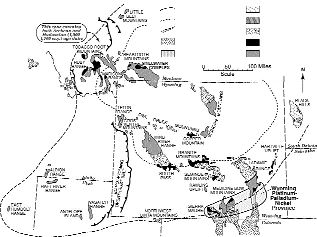
Wyoming is a vast state covering nearly 260,000 sq. km of surface area that houses fewer people than most large cities (fewer than 500,000 call Wyoming home). The state has no state income tax, is driven by taxes generated by the oil and gas and mining industries, and sometimes has the lowest temperatures in the nation. People who have visited the Cowboy State often recall the large herds of antelope grazing between oil rigs and pump jacks or near a highwall of one of the many open-pit coal mines. The Wyoming basins also host the largest trona resources in the world, which are being exploited by some underground mines.
But Wyoming is more than just basins, wind and antelope; the state also has mountain ranges dividing the basins that at one time hosted several gold and copper mines, including an extraordinary copper deposit developed in the early 1900s known as the Ferris-Haggarty mine. Many of Wyoming’s mountains are formed of ancient Archean and Proterozoic basement rock that projects up through the basins, providing potential hosts for metal and gemstone deposits, as well as evidence of untapped gold and diamond deposits. Another major mountain range, the Absaroka Mountains, bordering Yellowstone National Park, is an eroded Tertiary volcanic plateau that hosts dozens of porphyry copper-silver deposits.
Much of Wyoming is underlain by a craton, and evidence for diamonds has been found nearly everywhere in the state. Even so, much of the region remains unexplored for diamonds, even though Wyoming hosts the two largest kimberlite districts in the U.S., the largest lamproite field in North America, scattered lamprophyres, and hundreds of kimberlitic indicator mineral anomalies. Overall, the geology of Wyoming is similar to parts of Canada, with one notable exception: one can drive to most locations in Wyoming. Even so, Wyoming is still a frontier for mineral exploration, and a place where new mineral deposits are found, with minimal effort, nearly every year.
Wyoming is one of the more under-explored cratons in the world for diamonds. Yet cratonic rocks underlie the state and continue north under Montana, Saskatchewan and Alberta, and into the Northwest Territories.
Wyoming’s largest kimberlite district, the State Line district, is shared with Colorado, and includes 40 known diamondiferous kimberlites that continue from Wyoming south into Colorado. Some kimberlitic indicator mineral anomalies have been identified in the district, as well as some excellent INPUT geophysical anomalies interpreted as blind pipes. But these have never been explored, even though they sit adjacent to several diamondiferous kimberlites. More than 130,000 diamonds have been recovered from the district, including diamonds weighing more than 28 carats. There are even reports of pink diamonds in the district.
North of the State Line district is the Iron Mountain kimberlite district, which includes numerous kimberlites that have yielded diamond-stability signatures. To date, only a small portion of the district has been sampled for diamonds, yielding a few microdiamonds and one macro. Elsewhere in Wyoming, specifically in the southwest, a small group of breccia pipes were sampled in the 1990s and yielded some microdiamonds. The breccias are in a vast kimberlitic indicator mineral anomaly that is scattered over more than 650 sq. km. Some of the indicator minerals collected from this region have been faceted, producing attractive pyrope and chrome diopside gemstones.
With a bare-bones budget for diamond exploration (about US$5,000 per year), the Wyoming State Geological Survey (WSGS) was able to identify more than 300 kimberlitic indicator mineral anomalies in the Laramie Range. In addition, the WSGS has now identified indicator mineral anomalies in the Medicine Bow, Sierra Madre and Seminoe Mountains, and in the Bighorn Basin. Pyrope garnets have also been recovered in the Hartville uplift in eastern Wyoming. Few of these have ever been tested geochemically, and few have ever been explored.
Colored gemstones
Prior to 1995, Wyoming was known for jade, agates and petrified wood; other coloured gemstones and lapidaries were essentially unknown. However, the WSGS initiated a project to study the state’s potential for coloured gemstones. During the initial investigations, a source for gem-quality corundum and cordierite was identified in the central Laramie Range. Samples of schist from this site contained as much as 15% corundum, including some sapphire and ruby. Corundum crystals weighing more than 25 carats were recovered. The deposit also hosts considerable sky-blue kyanite and gem-quality cordierite (called iolite). Several specimens of gem-quality cordierite weighing more than 1,000 carats, and one weighing more than 3,000 carats, have now been recovered from the property.
Additional research by the WSGS resulted in the discovery of more corundum and cordierite deposits, plus evidence of several other undiscovered deposits that are now being investigated. The WSGS also identified a source for gem-quality olivine (peridot), within the Leucite Hills lamproite field. Several other gemstones have been identified in the state during the past decade.
Precious metals
One of the only historic palladium-platinum mines in North America lies in the Medicine Bow Mountains in southeastern Wyoming. The New Rambler mine lies on the northeastern edge of the Mullen Creek layered mafic complex, and, in the early 1900s, produced palladium, copper, gold, silver and some platinum. Much of this layered complex remains unexplored. Nearby, the Lake Owen layered mafic complex is also relatively unexplored, even though it also has yielded several palladium and platinum anomalies. Within the same mountain range, and next door in the adjacent Sierra Madre range, some mafic and ultramafic rocks remain unexplored. As an example of the potential in this region, the WSGS identified a previously unknown pyroxenite massif in 1994 and recovered anomalous samples containing palladium, copper, gold, silver, nickel and platinum.
Several gold and silver prospects have been identified in the state, nearly all of which are at the grassroots stage. Among the more exciting ones are in the Rattlesnake Hills gold district, which is underlain by an Archean greenstone belt intruded by 42 tertiary alkalic intrusives. Following the discovery of gold in this district by the WSGS in 1982, three companies explored the district and identified dozens of gold anomalies associated with exhalatives, including one large-tonnage, low-grade gold deposit associated with a Tertiary breccia that potentially hosts more than 1 million oz. gold. Yet much of this terrain remains unexplored.
In the 1980s, the WSGS mapped about 1,000 sq. km of Archean greenstone terrain in western Wyoming, in an area known as South Pass. Dozens of gold anomalies were identified in the greenstone belt. Past production in the greenstone belt included 90 million tons of iron ore and at least 350,000 oz. gold. Mapping by the WSGS suggests a possibility for several gold deposits within the greenstone belt, and research by the U.S. Geological Survey identified tertiary paleo-placers along the northern and southern flanks of the greenstone belt; these paleo-placers contain an estimated resource of 35 million oz. gold. The source of the paleo-placer gold has never been identified, though all of the paleo-indicators point to the South Pass greenstone belt.
The most productive gold mine in the belt was the Carissa mine, which last produced ore in the 1950s. The Carissa hosts a known gold resource hosted in a shear zone that varies from 1 to 25 metres wide. However, this structure is enclosed by a larger, unevaluated shear structure that is up to 300 metres wide. The Carissa lies along a mineralized trend that extends northeast for about 15 km, much of which is untested. There are similar mineralized shears to the southeast, within the Lewiston district of the same greenstone belt.
The old adage “gold is where you find it” certainly applies to Wyoming. In the mid-1990s, the WSGS received grants to search for gold in southern Wyoming and identified dozens of previously unrecognized anomalies, including a historical gold mine operated in the late 1800s that no one was aware of — sitting within a hundred yards of Interstate 80. But to prove a point, the WSGS collected a sample in a paleo-channel exposed in the highwall of the Laramie City landfill that was highly anomalous in gold.
Base metals
Scattered base metal deposits occur in Proterozoic exhalites and are associated with tertiary intrusions in Wyoming. One of the more notable copper deposits was the Ferris-Haggarty copper mine, in the Sierra Madre of southeastern Wyoming. The mine operated for about a decade before its mill and smelter burned to the ground, and after a 30% drop in the copper price, it never reopened. Reports suggest that the mine still hosts a sizable copper-silver-gold resource. The ore was reported to average more than 5% copper, and recent sampling by the WSGS showed the orebody to be a Proterozoic-age, copper paleo-placer.
The WSGS has produced numerous reports on these resources; copies are available by visiting http://www.wsgsweb.uwyo.edu/metals/
— The author is a senior economic geologist with the Wyoming State Geological Survey (WSGS) and handles investigations related to gemstones, precious metals, base metals, and Precambrian geology. He is the author or co-author of more than 400 books, professional papers, and maps, many of which were published in various national and international journals and books.
Be the first to comment on "Wyoming’s geology augurs well for diamond discoveries"