
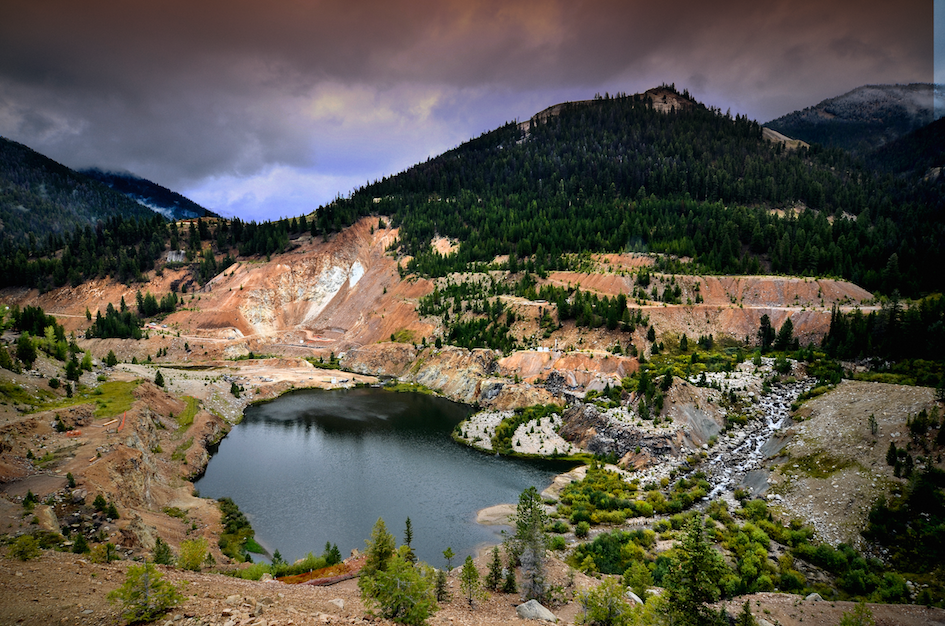
U.S. Secretary of Labor Lori Chavez-DeRemer and Idaho Governor Brad Little visited Perpetua Resources’ (Nasdaq: PPTA; TSX: PPTA) Stibnite gold-antimony project this week, underscoring the Trump administration’s push for minerals essential to U.S. weapons production and geopolitical dominance.
The project, about 160 km northeast of Boise, may become the only mined source of antimony in the United States. Perpetua is aiming the $2.2-billion capex Stibnite to supply all of the country’s demand for the mineral used in ammunitions, semi-conductors and other military applications, about 100 million lb. over its 15-year life. Construction could begin as early as 2026, with commercial production starting by 2028, depending on final permitting and financing.
“This project represents exactly the kind of American-led initiative we need to secure our critical mineral supply chains, strengthen national security, and create in-demand, mortgage-paying jobs,” Chavez-DeRemer said during a site visit on Wednesday.
The Stibnite project would help alleviate Chinese dominance of antimony. In April, the U.S. Export-Import Bank issued a letter of interest for up to $1.8 billion in debt financing, one of the largest potential federal loans ever offered to a domestic mining project. The U.S. Department of Defense has also granted more than $80 million to Perpetua, citing antimony’s essential use in munitions and other defence systems.
Low-cost project
An open-pit operation may produce 337,000 oz. of gold annually in the first four years and about 301,000 oz. per year over the life of mine for about 4 million oz. gold over its mine life, according to a 2020 feasibility study. At a gold price of $1,600 per oz. and $3.75 per lb. of antimony, the project would have an after-tax net present value (NPV) of $1.32 billion at a 5% discount rate, with an internal rate of return (IRR) of 22% and payback in under three years.
At spot prices used in the 2025 financial update, the NPV increases to $3.65 billion and the IRR rises to 27%, with a payback of 2.2 years. All-in sustaining costs are estimated at about $435 per oz. in the early years and $756 per oz. over the life of the mine, placing it among the lowest-cost gold projects in a tier-one jurisdiction.
The project in Idaho’s Stibnite-Yellow Pine district hosts 104.6 million proven and probable tonnes grading 1.43 grams gold per tonne and 0.064% antimony for 4.8 million oz. gold and 148 million lb. antimony, according to the feasibility study.
Perpetua has positioned the project not just as a source of critical minerals but also as an environmental restoration initiative. The development plan includes rebuilding fish passage in the East Fork of the South Fork Salmon River, reprocessing more than 10 million tonnes of historical tailings, recontouring legacy waste rock, and replanting disturbed areas with native vegetation.
The project has received a final Record of Decision from the U.S. Forest Service under the National Environmental Policy Act, following nearly a decade of environmental review.
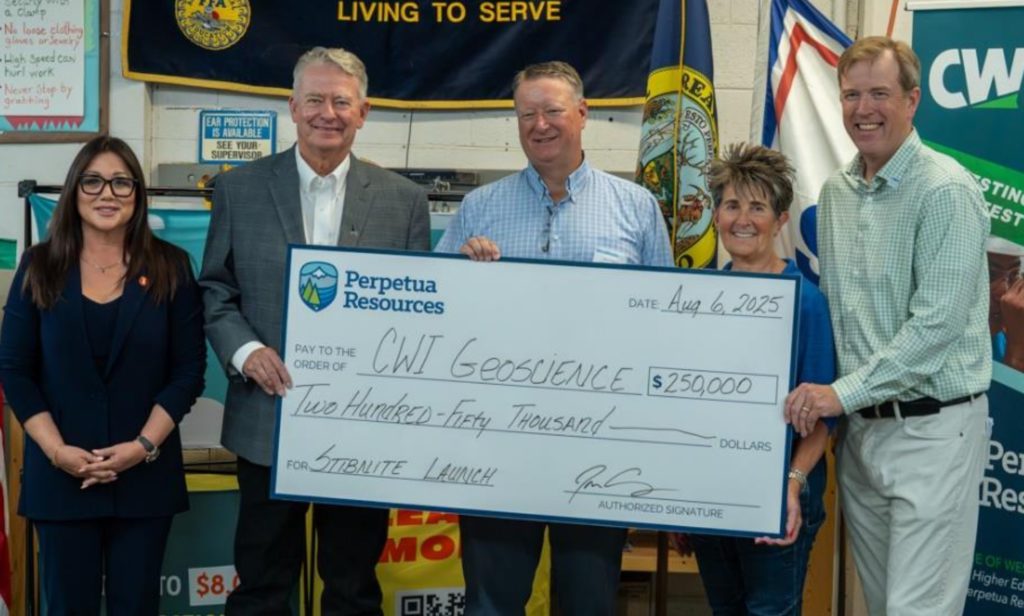
$250K scholarship
The Secretary of Labor and Governor Little met with Perpetua executives, education leaders and workforce partners to announce a new skills development initiative tied to the project. Perpetua is partnering with the College of Western Idaho to fund the Stibnite Launch Scholarship, which will support geoscience and mining technician students.
“Perpetua is committed to Idaho,” Perpetua CEO Jon Cherry said. “We want our project to benefit local communities, and one of the most tangible ways we can do that is by providing meaningful, well-paying careers.”
The company has committed $250,000 over three years to provide full tuition and training support, complementing the Idaho LAUNCH grant program initiated by Governor Little in 2023.
“Partnerships like this between Idaho businesses and our higher education institutions mean we can keep jobs, economic benefits and expertise right here in Idaho,” Little said. “I appreciate Perpetua Resources for its commitment to supporting students and families and strengthening rural Idaho.”
World War II
Originally mined for tungsten and antimony during the Second World War, the site was later abandoned, leaving behind waste rock piles and contaminated streams. Perpetua’s proposal aims to integrate mine redevelopment with site cleanup, while securing domestic supplies of antimony.
Perpetua Resources, formerly Midas Gold, has traded on the TSX since 2011 and on the Nasdaq since 2021. The company says it has already received expressions of interest for offtake and long-term supply agreements for antimony, including from defence contractors. Antimony is classified by the U.S. Geological Survey as one of 50 critical minerals deemed vital to the country’s economy and security.
With full federal permits now in hand, engineering work underway and a financing path emerging, Stibnite is advancing as one of the largest new gold developments in the United States — and one of the few globally aiming to deliver both precious metals and critical minerals from a single site.
Be the first to comment on "Why a bullet metal is behind $2.2B Idaho project"