
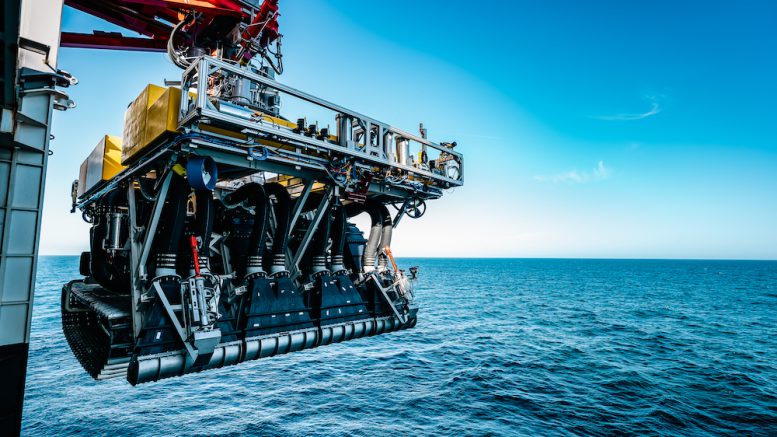
The Metals Company (Nasdaq: TMC) has released a prefeasibility study and a resource — the first of its kind — for its seabed mining plans that show a potential return around 30% with copper and nickel grades at more than 1%.
The New York-based company is exploring in the Clarion-Clipperton Zone between Hawaii and Mexico. Its prefeasibility study for the area’s NORI-D block shows an after-tax net present value of $5.5 billion (C$3.99 billion) with an internal rate of return (IRR) of 27%, The Metals Co. said on Monday. A separate initial assessment for the remainder of its Nori and TOML blocks post an after-tax NPV of $18.1 billion with an IRR of 36%.
TMC said it expects first production in the fourth quarter of 2027, subject to permitting, scaling to an average of 10.8 million tonnes of wet nodules per year through 2043. Mining international waters is in the spotlight as companies and countries are looking at minerals concentrated on the ocean floor that can be used in batteries for smart phones and electric vehicles. Environmental groups are calling for all activities to be banned, warning that industrial operations on the ocean floor could cause irreversible biodiversity loss.
Shares in The Metals Co. spiked at $6.88 apiece on Friday evening in New York but have fallen 9.5% since Friday’s close at $5.87 to $5.31 by mid-Tuesday.
1.3% nickel
The NORI and TOML blocks hold 73 million measured and indicated tonnes of wet nodules grading 1.3% nickel, 0.2% cobalt, 1.2% copper and 30.2% manganese with an abundance of 12.8 kg per sq. metre, according to the study. They have 1.2 billion inferred tonnes of wet nodules grading 1.3% nickel, 0.2% cobalt, 1.1% copper and 28.7% manganese with an abundance of 11.6 kg per sq. metre.
“The combined net present value of $23.6 billion of the two studies should give investors a better idea of the economic potential of our total estimated resource,” TMC Chairman and CEO Gerard Barron said in the release. “These are our first 50+ million tonnes with a potential commercially viable path to production, with more to follow as we advance our mine planning work.”
The NORI-D study outlines an 18-year mine life and annual output of about 97,000 tonnes nickel, 2.39 million tonnes manganese, 70,000 tonnes copper and 7,400 tonnes cobalt, with projected C1 cash costs of $1,065 per tonne of nickel (including by-product credits) and all-in sustaining costs of $2,569 per tonne.
TMC said the NORI-D project would ramp to 12 million tonnes per year of wet nodules within five years. Longer term, the company assumes construction of two dedicated U.S. refining facilities to produce nickel and cobalt sulphates and copper cathode, with most refining capital spending occurring in the 2030s.
‘Capital light’
TMC said the development plan is “capital-light,” leveraging existing offshore vessels and rotary-kiln electric-furnace capacity in Japan and Indonesia via tolling, before refining in the United States. The company and partner Allseas, a privately‑held Swiss–Dutch offshore engineering and construction contractor, each expect to contribute about $113 million of development capital to start production using the Hidden Gem vessel.
The Canadian miner, which has exclusive access to the Nori Clarion-Clipperton Zone, in March formally initiated a process under the U.S. Department of Commerce to apply for exploration licenses and permits to extract minerals from the ocean floor.
The reports also follow an $85 million investment from Korea Zinc in June. The deal gives Korea Zinc a 5% stake in TMC through the purchase of 19.6 million shares at $4.34 each. It also includes a three-year warrant allowing the South Korean refiner to acquire an additional 6.9 million shares at $7 apiece.
Hear CEO Barron on The Northern Miner podcast with host Adrian Pocobelli.
Be the first to comment on "The Metals Co. posts first deep-sea resource"