
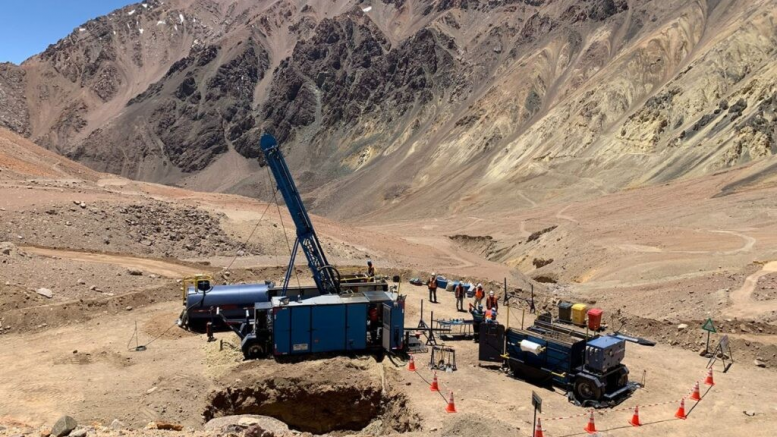
Exploration is the lifeblood of the world’s metal supply but economic deposits are becoming harder to find and sometimes even harder to exploit. Here’s a look at four more companies determined to find the mines we need for the future.
Hot Chili
Hot Chili (TSXV, ASX: HCH; US-OTC: HHLKF) is advancing its Costa Fuego project in Chile, one of the largest undeveloped copper sites outside the control of a major mining company.
The project consists of three open-pit areas within a 10-km radius, about 160 km north of the coastal city of La Serena and 600 km north of Santiago.
Costa Fuego’s pits (Productora/Alice, Cortadera and San Antonio) are located along the Pan-American Highway at an elevation of 740 metres above sea level.
A pre-feasibility study last March envisioned open pit and underground processing at a centralized plant. The study outlined a 20-year project with average annual output over the primary production life of 14 years of 255 million lb. copper and 48,000 oz. gold. It could also produce 4.4 million lb. molybdenum and 158,000 oz. silver at initial costs net of byproduct credits of $1.38 per lb. copper.
The study forecast a post-tax net present value (at an 8% discount rate) of $1.2 billion and an internal rate of return (IRR) of 19% at a long-term copper price of $4.30 per lb. Initial capital of $1.27 billion could be repaid in 4.5 years.
Costa Fuego hosts open pit and underground resources of 798 million measured and indicated tonnes grading 0.37% copper, 0.1 gram gold, 0.5 gram silver, 85 ppm molybdenum and another 203 million inferred tonnes grading 0.25% copper, 0.06 gram gold, 0.36 gram silver and 61 ppm molybdenum.
The company has also discovered La Verde, a copper-gold porphyry about 30 km south of Costa Fuego’s planned central processing hub.
The discovery hole last year cut 308 metres of 0.5% copper and 0.3 gram gold from 46 metres downhole in DKP002. Notable intercepts have included 495 metres grading 0.38% copper and 0.1 gram gold starting from 3 metres downhole in drill hole DKD033, including 123 metres averaging 0.5% copper and 0.13 gram gold. Hole DKD034 cut 426 metres grading 0.37% copper and 0.08 gram gold from 194 metres depth .
Hot Chili has a market cap of about $321.4 million.
Midnight Sun Mining
Midnight Sun Mining (TSXV: MMA; US-OTC: MDNGF) is exploring targets at its Solwezi copper project in the Zambian Copper Belt.
The 506-sq.-km project is just a few kilometres from First Quantum Minerals’ (TSX: FM) Kansanshi mine, Africa’s largest copper mining complex, and is close to several other world-class copper mines, including Barrick Mining’s (TSX: ABX; NYSE: B) Lumwana, 60 km to the west, CMOC Group’s Tenke Fungurume, 50 km to the north and Ivanhoe Mines’ (TSX: IVN; US-OTC: IVPAF) Kamoa-Kakula, 80 km to the northwest.
The flagship Dumbwa target is a near-surface, low-strip ratio exploration opportunity with similar geology and mineralization to Barrick’s Lumwana mine, the company says. The target features a continuous high-grade copper-in-soil anomaly that extends for over 20 km along strike and more than 1 km in width.
The company added a third drill rig at Dumbwa in September and the most recent drill results include 25 metres grading 0.89% copper starting from 41 metres depth in hole DBW-25-021; 50 metres at 0.46% copper from 8 metres downhole, including 1.36% copper over 6 metres, in drill hole DBW-25-30; and 21.85 metres grading 0.48% copper starting 12 metres downhole in drill hole DBW-25-027.
Midnight Sun is also exploring near-surface high-grade oxide copper mineralization at its Kazhiba Main and Mitu targets. Kazhiba Main hosts near-surface, acid-soluble copper with a compact footprint, extending to an average maximum depth of about 30 metres. A resource estimate in January outlined 2.33 million indicated tonnes grading 1.41% copper. The company plans to convert the deposit into a non-dilutive funding source to advance Dumbwa.
Drill highlights from Kazhiba include 14.86 metres grading 7.39% copper starting from 17 metres, including 4 metres of 16.9% copper in hole MSZ-25-029E; 21 metres of 10.69% from 13 metres downhole in MSZ22-028; and 26 metres of 5.6% copper from 14 metres depth in MSZ22-020.
Last May, the company entered into a strategic acquisition of the 366-sq.-km Luswishi Dome project, about 40 km to the southeast of Solwezi. The company has the right to earn up to 80% of the project.
Midnight Sun Mining has a market cap of about $318.7 million.
NGEx Minerals
NGEx Minerals (TSX: NGEX; US-OTC: NGXXF) is drilling at its main Lunahuasi copper-gold-silver project in the Vicuña district of Argentina’s San Juan province, about 6 km north of Lundin Mining (TSX: LUN) and BHP’s (ASX: BHP) joint Filo del Sol deposit.
Eight drill rigs are turning in NGEx’s 25,000-metre stage four program that started in October, part of a wider goal of building up a dataset on Lunahuasi. It has not yet announced a timeline for an initial resource.
Recent highlights include hole DPDH051, which intersected 327.4 metres grading 2.43% copper, 1.53 grams gold and 21.8 grams silver starting from 436.7 metres, including 4.3 metres of 12.67% copper, 62.11 grams gold and 297.1 grams silver, in drillhole in DPDH051; 13 metres of 3.90% copper, 1.44 grams gold and 118.2 grams silver from 395.40 metres in DPDH052; and 94 metres of 3.88% copper, 6.66 grams gold and 29.6 grams silver from 271 metres in DPDH054.
Last year, drilling to the west of the Lunahuasi deposit revealed copper-gold porphyry mineralization, confirming that the high-sulphidation veins comprising most of the deposit are related to a porphyry system.
Drillhole DPDH027 cut 1,619.4 metres at 0.52% copper and 0.32 gram gold starting from a depth of 385.6 metres. Step-out hole DPDH029 extended the mineralization by over 400 metres to the south of hole 27, hitting 85 metres comprising 1.67% copper and 0.49 gram gold from 777 metres.
About 10 km to the north of Lunahuasi across the border in Chile, NGEx owns 69% of the Los Helados porphyry copper-gold-silver project. Nippon Caserones Resources LLC holds the remaining 31%. Los Helados is about 17 km from the operating Caserones mine, in which Nippon Caserones holds a minority interest.
Los Helados hosts 2.08 billion indicated tonnes grading 0.4% copper, 0.15 gram gold and 1.5 grams silver and 1.08 billion inferred tonnes grading 0.34% copper, 0.1 gram gold and 1.4 grams silver, according to an updated resource from 2023.
The company has spun off net smelter return interests on the two projects into its subsidiary LunR Royalties (TSXV: LUNR) .
NGEx Minerals has a market cap of about $6.5 billion.
Solaris Resources
Solaris Resources (TSX: SLS; NYSE: SLSR) has kicked off a feasibility study on its Warintza copper-molybdenum porphyry project in southeastern Ecuador.
A pre-feasibility study in November outlined a single-stage open-pit operation that could produce 3.44 million tonnes copper, 154,000 tonnes molybdenum, 1.1 million oz. gold and 26.6 million oz. silver over a 22-year mine life. All-in sustaining costs were pegged at 85¢ per lb. payable copper during the first five years and $1.07 per lb. over the remaining 15 years.
The study forecast a post-tax NPV (at an 8% discount rate) of $4.62 billion and an IRR of 26%. Initial capital of $3.73 billion could be repaid after-tax in 2.6 years.
The deposit hosts 3.75 billion tonnes grading 0.24% copper, 0.01% molybdenum, 0.04 gram gold and 1.19 grams silver and another 2.1 billion inferred tonnes averaging 0.16% copper, 0.01% molybdenum, 0.02 gram gold and 1.11 grams silver.
A $200-million financing deal with Royal Gold (Nasdaq: RGLD) consisting of a gold stream and a net smelter return royalty completed in May will fully fund the project to a final investment decision. The proceeds will be used for technical studies, permitting work, early infrastructure development, debt repayment and exploration.
Earlier this year, Ecuador’s state-owned mining company, Empresa Nacional Minera, granted Solaris an option to acquire up to full interest in a new set of exploration areas immediately adjacent to Warintza. The award (Solaris 2) expands the company’s footprint by about 400 sq. kilometres.
Early-stage prospecting on the company’s Solaris 1 concessions have identified copper anomalies with rock samples returning up to 8.38% copper.
Solaris Resources has a market cap of about $2.4 billion.
Be the first to comment on "Spotlight: Global Exploration – Part 2"