
In addition to precious metals, Latin America is rich in critical minerals, such as copper, and lithium. Beyond these minerals, the continent has potential in graphite, nickel, manganese and rare earth elements. It is proving to be a rich hunting ground for the following companies.
Solaris Resources
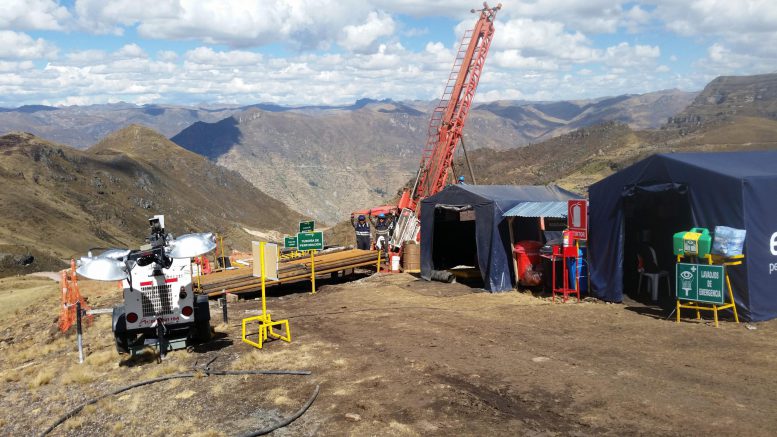
Solaris Resources (TSX: SLS; NYSE: SLSR) kicked off a feasibility study earlier this year for its flagship Warintza copper project in southeastern Ecuador.
A prefeasibility study last November envisioned a 22-year open-pit mine producing 183,000 tonnes copper, 8,600 tonnes molybdenum, 57,000 oz. gold and 1.3 million oz. silver per year. Over the first five years of operations, it would also include 230,000 tonnes of copper, 10,800 tonnes molybdenum, 71,000 oz. gold and 1.8 million oz. silver. AISCs were pegged at 85¢ per lb. of payable copper for the first five years and $1.07 per lb. of payable copper over the first 15 years.
Based on a copper price of $4.50 per lb., the study forecast Warintza would generate an after-tax NPV (at an 8% discount rate) of $4.6 billion and a post-tax IRR of 26%. Initial capital costs of $3.7 billion, including a 16% contingency, could be repaid post-tax in 2.6 years.
The project in Morona Santiago province, about 500 km south of Quito, hosts proven and probable reserves of 1.3 billion tonnes grading 0.31% copper, 0.02% molybdenum, 0.04 gram gold and 1.3 grams silver for about 4.1 million contained tonnes of copper, 214,000 tonnes molybdenum, 1.8 million oz. gold and 54.1 million oz. silver.
Warintza is planned to be developed through two main pits and to produce copper and molybdenum concentrates.
The project is fully funded through to a construction decision, following a $200-million non-dilutive financing last May from Royal Gold (Nasdaq: RGLD).
Solaris has also recently optioned exploration concessions adjacent to Warintza from Ecuador’s state-owned mining company, Empresa Nacional Minera. The award expands the company’s footprint around Warintza by about 400 sq. km.
In addition to Warintza, Solaris has an option to earn 75% in two copper-gold exploration projects in Peru (Capricho and Paco Orco); and owns the Tamarugo discovery in Chile’s copper belt, 5 km northeast of Copiapo.
Solaris Resources has a market cap of about C$2.1 billion.
Tinka Resources
Tinka Resources (TSXV: TK; US-OTC: TKRFF) is exploring in the central Andes of Peru and is focused on its main Ayawilca zinc-tin-silver project, about 200 km northeast of Lima.
Buenaventura Mining (NYSE: BVN) and Nexa Resources (NYSE: NEXA), which owns the Cajamarquilla zinc refinery near Lima, each hold a 12% stake in the junior.
Ayawilca hosts 28.3 million indicated tonnes grading 5.82% zinc, 16.4 grams silver and 91 grams indium for 3.64 billion lb. zinc, 14.9 million oz. silver and 2,582 tonnes of indium.
Inferred resources total 31.2 million tonnes averaging 4.21% zinc, 14.5 grams silver and 45 grams indium for 2.9 billion lb. zinc, 14.6 million oz. silver and 1,414 tonnes indium. Additionally, Ayawilca hosts a tin zone, with 1.4 million indicated tonnes grading 0.72% tin for 22 million lb. of contained tin and 12.7 million inferred tonnes averaging 0.76% tin for 213 million lb. of tin.
This year the company plans to drill 5,000 metres to extend high-grade silver, zinc and tin areas. Drill hole A22-195 is a previous highlight from Ayawilca with 6 metres grading 18.8% zinc; A22-199 cut 42.4 metres at 9.4% zinc, including 9.1 metres of 20.8% zinc; and A22-200 returned 44.9 metres grading 12% zinc, including 16.1 metres of 22.2% zinc.
A PEA in 2024 outlined an underground mine with two separate circuits producing 2 million tonnes of zinc-silver-lead a year over 21 years and 300,000 tonnes of tin a year over 15 years.
The study estimated an after-tax NPV (at an 8% discount rate) of $434 million and an IRR of 26% based on metal prices of $1.30 per lb. zinc, $22 per oz. silver, $11 per lb. tin and $1 per lb. lead. Initial capital of $382 million could be repaid in 2.9 years post-tax.
Tinka is also exploring 1.5 km north of the Ayawilca zinc zone at its Colquipucro property, which it says is a potential starter pit for a future project. Colquipucro is a disseminated sandstone-hosted silver deposit at surface with a 2016 resource estimate of 7.4 million indicated tonnes grading 60 grams silver for 14.3 million oz. silver and another 8.5 million inferred tonnes grading 48 grams silver for 13.2 million oz. silver.
In addition, Tinka owns the Silvia gold-copper project adjacent to Ayawilca and about 80 km south of the Antamina copper-zinc mine, owned by BHP (NYSE, LSE, ASX: BHP), Glencore (LSE: GLEN), Teck and Mitsubishi. It kicked off its first drill program in October.
Tinka Resources has a market cap of C$60.2 million.
Titan Minerals
Titan Minerals (ASX: TTM) has exploration projects in southern Ecuador’s Loja province. Its main 139-sq.-km Dynasty epithermal and porphyry gold project is fully permitted for exploration and small-scale mining.
Titan completed a 25,000-metre drill program last year. Drill results released in January included 38.5 metres grading 3 grams gold and 5.6 grams silver from 169 metres downhole, including 7.5 metres at 11 grams gold and 12.7 grams silver in CVDD25-173. Hole CVDD25-177 cut 8.6 metres grading 5.9 grams gold and 9.5 grams silver from 65 metres;
And hole CVDD25-171 returned 9.5 metres at 4.2 grams gold and 12.1 grams silver from 151 metres, including 5.3 metres of 7.4 grams gold and 19.4 grams silver from 152 metres.
Dynasty hosts a JORC-compliant (Australian rules) open-pit resource of about 18.1 million indicated tonnes grading grading 2.09 grams gold and 14.73 grams silver for 1.21 million oz. of contained gold and 8.57 million oz. silver. It has 25.44 million inferred tonnes grading 2.33 grams gold and 16.4 grams silver for 1.9 million oz. gold and 13.41 million silver.
The 2023 resource was defined from surface to a depth of about 250 metres and remains open. The resource was based on 394 diamond drill holes (63,342 metres), 85 channel samples (2,089 metres) and 1,599 trenches (6,743 metres).
At Titan’s 143-sq.-km Linderos copper project, 20 km west of Dynasty, surface mapping, geochemistry and diamond drilling have identified porphyry copper and epithermal gold mineralization. Hancock Prospecting is earning up to an 80% stake in the project by spending $120 million.
A 25,000-metre drill program is underway. Recent results include drill hole DHCR-09 which cut 694 metres grading 0.21% copper, 0.04 gram gold, 1.14 grams silver and 18 million ppm molybdenum from 325 metres, including 164 metres of 0.28% copper, 0.06 gram gold, 1.21 grams silver and 21 ppm molybdenum.
Data from that program were due to be incorporated into a resource update for Dynasty expected in this year’s first quarter.
The company is also exploring 24 km east of Dynasty at its 130-sq.-km Copper Duke project. Magnetics, soil geochemistry and trenching and surface mapping have outlined a 7-km porphyry alteration footprint.
Titan’s earliest-stage project is Copper Field, about 42 km northeast of Dynasty. The 65-sq.- km project has seen limited modern exploration.
Titan Minerals has a market cap of about A$276 million ($195 million). China’s Lingbao Gold holds a 9% stake in the company.
Unigold
Unigold (TSXV: UGD; US-OTC: UGDIF) has been active in the Dominican Republic since 2002 and has identified over 20 areas on its Neita concessions in the northwestern province of Dajabón that host surface expressions of gold systems.
The company is focused on the Candelones gold project, completing a feasibility study on the oxide portion of the deposit in late 2022. The study envisions a 5,000-tonne-per-day heap-leach operation with a mine life of 3.3 years. It estimates average annual payable gold at 31,400 oz. and AISCs at $829 per ounce.
The study forecast average annual after-tax free cash flow of $23.8 million. At $1,650 per oz. gold, the after-tax NPV (at a 5% discount rate) was pegged at $30.6 million, with an IRR of 44%. Initial capital was set at $36 million.
As part of the feasibility study, Unigold completed baseline environmental work and now has over five years of baseline data available to use in its consultation and design work. The company says it can table an initial environmental and social impact assessment study by this year’s third quarter.
On its Niete North concession, Unigold completed an agreement with Barrick Mining in 2024 to earn up to a 60% stake. Barrick must spend a minimum of C$12 million over an 8-year period and deliver a prefeasibility study on an unidentified deposit. It can then earn another 20% by paying for a feasibility study within the following four years.
Unigold completed a new outreach program in February to provide information before starting the full environmental study. The preliminary results showed more than 70% support to acelerate studies and community consultations.
The Candelones oxide project hosts 3.4 million measured and indicated tonnes grading 0.82 gram gold for 91,000 oz. and another 1.6 million inferred tonnes averaging 0.68 gram gold for 36,000 oz. gold.
Unigold has a market cap of C$125.2 million.
Be the first to comment on "Spotlight 2: 4 companies to watch in Latin America"