
A stack of executive orders and a Supreme Court ruling could speed U.S. mine approvals next year, but decades of constraints mean any rebound will be gradual, according to a leading industry group.
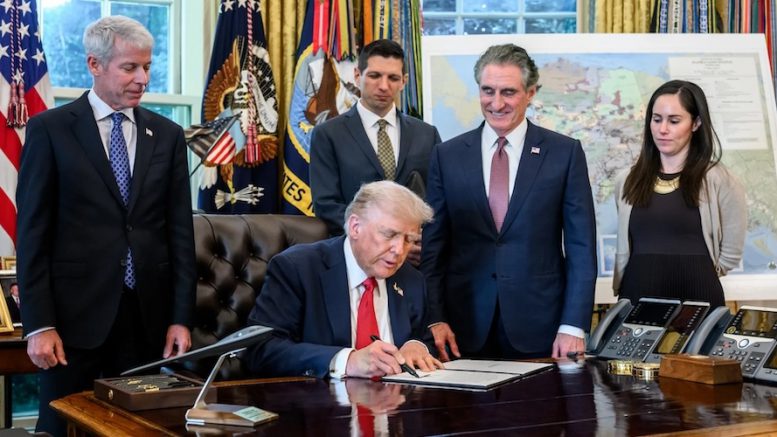
President Donald Trump issued orders this year directing agencies to expand domestic energy and mineral output, pare permitting delays and open more ground to exploration and processing. The top court’s Seven County decision significantly narrowed the required scope of environmental reviews. Projects added to the federal FAST-41 dashboard may see shorter timelines and stronger investor confidence.
But more than 30 years of restrictive policy and land-use limits hollowed out the sector, making any turnaround incremental rather than explosive, according to Debra W. Struhsacker. She’s a consultant to the Society for Mining, Metallurgy & Exploration, a U.S.-based association of 13,000 engineers, geoscientists and other technical specialists across the industry. Momentum is building, she said, but rebuilding foundations will take time.
What’s at stake is whether the U.S. can cut permitting times, encourage private capital to invest and rebuild processing expertise fast enough to reduce reliance on China for critical minerals central to national defence and the energy transition.
Permits and risks
Federal departments have begun unwinding parts of long-standing National Environmental Policy Act (NEPA) procedures, drafting program-specific guidance and moving projects onto FAST-41 tracking to highlight schedules and bottlenecks.
Ltigation remains the immediate risk, she said, with lawsuits over NEPA documents and approvals still likely. Passage of the SPEED Act, which aims to limit delays and curb forum shopping — the practice of deliberately choosing a specific court or jurisdiction from the available options because the litigant believes it will provide the most favourable ruling — would help blunt what is sometimes called legal drag.
Financing is another constraint. Many critical minerals projects still need federal backing to offset high capital costs and thin markets, particularly where private lenders remain hesitant. Public‑private models introduced this year are likely to expand in 2026 through offtake guarantees, credit support and strategic grants to de‑risk build‑outs.
Security and supply
Rare earths sit at the centre of the risk picture. The U.S. remains dependent on China for both heavy and light rare earths, even after Beijing spent decades building processing capacity and controlling the supply chain, Struhsacker said. Separating rare earth elements is expensive and slow, and small domestic markets limit commercial returns.
China’s history of price moves can chill private investment and heighten calls for government intervention.
Given the strategic stakes, she said critical minerals can no longer be treated as ordinary commodities. Additional federal investment and directed demand are unavoidable if the U.S. wants to onshore processing and close vulnerabilities in defence and clean‑tech supply lines.
Talent pipeline
Beyond capital and permits, Struhsacker flagged a looming skills gap. The U.S. has about 14 mining schools and graduates far fewer geologists, mining engineers and metallurgists than China. She urged Congress to pass the Mining Schools Act of 2025 and to rebuild national minerals research capacity after the defunding of the Bureau of Mines, noting that the country remains far behind in processing know‑how.
The U.S. has begun to confront its mineral vulnerabilities. Whether policy intent turns into durable gains next year will depend on legislation, sustained investment and rebuilding the industry’s technical backbone.
Be the first to comment on "U.S. mining revival gradual not explosive: industry group"