
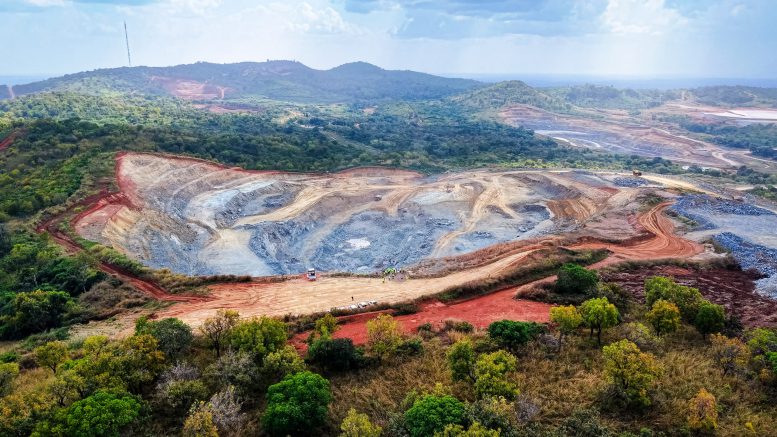
Séguéla, Côte d’Ivoire – Fortuna Mining’s (TSX: FVI; NYSE: FSM) success in expanding its flagship Séguéla mine in Côte d’Ivoire has surprised even some of its own employees.
Vancouver-based Fortuna last month doubled indicated resources at the mine compared with a December 2024 estimate as it disclosed increases in both contained reserve ounces and inferred ounces. Séguéla now hosts proven and probable mineral reserves of 13 million tonnes grading 2.81 grams gold per tonne for 1.2 million oz. contained metal, the company says.
A 7.5-year mine life – based on Séguéla’s largest mineral resource to date – is just the start. Fortuna has begun “aggressive” infill drilling and studies on the construction of an underground mine for its Sunbird deposit, the property’s richest, with first production envisioned for 2028. Another study, meanwhile, will look at possibly expanding Séguéla’s mill capacity by about 25% to as many as 2.5 million tonnes a year.
“I will be the first one to put my hand up: I was skeptical. I thought we wouldn’t find enough ore (at Sunbird) to make an underground mine viable,” mine general manager Peter McLean, a native of Australia, chuckled during a recent interview at Séguéla. “This deposit has grown and grown. It’s added an enormous potential to our operation here, and we’re very confident we can turn it into a mine.”
Rising output
Séguéla’s methodical expansion is a crucial building block in Fortuna’s strategy of boosting annual output to at least 500,000 oz. of gold by the start of the 2030s. The mine, whose three active deposits – Antenna, Ancien and Koula– could soon rise to eight, is projected to produce up to 147,000 oz. gold in 2025, climbing to as many as 200,000 oz. annually within a few years.
Sunbird is the first deposit to crack the 1-million-oz. mark at Séguéla, said fellow Australian Pat Manouge, Fortuna’s exploration manager for West Africa.
“It’s a fantastic deposit right from surface,” he told The Northern Miner in late November during a site visit by financial analysts, investors and reporters. “We have drilled more than 1 km of plunge length, and it’s still going with high grades. Now that we have critical mass here, it gives us the opportunity to mine some of the other underground deposits.”
Crews at Séguéla have drilled more than 200,000 metres so far, and about 60% of the exploration licence has been covered by auger drilling programs “that are unearthing very attractive targets” such as the Kingfisher deposit, National Bank Financial mining analyst Mohamed Sidibé, who attended the site visit, said in a recent report.
Antenna deposit
Exploration at Séguéla began under Australia’s Newcrest Mining in 2015 with the discovery of Antenna – named for the large telecommunications antenna that sits atop a nearby hill. Fortuna plans to dismantle it when the Sunbird open pit has been dug, and has already installed three replacement towers.
Newcrest didn’t stick around to see the fruits of its labour: by 2019, it had sold its portfolio of 11 Côte d’Ivoire exploration permits, including Séguéla, to Canadian miner Roxgold for about $30 million. Fortuna inherited the properties when it acquired Roxgold two years later for about C$1 billion ($714 million) and poured first gold at Séguéla in May 2023.
“This project is my baby. I started work with the discovery hole at Antenna,” exploration manager Franck Gboko, an Ivorian native, told The Northern Miner. “Back then, we only had an inferred resource of 400,000 oz. at Antenna. We were hoping it would grow but did we expect to reach 2 million ounces? Probably not.”
Hard to reach
Fortuna’s biggest mine isn’t easy to reach: It takes almost two full days to reach the site from North America. With no direct flights available from either Canada or the United States, visitors must fly for about 15 hours, connecting via Brussels or Paris, before hitting the road from Abidjan, the country’s bustling metropolis, for a 480-km trek northwest.
Most of the drive takes place on a four-lane toll highway, save for a final 25-km stretch on an unsealed road made to feel longer by regular police roadblocks.
Along the way, travellers will pass myriad minibuses – some painted in honour of soccer stars such as Argentina’s Lionel Messi, Portugal’s Cristiano Ronaldo or Ivorian national team stalwart Franck Kessié – carrying passengers, assorted luggage, dogs and sometimes even chickens or goats. When traversing villages on regional roads, drivers must steer clear of rice grain heaps drying on the roadside.
With a population of about 67,000, the adjacent city of Séguéla boasts a small airport, a hospital, a prison and a military garrison. Outside of mining, crops such as cocoa, cotton and cashew nuts dominate the region’s economic output. Côte d’Ivoire is the world’s biggest producer of both cocoa beans and cashews.
Modern compound
Fortuna has spared no expense to ensure Séguéla’s roughly 1,600 employees and contractors feel at home on the remote site.Staffers are lodged in a modern compound that features individual rooms with private bathrooms, a cafeteria, a bar and even a miniature soccer field. On the week of the visit, the Séguéla soccer team was holding tryouts in preparation for a miners’ tournament in Yamoussoukro, the Ivorian capital.
Excluding reserves, Séguéla’s measured and indicated resources now total 6 million tonnes grading 4.12 grams gold for 794,000 oz., according to the company. Inferred resources stand at 8.8 million tonnes averaging 2.52 grams for 712,000 ounces.
“It’s been a significant growth story and we continue to find one, sometimes two deposits a year or every two years,” McLean said. “There are still an awful lot of untested areas. We have a strong pathway to extending the mine life and continuing to grow the resources and reserves.”
Resource base
Fortuna’s 620-sq.-km land package for Séguéla includes more than 30 targets. The company is spending an estimated $13.5 million in exploration in 2025 to expand the resource base. Mineralization on the property is characterized by high-grade, coarse gold, quartz vein hosted systems.
Côte d’Ivoire “has the same geology as Ghana,” said Manouge. “It’s the same package of rocks that goes straight across the border into Ghana and stretches from Guinea to Burkina Faso, into Niger, Mali and the very eastern part of Senegal,” where Fortuna is advancing the Diamba Sud gold project.
“Deposits here are like pencils. They are very high grade but they are narrow and vertical,” adds Neil Colbourne, the company’s vice president of operations for West Africa.
Mill expansion
Part of Séguéla’s growth potential hinges on a planned increase in the processing mill’s capacity. Expanding the plant could add 60,000 oz. in annual production and cost less than $200 million, Sidibé estimates. A final decision will be taken by mid-2026, said process manager Michael Burns.
Thanks to optimization measures such as increased automation, the installation of a more efficient reactor and a bigger oxygen tank, the mill is already running above its original design capacity of 1.25 million tonnes per year.
“It’s stretched to the max, hence the announcement that we are investigating a possible upgrade,” Burns told The Northern Miner.
Lead time
Expanding the mill would probably take 18 months to two years, depending on the scope of the capacity increase, he said.
“The biggest lead time is for the manufacturing equipment,” Burns said. “It takes almost 12 months to get a pump these days. The gold mining industry is really heating up. Supply chains are stretched and they seem not to have recovered from Covid. That’s the challenge for any new project.”
If the expansion does proceed, Manouge has no doubt that enough new deposits will be found to keep the mill busy for several years. Fortuna’s 22-person exploration team – which consists entirely of Ivorian nationals – will play a key role in driving the mine’s growth, he says.
“They do a fantastic job. They’ve learned a lot and they know the deposits well,” said Manouge. “They’ve been very successful at continuing to find gold, and I could see Séguéla going for 20 years at least. It has a ton of potential.”
Be the first to comment on "Site visit: Fortuna’s Séguéla gold mine poised for growth"