
The copper price hit a new 16 month high in London this week, while BHP (NYSE, LSE, ASX: BHP) is predicting global copper demand to grow by at least a million tonnes a year, rising from the current 33 million tonnes annually to 50 million tonnes by 2050. US Geological Survey data signal supply must at least double to avoid a severe crunch.
Amplifying the alarm, some of the world’s biggest mines are experiencing production setbacks. The shutdown of Freeport-McMoRan’s (NYSE: FCX) Grasberg could swing the copper market into a deficit this year, according to analysts at Goldman Sachs.
Flooding at Kamoa-Kakula, another major producer, caused operator Ivanhoe Mines (TSX: IVN; US-OTC: IVPAF) to revise down its output estimate, while Teck Resources (TSX: TECK.A, TECK.B; NYSE: TECK) slashed its copper forecast over persistent setbacks at its Quebrada Blanca mine in Chile and Highland Valley Copper operation in Canada.
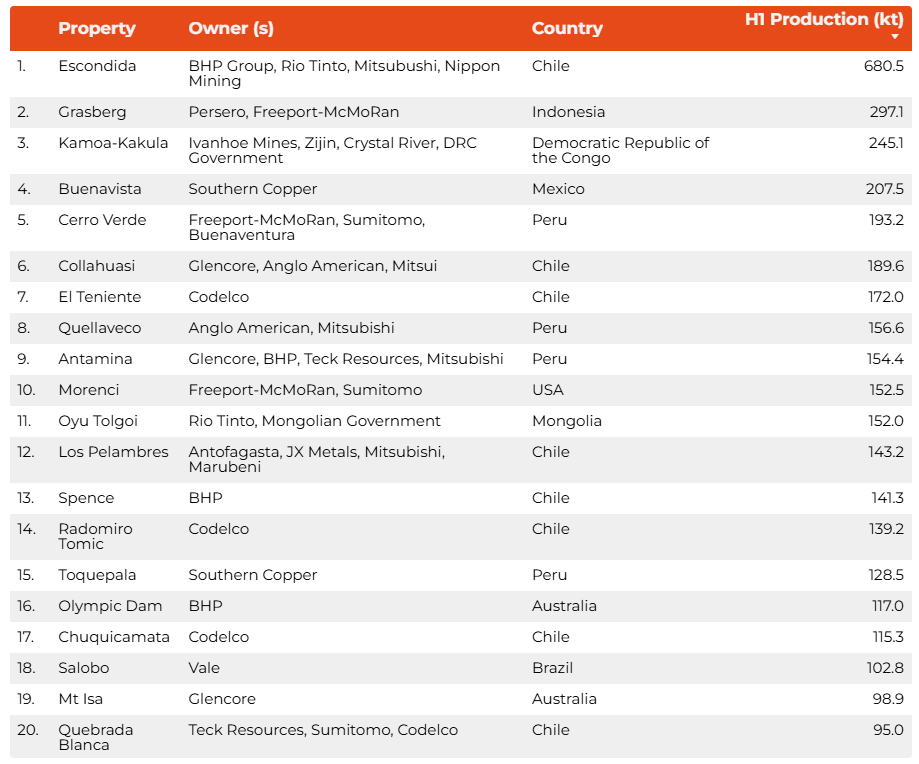
Tracking global production, we rank the world’s top 20 copper mines for the first half of 2025, measured in kilotonnes (kt).
1. Escondida
Escondida in Chile, a joint venture between BHP, Rio Tinto Mitsubishi, Nippon Mining, holds on to the top spot, producing 680,500 tonnes of copper metal to June 30 this year. While Escondida has long ranked the world’s biggest copper mine, the $53-billion proposed merger between Anglo American (LSE: AAL) and Teck could create the world’s largest copper complex, according to analysts.
2. Grasberg
Grasberg in Indonesia, held jointly between Freeport-McMoRan and Indonesian state-owned enterprise Persero and operated by Freeport, produced 297,103 tonnes during the half year. Production at Grasberg has been under suspension since Sept. 8 after a landslide unleashed 800,000 tonnes of mud, killing seven workers.
3. Kamoa-Kakula
In the Democratic Republic of Congo, the Kamoa-Kakula complex owned jointly by Ivanhoe Mines, Zijin Mining, Crystal River and the DRC government, churned out 245,129 tonnes. Ivanhoe halted operations at Kamoa-Kakula for three weeks after seismic activity on May 18 severely flooded the underground mine.
4. Buenavista
Buenavista in Mexico, owned and operated by Southern Copper (NYSE: SCCO) takes fourth place with 207,473 tonnes produced. Copper has been mined at the site, just 22 miles south of the US border, continuously as far back as 1899.
5. Cerro Verde
Cerro Verde in Peru, a joint venture between Freeport-McMoRan, Sumitomo and Buenaventura produced 193,320 tonnes during the period. The Peruvian government first mined Cerro Verde’s oxide ores and built one of the world’s first SX/EW facilities in 1972.
6. Collahuasi
Collahuasi in Chile, co-owned by Glencore (LSE: GLEN), Anglo American and Mitsui produced 189,600 tonnes. In July, Chile flagged lagging output from the mine.
7. El Teniente
Chilean state run copper miner Codelco’s El Teniente, the world’s largest underground copper mine, churned out 172,000 tonnes. The mine incurred a multi-day shutdown due to a collapse triggered by a 4.2-magnitude earthquake in late July led to a loss of 20,000 to 30,000 tonnes. Six workers died.
8. Quellaveco
In Peru, the Quellaveco mine, jointly owned by Anglo American and Mitsubishi, produced 156,600 tonnes of the red metal during the period. This year, Anglo announced it’s planning an almost $26-million upgrade at Quellaveco.
9. Antamina
Also in Peru, Antamina produced 154,369 tonnes in the first half. The co-owners BHP, Glencore, Teck and Mitsubishi are forecasting an almost 20% boost in cooper output next year.
10. Morenci
Morenci mine in Arizona, held by Freeport-McMoRan and Sumitomo produced 152,458 tonnes in this year’s first six months. The operation has a long history: it was established as an underground mine in 1871 by Longfellow Mining and was converted into an open-pit mine by the Phelps Dodge Corp. in 1937.
11. Oyu Tolgoi
Oyu Tolgoi, owned by Rio Tinto (NYSE, LSE, ASX: RIO) and the Mongolian government, produced 152,000 tonnes to June 30. Rio said then the ramp up of production from Oyu Tolgoi remains on track to deliver an average of around 500,000 tonnes of copper from 2028 to 2036.
12. Los Pelambres
In Chile, the Los Pelambres joint venture between Antofagasta (LSE: ANTO), JX Metals Mitsubishi and Japanese conglomerate Marubeni produced 143,200 tonnes during the period. In September, the union for supervisors rejected a contract offer, paving the way for a potential strike if further negotiations fail.
13. Spence
Spence mine, owned by BHP in Chile, churned out 141,300 tonnes in the first half. Last year, Spence became the company’s first fully autonomous operation, a status reached after a two-year journey that included converting its trucks fleet and drilling rigs.
14. Radomiro Tomic
Codelco’s Radomiro Tomic mine in Chile produced 139,200 tonnes during the period. Last year, it signed a three-year collective labour contract with the union representing Radomiro Tomic workers, ending a recurring dispute.
15. Toquepala
Southern Copper’s Toquepala mine in Peru produced 128,503 tonnes in the six-month period. A decade ago, Southern Copper sunk $1.2 billion into the mine’s expansion.
16. Olympic Dam
BHP’s Olympic Dam copper mine in South Australia produced 117,000 tonnes of metal to June 30. Last week, the world’s top miner invested more than A$840 million ($555 million) in the Olympic Dam copper, gold and uranium complex, advancing a series of growth projects ahead of a multibillion-dollar expansion decision expected in 2028.
17. Chuquicamata
Codelco’s Chuquicamata mine achieved 115,300 tonnes in the first half. Mirroring progress at Radomiro Tomic, Codelco and Chuquicamata workers reached an early contract agreement late last year.
18. Salobo
Vale’s (NYSE: VALE) Salobo mine in Brazil’s Pará state produced 102,800 tonnes during the period. Last year, Vale resumed operations following a one-month suspension due to fire at a processing plant.
19. Mt Isa
Glencore’s Mt Isa mine in Queensland, Australia produced 98,900 tonnes of copper metal by the end of June. In July, Glencore shut its final two copper mines in Mount Isa, ending more than six decades of operations.
20. Quebrada Blanca
In Chile, the Quebrada Blanca operation owned by Teck, Sumitomo and Codelco, produced 95,000 tonnes in the year’s first half. Last month, Teck said it was deferring major expansion projects while it works to fix output problems at Quebrada Blanca.
Be the first to comment on "RANKED: Top 20 biggest copper mines 2025"