
Higher nickel prices allowed
Fourth-quarter earnings were US$5.7 million on sales of US$73 million, a solid improvement from the US$8 million lost on sales of US$56 million in the corresponding period of 2001.
PT Inco is held 58.7% by Inco, 20.1% by Japan’s Sumitomo Metal Mining Co., 20% by public shareholders through a listing in Jakarta, and 1.2% by four other Japanese companies.
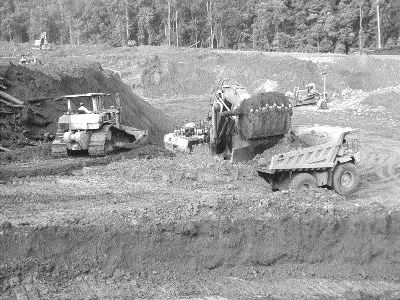
The subsidiary generates revenue from a mine and pyrometallurgical processing plant on the island of Sulawezi, near the town of Sorowako and about 70 km inland from a shipping port near Malili.
The nickel-laterite deposits at Sorowako are divided into two blocks, East and West. Each has a unique chemistry, mineralogy and weathering profile developed over serpentinized (East) and un-serpentinized (West) ultramafic bedrock.
West-block ore is a low-grade, boulder-saprolite clay mixture that PT Inco upgrades through the screening-out of boulders before the ore is fed into the processing plant.
The ore mined from the East block is a more typical laterite with variably weathered rock, and saprolitic clay that requires less upgrading with screens.
PT Inco’s nickel-in-matte production for 2002 totalled 59,500 tonnes, down from 62,600 tonnes a year earlier. The decline is attributable to a 20% reduction in fourth-quarter production, year over year, to 12,300 tonnes of nickel in matte.
In 2002, the company realized an average of US$5,114 per tonne (US$2.32 per lb.) for its nickel-in-matte deliveries, up from US$4,836 per tonne (US$2.19 per lb.) in 2001.
PT Inco says production in 2002 was constrained both by the “complexity” of the orebody and the rebuilding of its no. 3 electric furnace, which should be back at full capacity by April.
PT Inco President Edward Hodkin says drilling, test pitting and ore-blending have resulted in better nickel grades and that the subsidiary remains committed to reducing costs.
In 2004, PT Inco plans to begin mining a large, East-block-type deposit named Petea, which was drilled extensively last year and is still open to expansion. Material from Petea has good grades and is said to be ideal for blending with ores from areas currently being mined.
Between 2001 and 2002, PT Inco’s mined ore grade increased to 1.77% from 1.70%, and the target for 2002 is 1.78%. Nickel recoveries are expected to remain at 89% this year.
Hodkin stresses that the processing plant can consistently operate at feed rates equivalent to its design capacity of 150 million lbs. (68,100 tonnes) nickel in matte per year. Indeed, for 2003, PT Inco has upped its production target to 140 million lbs. (63,600 tonnes) nickel in matte, with cash costs expected to decrease US3 to US$1.36 per lb.
On the downside, the cost to PT Inco of a barrel of oil is expected to rise to US$23.43 in 2003 from US$21.58 last year. PT Inco uses about 2.6 million barrels of oil annually but has hedged 589,000 barrels of oil at US$18.18 apiece for 2003. (Current spot prices are in the neighbourhood of US$35 per barrel.)
PT Inco plans to use 200,000 additional barrels of oil in 2003 to produce 4,086 more tonnes of nickel in matte.
“We will be challenged by oil prices [at PT Inco] but far less than our competitors, because of our major hydroelectric-generating capacity,” said Inco Chairman Scott Hand during a meeting with analysts in early February.
Accordingly, PT Inco is looking to derive more power from its 258-MW Balambano hydroelectric dam, which has created the main Lake Towuti reservoir. In 2002, 98% of power from the dam was derived at a cash cost of US$0.0015 per kWh.
The company is monitoring the inflow of water to its reservoirs, which were 0.4 metre below normal at year-end, though levels improved in January as a result of more rainfall.
Higher cash flow
After making debt repayments and spending US$42 million on capital expenditures, PT Inco realized a net cash outflow of US$21 million for 2002, compared with US$6.8 million in 2001.
Since PT Inco began its latest debt-repayment program in 2000, long-term debt has been halved to US$269 million, and the remainder is expected to be paid by March 2006.
At the end of 2002, the company’s nickel-in-matte inventory was 1,098 tonnes, compared with 2,043 tonnes at the end of the third quarter.
On the labour front, PT Inco signed a 2-year collective agreement with its Indonesian workforce.
Inco President Peter Jones brushed off concerns relating to the political risk of operating in Indonesia: “While the political and social situation in Indonesia remains unsettled, we had no significant work interruptions last year. . . I was in Indonesia [at the end of January] and I came away feeling very positive.
“Our focus this year is on achieving significant productivity gains and enhancing our leading competitive position in Asia. Our major orebodies in Indonesia and our low-cost hydroelectric power represent a long-lived and low-cost operation.”
Meanwhile, PT Inco is looking at development opportunities elsewhere on Sulawezi. In early February, it signed a joint-venture agreement with Indonesian nickel and gold miner
Startup in ’05
PT Inco will spend US$2.8 million defining reserves sufficient for two years of production, and hopes to bring the deposit into production by 2005.
Antam, which employs 3,600 workers, is 65%-owned by the Indonesian government; the second-largest shareholder is U.S.-based Oppenheimer Developing Market Fund, at 5.75%.
Antam has traded on the Jakarta and Australian stock exchanges since the late 1990s and is the only Indonesian company to be fully listed on a stock exchange outside of Indonesia, though lack of liquidity on the ASX remains a problem.
The market capitalization is about US$90 million, down from a long-term average of US$150 million, despite Antam’s US$279 million worth of assets (including US$52 million in U.S. currency) and US$8 million in long-term debt, for a long-term debt-to-equity ratio of 4%.
Thus, reflecting Indonesia’s high country risk, Antam’s current price-to-book ratio is a very low 0.4.
For the first nine months of 2002, Antam’s net income slumped to 123 billion rupiahs (about US$13 million) on sales of 1.1 trillion rupiahs (US$124 million), compared with a year-earlier profit of 311 billion rupiahs (US$35.1 million) on sales of 1.2 trillion rupiahs (US$118 million).
Aneka attributes the decline to a stronger rupiah, lower revenues on gold and nickel sales, and higher oil prices.
As a result, the dividend policy has changed: Antam will now pay out a maximum of 30% of its profits, rather than a minimum of 30%.
During the 9-month period, Antam’s production of nickel in ferronickel totalled 5,985 tonnes (compared with 6,916 tonnes a year earlier), plus 93,591 oz. gold (104,651 oz.) from the Pongkor mine. The nickel output was sold at an average of US$2.97 per lb. (US$2.84 per lb.) to European and Asian stainless-steel producers such as Germany’s Krupp Thyssen Nirostas and South Korea’s Pohang Steel Company.
Cash costs for ferronickel production are expected to be US$2.35 per lb. in 2003, up from US$1.78 per lb. last year, owing to the removal of fuel subsidies.
With the rising costs, Antam has slipped one position to fourth on the list of the world’s lowest-cost ferronickel operations, behind Cerro Matoso, Codemin and Loma de Niquel.
However, the company does enjoy an operating margin of 16%, and a 5-year average margin of 35%. This easily beats the 5-year averages of 8% for
Inco, 9% for Falconbridge, 4% for WMC Resources, 7.5% for Newcrest and 7% for Eramet.
In 2001, Antam opened its fourth nickel mine, named Tanjung Buli, which allowed the company to boost its sales of high-grade nickel ore by 50% to 2.5 million tonnes annually. Some 1 million tonnes of low-grade ore are also sold each year to Australia’s QNI.
Antam is gearing up to expand its FeNI III nickel smelter, which will increase the company’s annual capacity to 26,000 tonnes nickel-in-ferronickel, and should boost the company’s revenues above US$100 million per annum. At that expanded rate, Antam would be producing 10% of the world’s ferronickel. Construction could begin as soon as April, with commercial production slated to commence in late 2005.
The FeNI III smelter is expected to produce ferronickel at a cash cost of US$1.70 per lb., which would bring Antam’s entire ferronickel cash costs below US$2 per lb.
The total investment is expected to be about US$380 million, which will be funded by a syndicate led by IKB Deutsche Industriebank, as well as by Bank Mandiri and Antam’s own equity.
In addition to nickel ore, ferronickel and gold, Antam produces bauxite, iron sands and silver, and operates Logam Mulia, Indonesia’s only precious metal refinery. Logam has been refining gold and silver since 1937, and is now branching out into manufacturing precious-metal-related industrial products and jewelry.
On the exploration front, Antam’s strategy is to spend at least 5% of export revenue on exploration.
Antam has more than a dozen joint-venture partnerships in Indonesia, though several have been put on care and maintenance in recent years.
Cempaka project
One bright light is the progress being made by
In early February, BM arranged a convertible loan totalling US$2.9 million and bearing interest at 12% from Ocean Resources Capital Holdings, a US$63-million, U.K.-based resource investment fund.
Converting all of the Ocean loan into BM shares would result in the issue of 28 million new BM shares, adding to the 13.6 million currently outstanding and which trade in the 20 range (for a market capitalization of C$2.3 million).
The new funds should permit Cempaka to proceed to commercial production in the first half of 2003 at a rate of 47,000 carats per year, plus some gold and platinum credits.
A feasibility study, completed in August 2002, indicates that the project would generate average cash flow of US$2.4 million per year during the first five years of production, based on diamond prices of US$175 per carat. (During 2002, BM sold 4,447 carats recovered from Cempaka for an average US$182.39 per carat.)
For its part, Ocean Resources is applying to have its shares traded on London’s Alternative Investment Market, with a likely offering price of 50 pence.
Be the first to comment on "PT Inco triples earnings"