
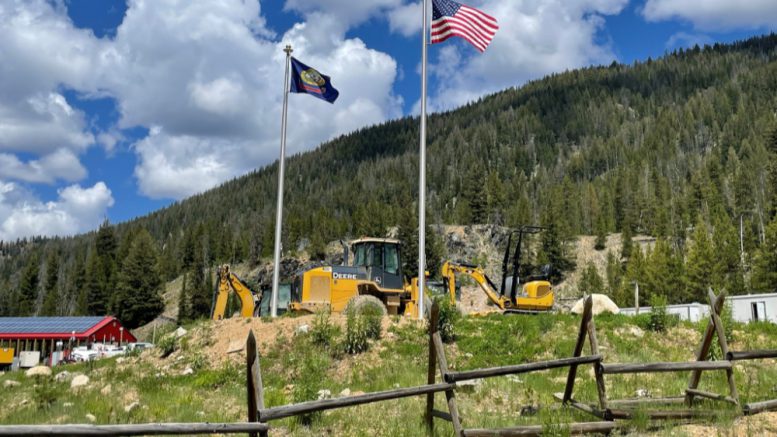
Perpetua Resources (Nasdaq: PPTA; TSX: PPTA) says it’s obtained the final federal approval for the $1.3 billion capex Stibnite gold-antimony project in Idaho that U.S. President Donal Trump fast-tracked in an executive order in March after nearly a decade of permitting.
Stibnite holds an estimated 148-million-lb. antimony reserve — the only identified reserve in the U.S. and one of the largest reserves outside of Chinese control for the metal technology, defence and energy. Once built, Perpetua expects the mine to produce about 450,000 oz. of gold annually over its first four years and some 35% of domestic antimony needs. Full production is slated for 2028.
The clean water permit from the U.S. Army Corps of Engineers “marks the culmination of eight years of permitting, scientific study, project refinement, and lots of hard work,” Perpetua Resources CEO Jon Cherry said in a news release. “It’s time to move forward and take the Stibnite gold project into a new and exciting phase of development.”
Perpetua said it is now focused on finalizing the remaining state permits for using cyanide, discharging water and dam safety as well as securing project financing needed to begin construction.
Shares in Perpetua Resources gained 11% from Friday’s close to Tuesday morning in Toronto at $18.46 apiece. They traded as low as $3.65 in the past 12 months. Perpetua has a market capitalization of $1.34 billion.
Fast track
Stibnite is one of 10 initial U.S. projects selected by Trump’s newly formed National Energy Dominance Council for placement on the Federal Permitting Improvement Steering Council dashboard. The projects are being given access to increased inter-agency transparency, coordination and oversight.
According to the feasibility study published in 2021, Stibnite is expected to produce 4.2 million oz. of gold and 115 million lb. of antimony over a 15-year mine life, with the first four years making up a sizeable part of the production.
China accounted for 60% of globally mined antimony in 2024, according to data from the U.S. Geological Survey. Last year, China banned exports of the metal to the U.S.
Mining at Stibnite is to involve three open pits. The project also entails punching in a new road through three areas and along a designated wilderness zone as well as the filling of a local waterway, Meadow Creek, with mine waste. Legacy tailings and waste are to be removed and reprocessed to improve water quality.
The company aims to restore the natural flow of the headwaters of the Salmon River and reopen fish passage to miles of critical spawning habitat that have been blocked for over 80 years and provide a net increase in wetland acres and an uplift in wetlands quality.
The project has an after-tax net present value of $1.3 billion at 5% discount rate, according to the feasibility study. It has an internal rate of return of 22% and a payback period of just under three years. Those figures were calculated using a gold price at $1,600 per oz. However, these figures would improve to $1.9 billion NPV, 28% IRR and 2.5-year payback when a higher gold price of $1,850 an oz. is applied.
Be the first to comment on "Perpetua gets final U.S. OK for fast-tracked Stibnite"