
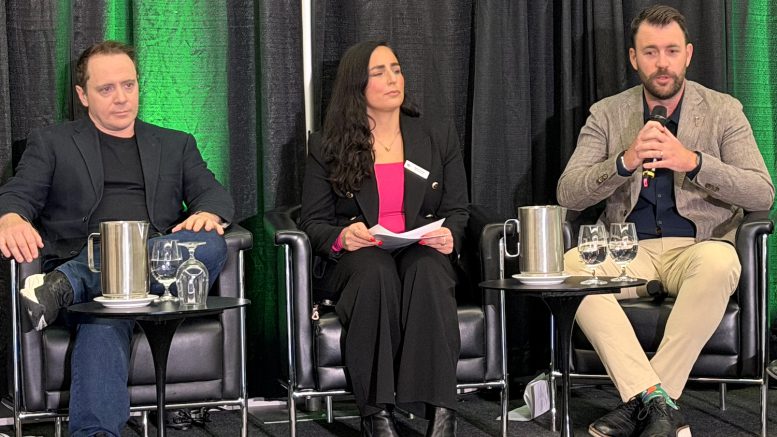
Mining companies should start measuring “digital trust” online the way they track costs and safety, treating social media sentiment and responsiveness as early-warning signals for community risk, social media experts suggest.
Miners should fold digital trust into social and key performance indicators, Elizabeth Freele managing partner at sustainability consultancy Sympact, said Monday on a PDAC panel. Social media tolls could help sentiment monitoring, response-time tracking and measuring whether affected communities are part of the online conversation.
“It’s not gold or copper. It’s trust,” Haydon Mort, CEO of mining communications firm Geologize, told the sesson. “Let’s face it – most people hate the mining industry outside this convention centre.”
The panel’s argument is that projects now face a faster feedback loop: a local grievance, activist campaign or perceived misstep can spread virally online in hours, hardening opposition and raising the reputational stakes for investors, lenders and boards long before permitting decisions are made.
Feelin’ groovy
Cate Larsen, a geology educator known online as the Groovy Geologist, said her young audience gives her leverage to amplify issues and connect people who might otherwise be ignored – a responsibility she’s trying to use deliberately.
“I have the power to bring things to the attention of the right parties that a lot of people can’t,” Larsen told the panel. “I want to use that power in a really good way.”
Miners often judge online engagement using “vanity metrics” such as views, likes and follower counts – even though those numbers say little about whether communities believe what they’re seeing, said Freele, who co-founded the Vancouver-based Responsible Mining Academy.
The better test is whether online engagement leads to offline outcomes such as meetings, questions answered, design changes and clearer accountability. Companies should also rethink how they tell community stories. Co-creating content can mean sharing control and letting local partners shape the message, rather than lifting a quote, polishing it and posting it on a corporate channel, Freele said.
But that approach runs headlong into another reality: legal limits. Disclosure rules and confidentiality agreements can keep companies from sharing the most compelling details of exploration work in real time, Justin Daley, vice-president of exploration at Nevada King Gold (TSX-V: NKG; US-OTC: NKGFF), said on the same panel.
The industry’s communications often fall flat because “we’re not able to say everything that we think is interesting,” he said. The dilemma is that social platforms often reward heat, not nuance – a trap he said miners should avoid. “Generally, you have to be controversial to get a lot of views,” he said. “And in this space, that is the one thing that I feel I cannot do and you should not be doing.”
Cultural responsibility
Credibility equates to cultural responsibility these says, according to Shawna-Lee Enair-Fox, corporate Indigenous relations coordinator at Agnico Eagle Mines (TSX, NYSE: AEM). .
Enair-Fox, who is also host of Wild North Adventures TV, described sitting with elders and ensuring stories remain accurate and respectful, especially when audiences ask whether an Indigenous creator is speaking for herself or for many nations.
“There’s lots of pauses when elders speak,” she said, citing how easily outsiders can talk over them. “It’s about taking that responsible time to sit with them, hear them out to understand them and deliver that appropriately in a way that they feel respected and heard.”
Balancing act
The job can often entail a balancing act between teaching and absorbing backlash, Groovy Geologist Larsen told the session. With many of her followers still in school, she said she feels responsible for showing students the range of work across the sector – not just the stereotypes they arrive with.
Yet Mort said the starting point for any outreach remains accepting the industry’s image problem, then listening long enough to understand what’s driving it.
“In mining,” he said, “empathy isn’t a soft skill. It’s part of the work.”
Be the first to comment on "PDAC: How social media can transform miners into groovy geologists with ‘digital trust’"