
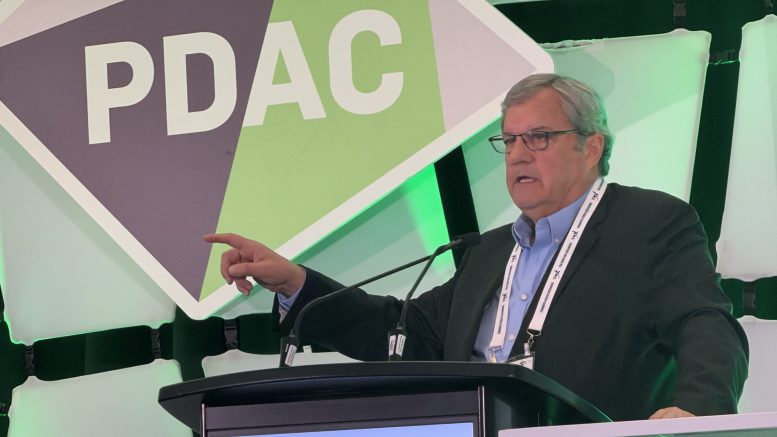
Canada’s flow-through share financing system underpins the country’s status as a dominant mine finance hub by supporting the efforts of some 670 listed explorers, Canadian Mining Hall of Fame member Douglas Silver said.
Flow-through investors supply roughly three-quarters of the equity raised annually by eligible exploration companies in Canada, said Silver, partner and senior advisor of Sydney-based Benwerrin Investment Partners. Those issuers raised about $2.2 million (US$1.6 million) each on average in 2024, including about $1.7 million in flow-through shares, leaving roughly $500,000 from other equity, he added, citing his review of thousands of public filings.
“If [Canada] terminated flow-through financing, [Australia’s] ASX could become the premier mining stock exchange in the world,” Silver said Tuesday at the Prospectors and Developers Association of Canada’s annual convention in Toronto. The financing mechanism is “absolutely critical” to Canada’s public exploration ecosystem, he added.
Lifestyle trap
So-called ‘lifestyle companies’ give the junior exploration industry a bad rap, Silver said. Those companies spend about $215,000 a year in overhead, he said.
“That means a junior raising only $300,000–$400,000 can end up funding more general and administrative costs than drilling,” he said.
Flow-through, a tax-incentive driven funding tool unique to Canada, sits near the heart of the country’s exploration pipeline and its claim as the world’s busiest market for mining listings.
Canada’s mineral exploration tax credit (METC) is a 15% credit designed to help exploration companies raise equity funds. The federal government extended the METC for two years in 2025.
First introduced in the 1970s, flow-through shares give individual investors a 100% tax deduction for the amount they invested in the shares, plus tax credit of up to 30% in the case of an eligible mining expense such as drilling.
Flow-through shares let exploration companies “flow through” eligible exploration expenses to investors who claim the tax breaks. The program encourages investment in the industry by high-net-worth individuals.
Existential tool
Silver’s breakdown of gold equity financings over five years finds that the explorers’ share peaked in 2022 before sliding, while producers’ share climbed sharply as investors chased near-term revenue and liquidity.
“That’s where flow-through becomes existential,” Silver argued.
Grassroots explorers have no revenue and rely on equity. Flow-through funding, he said, pays for fieldwork while other equity keeps the lights on. Without it, many early-stage Canadian explorers would struggle to survive long enough to make a discovery.
Based on his research, Silver expects market forces to keep culling weak companies without a broad collapse in issuer counts.
Carrying capacity
The broader question is whether Canada has too many mineral companies chasing too little money, Silver argued. Borrowing a concept from his background studying zoology at the University of Vermont, he referred to an ecosystem’s “carrying capacity.” Silver argued that capital markets, like ecosystems, can only sustain so many “members” before the weaker ones starve.
Canada, he said, makes a useful proxy because it hosts the world’s largest concentration of public mineral companies and offers unusually rich disclosure. In his count, the number of Canadian-listed mineral issuers averaged about 700 in earlier decades, surged to a peak in the early 2010s and sat around 1,600 recently.
The pandemic didn’t trigger a mass die-off in listed companies. Instead, his research shows issuer counts bottomed during Covid-19 and have risen since 2020, a rebound he said he didn’t expect when he started the work.
Gold explorers
Gold dominates the herd. About 42% of Canada’s mineral companies focused on gold in 2024, with copper at about 17% and lithium, silver and uranium next. Those weightings matter, Silver argues, because gold explorers drive investor psychology and can make financing conditions look worse than they are across the rest of the sector.
Public listings rose fastest in commodities that caught investor imagination after 2020, Silver’s data show. The number of copper issuers rose about 58% over five years, while lithium, uranium and nickel names more than doubled at their peaks before lithium cooled with prices, Silver said.
Crypto threat
Beyond policy, juniors face rising competition for speculative dollars from cryptocurrencies, sports betting and passive investing. Exchange-traded funds don’t solve the junior financing gap because they can buy stock in the market but can’t take part in private placements that often fund exploration, he said.
Mining is heading into a labour crunch just as governments are demanding new mines, Silver also warned. He cited research suggesting the industry’s average age sits in the high 60s, setting up a wave of retirements just as demand for metals rises.
“I wish I was 40 right now,” he said. “I could be making a killing in this business if I was working today.”




Be the first to comment on "PDAC: Flow-through shares drive TSX dominance, Douglas Silver says"