
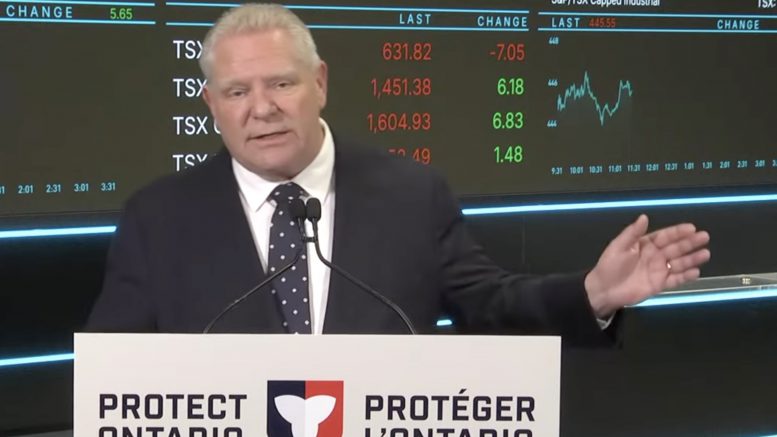
Ontario Premier Doug Ford is proposing new legislation to cut mining permit times in half, designate geographic areas for speedy treatment like the Ring of Fire by September and limit foreign ownership.
The new legislation announced on Thursday mentions Wyloo Metals’ Eagle’s Nest project by name. The proposed battery metals mine would be within a Ring of Fire special economic zone northeast of Thunder Bay and have its environmental assessment (EA) process, which the company had voluntarily advanced nearly 15 years ago, entirely removed because it’s out of date.
The province is considering about a dozen projects for rapid permits and approvals in a new “One Project, One Process” system where a provincial “account manager” would lead a project through the 32 permits across four ministries that might be required, as well as First Nations consultations. Officials see it knocking 18 months off approval times.
“We have the critical minerals the world needs and wants,” Ford said in a news conference Thursday at the Toronto Stock Exchange. “But for far too long, Ontario has been held back when it comes to unlocking this enormous potential, not by foreign competition, not by a lack of talent or resources. We’re being held back by our own processes. We’re being held back by red tape and endless delays.”
Ford had promised to create the economic zones like Ring of Fire and fast-track mining projects such as Eagle’s Nest during his re-election campaign in February as he confronted tariff threats from U.S. President Donald Trump hurting the province’s economy. The premier, with another majority government, has appointed Energy and Mines Minister Stephen Lecce to replace George Pirie and proposed the sweeping legislation destined to affect industries across the province from northern mines to the Ontario Place redevelopment on Toronto’s waterfront.
Zone components
A special economic zone could mean an area that includes one or several projects of critical or strategic importance, according to officials. The areas could include critical mineral projects as well as vital infrastructure projects. Any large economic opportunity – including a potential project to put a tunnel under the 401 Highway, Ford said – could be considered for a zone. The process and criteria are still being developed as the province moves towards making Ring of Fire the first of the zones, officials said.
Besides Eagle’s Nest, others on the province’s radar include Frontier Lithium’s (TSXV: FL; US-OTC: LITOF) PAK project, which received $120 million in federal support last month to be matched by a similar amount from Ontario; Canada Nickel’s (TSXV: CNC; US-OTC: CNIKF) flagship Crawford nickel sulphide project near Timmins; Generation Mining’s (TSX: GENM; US-OTC: GENMF) Marathon palladium-copper project; and Avalon Advanced Materials’ (TSX: AVL; US-OTC: AVLNF) Separation Rapids lithium project near Kenora.
Officials didn’t immediately reply to requests for a list of mining projects being considered for fast-tracking.
The EA process for Eagle’s Nest is being removed partly because the scope of the project has changed, like how Wyloo is proposing renewable energy on site to replace the need for a new electricity transmission line, provincial staff said. In general, mining projects don’t require EAs but some companies voluntarily propose them with the province for comprehensive coverage of environmental issues.
However, the EA process for the three all-season roads being proposed to access the Ring of Fire region, and led by local First Nations communities, will still proceed, the government said. That process has been ongoing for several years. The entire construction could still take nearly a decade and cost several billion dollars if measured against other projects.
15-year waits
Officials cited an average 15-year mine approval time in the province and the need to streamline projects where the time to receive one permit can vary between three months to more than two years. Businesses must submit environmental permission applications for review that can take up to a year for important projects (e.g., housing, transit, electrification infrastructure) and for certain sectors (e.g., construction and development, warehousing, mineral exploration and battery energy storage).
“We’re going to cut down the permit process by at least 50% which can mean a permit to be approved within 24 months, which is even quicker than the EU’s 27 months which they just reformed last month,” Lecce, the former education minister who at one time ran communications for former prime minister Stephen Harper, said at the same conference.
“This allows one project, one window,” Lecce said. “They come through the Ministry of Energy and Mines today, not 19 ministries for approvals. We shepherd the approvals right across the government enterprise so the end result is a streamlined, accelerated process.”
Foreign investors
Ontario also intends to crack down on foreign investors in mining and energy, including but not limited to those from China. The legislation would give the province new authority to suspend the Mining Lands Administration System, suspend or remove a registrant, deny the transfer of leases, or revoke a mining claim registration or lease to protect Canada’s mineral supply chain, according to officials.
Regarding the environment, the new legislation would streamline approvals for projects impacting certain species by adopting a “registration first” approach in place of the current permitting framework. Regulations to streamline environmental permissions would allow other types of activities to adopt the registration-first approach (such as permissions for construction site dewatering and stormwater systems), as long as they follow rules set out in regulation and, where required, have qualified professionals undertake certain assessments, the province said.
Ontario is removing fees for the Environmental Activity and Sector Registry (EASR), which staff estimate will save businesses about $2.6 million a year. The legislation implements a new regulation for certain designated municipal infrastructure projects that would save municipalities up to 18 months and eliminate environmental assessment requirements for 60 lower-risk projects types, (e.g., all municipal roads, new pumping stations, etc.) that are routinely completed by municipalities, officials said.
Be the first to comment on "Ontario to OK mines in half the time: Ford"