
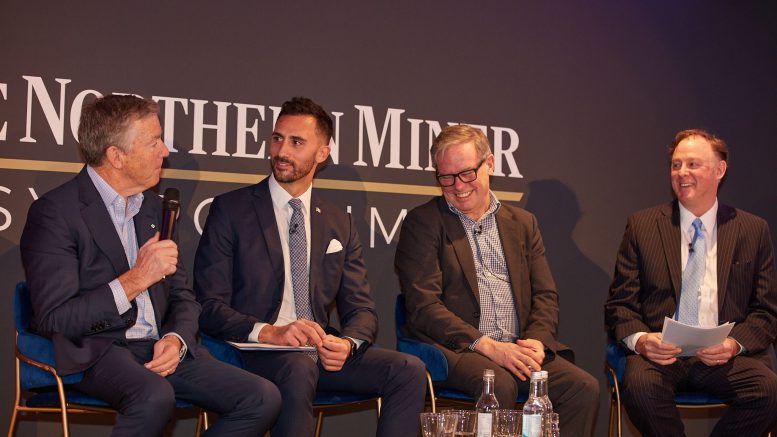
Ontario’s push to OK major projects in less than two years and keep more mineral processing at home stunned industry heavyweights at The Northern Miner’s International Metals Symposium in London.
“We’re moving with speed,” provincial Energy and Mines Minister Stephen Lecce told rapt conference delegates in early December. “One of the things that Ontario is determined to end is this propensity of the ripping and shipping of our raw materials to other industrialized economies, only for them to get the value-added jobs.”
Lecce’s remarks helped introduce a panel discussion of the province’s first entry into its One Project, One Process program: Frontier Lithium’s (TSXV: FL; US-OTC: LITOF) PAK project, which plans processing in Thunder Bay. And panellist Mark Selby, CEO of Canada Nickel (TSXV: CNC: US-OTC: CNIKF), explained how the company’s $3.5-billion (C$4.8-billion) Crawford project also plans local refining.
Ross Beaty, who founded Pan American Silver (TSX, Nasdaq: PAAS) and Equinox Gold (TSX, NYSE-A: EQX) before being named to the Canadian Mining Hall of Fame, appeared dumbfounded after hearing Lecce’s double-tracked full-tilt approach.
“I’ve never, ever, ever heard a politician make such supportive comments as you made this morning about mining,” said panellist Beaty, who’s worked for decades in jurisdictions around the planet. “We’re used to battling the regulators and battling permitters and battling all kinds of people in all kinds of places. And it’s just so refreshing to hear this breath of fresh air.”
Priority
The political willingness to prioritize mining investment comes at a time when Western governments are under pressure to secure domestic supplies of critical minerals and reduce reliance on China-dominated supply chains. There’s also a new urgency for resource self-sufficiency when Trump administration tariffs are pitted against its biggest trading partner, Canada.
Frontier’s PAK project in the province’s northwest is expected to require about C$943 million to build and is designed as a 31-year operation producing spodumene concentrate for conversion into battery-grade lithium chemicals. The company is targeting a final investment decision this decade, with first production early in the 2030s.
“It just made sense to get to ‘yes’ on this project,” Lecce said. “It includes a large mine. It includes a mill and downstream conversion. It really is the full ecosystem of production in the province.”
Selby said the same logic applies to Canada Nickel’s Crawford nickel sulphide project near Timmins, one of the largest undeveloped nickel deposits globally. Crawford has been nominated to Ottawa’s Major Projects Office, a federal mechanism intended to co-ordinate permitting and financing for nationally significant developments.
“Where we’ll really get some help is twofold,” Selby said of the federal designation. “One in terms of financing, and the second in terms of permitting. The goal for us right now is we want to break ground by Christmas time in 2026.”
Financing
Canada Nickel expects to fund the roughly $2-billion first stage of its Crawford project through a mix of cornerstone investors, government incentives and $1 billion in debt financing already secured through Export Development Canada and other agencies.
Strategic shareholders include Agnico Eagle Mines (TSX, NYSE: AEM), Anglo American (LSE: AAL) and Samsung SDI. The South Korean company would receive up to 30% of offtake in exchange for 10% project-level equity, while federal investment tax credits may reduce the equity burden by as much as US$600 million, Selby said.
The remaining equity requirement is relatively modest at US$300 million, he said. A mix of other government funding programs may provide a further $US100 million to US$200 million in funding.
The government programs include Canada’s 30% critical minerals refundable tax credit and a separate carbon-capture incentive worth up to 50% of eligible spending, reflecting Crawford’s proposal to permanently store as much as 1.5 million tonnes of carbon dioxide annually.
Indonesia
That contrasts with how much of today’s supply comes from the world’s top nickel producer Indonesia, where coal-powered laterite processing backed by Chinese capital has allowed rapid growth but at a steep environmental cost.
Beaty broadened the discussion, arguing that the issue extends far beyond nickel. China, he said, dominates production or processing of most industrial metals, from copper and aluminium to lithium, cobalt and manganese, largely because of low-cost energy and decades of state-backed investment.
“How are our smelters and refiners going to beat China on cost?” Beaty said. “It’s a real tough, tough issue without a pile of government support, which, quite frankly, is usually not very sustainable” if elections change policy, he said.
Power grid
Lecce said Ontario is trying to address those structural issues through an integrated approach that links mining, energy and infrastructure planning. The province has committed to 1,500 km of new transmission lines in northern Ontario and is advancing plans for additional hydroelectric and nuclear power generation to support future mines and processing facilities.
He also pointed to growing interest from allied governments, including the United States, in securing supplies of high-grade nickel for industrial and defence applications, a dynamic that could further strengthen the case for projects like Crawford.
Selby said the nickel market is already showing early signs of differentiation, particularly in North America, where premiums reflect a mix of local supply, product form and sustainability attributes. In Europe, he added, carbon border mechanisms tied to steel production are likely to reinforce demand for lower-emissions nickel over time.
While industry challenges remain, particularly around global pricing and competition from state-backed producers, Selby said government “talking is stopping” in favour of working. Beaty mentioned Ontario’s new approach is “music to his ears” even after the recent smooth start of Equinox’s Greenstone mine north of Lake Superior.
“I kind of wish I was developing a new mine in Ontario right now,” Beaty said. “We’ve had a great experience there.”



Be the first to comment on "London Symposium: Ontario’s focus on fast-track, refining wins industry praise "