
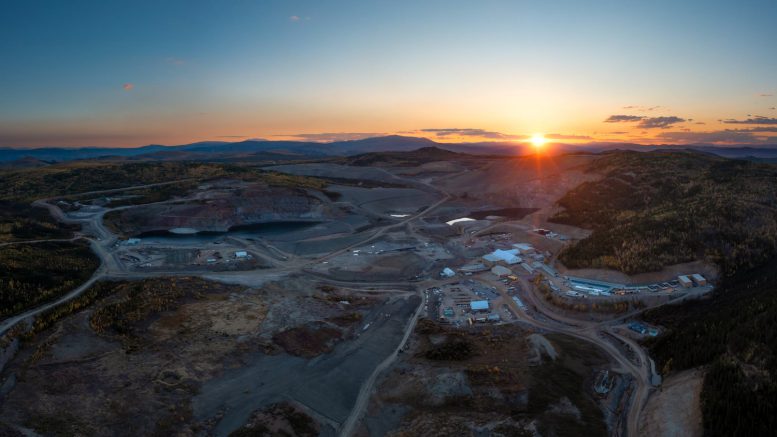
Selkirk Copper Mines (TSXV: SCMI) is pushing to restart Yukon’s former Minto copper-gold mine by 2028, a move that would test whether First Nations ownership can shift Canadian mining beyond impact benefit agreements (IBAs) toward equity and control.
The Selkirk First Nation bought the idled mine last year from receivership for $6.1 million (US$4.5 million) after Pembridge Resources walked away in 2023. The Nation said the purchase gave it access to more than $300 million in infrastructure and a permitted site on which it plans to make a redevelopment decision by mid-2027.
The deal comes as First Nations across Canada push for bigger ownership stakes in major projects, a trend tracked by the First Nations Major Projects Coalition (FNMPC), a national Indigenous-led group with 186 members – though not Selkirk.
“Those kinds of positions were rare until affordable capital became available,” Mark Podlasly, CEO of the FNMPC, said in a phone interview, noting Selkirk’s Minto acquisition as an example of the broader national shift toward Indigenous equity in mining.
Rare opportunity
Equity is increasingly attractive for all parties as social and environmental risk rises, consultant Qasim Saddique, a principal at Toronto-based project manager Suslop, said in an interview.
“It’s a win for the Indigenous nations because they have a pathway towards economic reconciliation, for governments that would like to see a transformation of the social structure and they would like to enable reconciliation, and for mining companies that see social risk escalate and environmental issues become more significant,” Saddique said.
International groups are now approaching First Nations directly as they look to secure critical minerals from Canada, Podlasly said.
Globally, the closest analogue is Teck Resources’ (TSX: TECK.A/TECK.B; NYSE: TECK) Red Dog mine in Alaska, which operates under a long-running lease-and-royalty agreement with local land owner the NANA Regional Corp. of 11 Indigenous communities. In New Caledonia, a French territory in the southwest Pacific, Glencore’s (LSE: GLEN) Koniambo nickel operation is 51% owned by the Kanak-dominated Northern Province.
Selkirk’s ownership also counters the idea that Indigenous communities are opposed to development, said Heather Exner-Pirot, senior fellow and director of natural resources, energy and environment at the Macdonald-Laurier Institute.
“They are opposed to being left out and opposed to having environmental damage that isn’t mitigated,” she said.
In some cases, Podlasly added, First Nation equity in mining projects can potentially reduce consultation risk and speed up permitting when a Nation becomes a co-investor.
“If a First Nation becomes an investor in a project, that effectively means they’re a co-proponent, and as a co-proponent, it’s very hard for the Nation to argue that it has not given consent,” he said. “In that logic, equity can be seen as a proxy for consent.”
IBAs vs. equity
Unlike IBAs, which typically focus on jobs, training and procurement, equity gives First Nations a direct ownership stake and commercial return.
That model is gaining traction as Ottawa’s $10-billion Indigenous loan-guarantee program and provincial programs in Alberta, Ontario, B.C. and Saskatchewan lower borrowing costs and make ownership stakes easier to finance.
Under the colonial-era Indian Act, reserve lands are held by the Crown for a band’s use, and on-reserve property generally can’t be pledged to outside lenders, limiting collateral and raising borrowing costs.
Selkirk, which has a market cap of $144 million, is seeking to restart a mine that produced 500 million lb. of copper over 16 years.
Norway House Cree Nation has taken full ownership of Manitoba’s Minago nickel project through Minago Development. Taykwa Tagamou Nation has invested in Ontario’s Canada Nickel (TSXV: CNC; US-OTC: CNIKF) in a deal that could lead to a minority stake, while Denendeh Exploration and Mining has advanced Dene-owned exploration assets in the Northwest Territories.
Restart plan
The Selkirk First Nation is looking for ways to improve the Minto mine plan and use existing infrastructure more efficiently, Selkirk president and CEO Colin Joudrie said in a February interview.
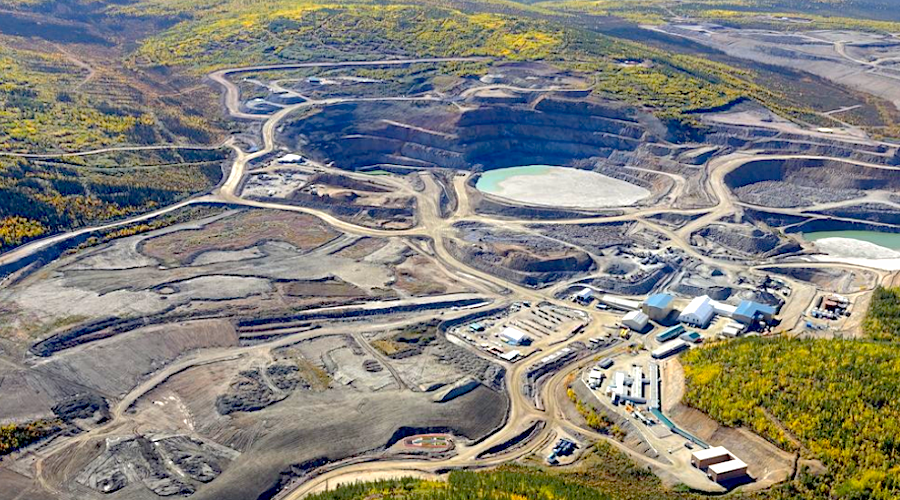
The Selkirk First Nation owns and plans to operate the former Minto mine in the Yukon. Credit: Minto Metals/PwC (Click image to enlarge)
“We’re trying to think about how we can do a restart and where we can invest additional dollars to make it more cost effective, more cost efficient and then also more productive,” he said. “It’s really important that we have an integrated mine plan here that gives us the opportunity to present ore to the mill in the most efficient and thoughtful way.”
Engineering firm Hatch and SRK Consulting are due to report next quarter on processing facilities, mine development, tailings and water management. Yukon’s Department of Energy, Mines and Resources has said Minto’s existing licences still apply and Selkirk expects to have most additional approvals in hand before its mid-2027 restart decision.
A 2025 resource estimate outlined 12.6 million indicated tonnes grading 1.2% copper, 0.46 gram gold per tonne and 4.27 grams silver for 167,000 tonnes of contained copper. Inferred resources total 23.7 million tonnes grading 1.05% copper, 0.39 gram gold and 3.9 grams silver, representing about 273,500 tonnes of copper.
Beyond a possible 15-year mine life at Minto, Joudrie said Selkirk’s land package offers room to grow. The Selkirk controls roughly 270 sq. km of claims in the Minto-Carmacks belt and is drilling to build a new resource base.
Drilling highlights
Assays released Feb. 19 strengthened Selkirk’s restart case with higher-grade results from both Minto East and Minto North West. At Minto East, hole 25SCM042 returned 15.2 metres grading 2.5% copper, 1.16 grams gold per tonne and 9.9 grams silver from 101.3 metres depth, including 6.5 metres at 3.37% copper, 1.88 grams gold and 14.96 grams silver.
At Minto North West, hole 25SCM043 cut 32.9 metres grading 2.09% copper, 1.84 grams gold and 9.48 grams silver from 195.9 metres, including 16.7 metres at 3.52% copper, 3.51 grams gold and 17.04 grams silver.
Ridgetop drilling continued to expand shallow mineralization south and southwest of the current open-pit resource, while Minto North West remains open to the north and south, the company said. As of Feb. 12, Selkirk had completed 39,315 metres in 144 holes, or 78% of its planned 50,000-metre Phase 1 program, with four rigs active and completion targeted by mid-March.
Earlier January results from Ridgetop and Minto North West had already pointed to stacked and open mineralized lenses beneath and beside the existing pit.
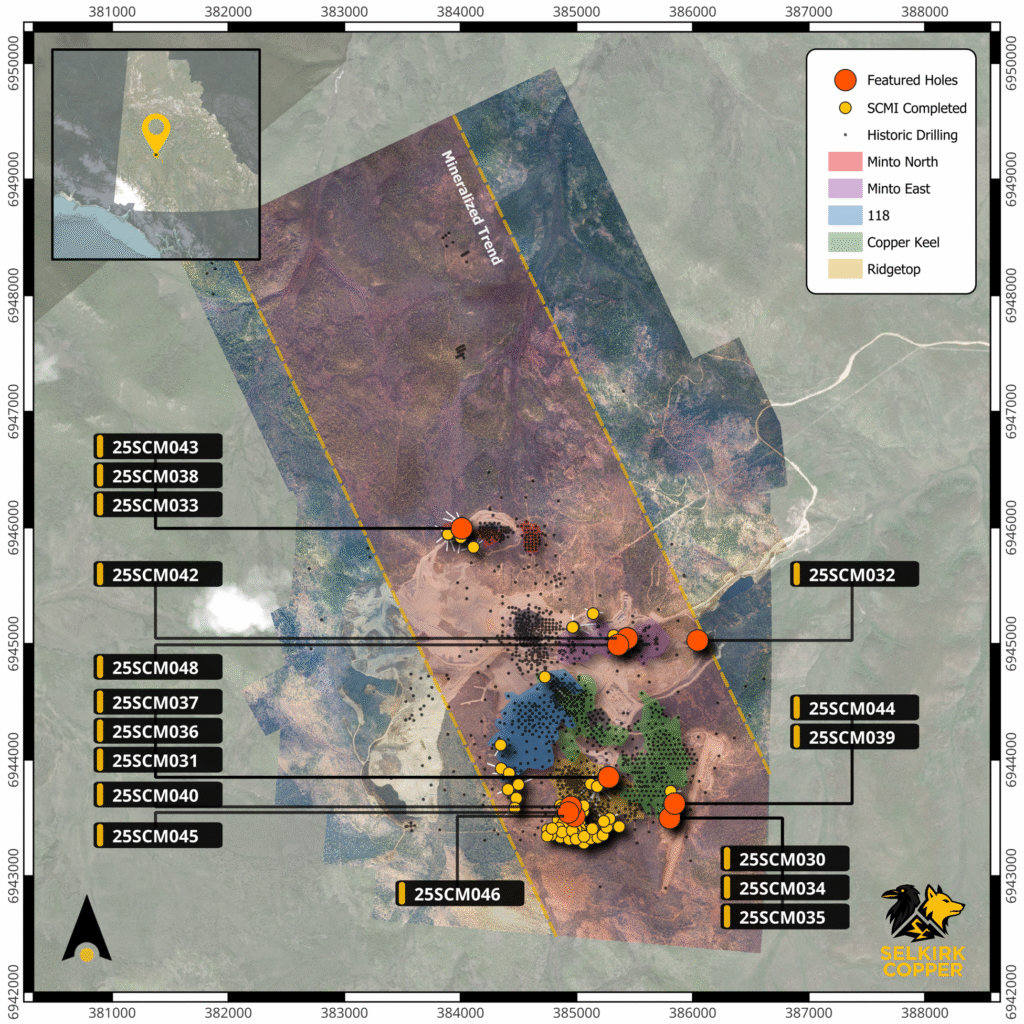
A plan map showing the Minto mine deposits and recent drill collars. Credit: Selkirk Copper
“The drilling program and the results of the program are actually going exactly as we had hoped,” Joudrie said.
The company has drilled about 32,000 metres so far and plans another 18,000 metres this year at Minto East, Copper Keel, Ridgetop and Minto North.
“We have the opportunity to go and explore, quite honestly, for the first time in decades, in a very deliberate, well-informed, geoscience-led exploration methodology,” he said. “There’s a lot of potential for additional discoveries.”
Be the first to comment on "Minto restart plan puts First Nation equity model into national focus"