
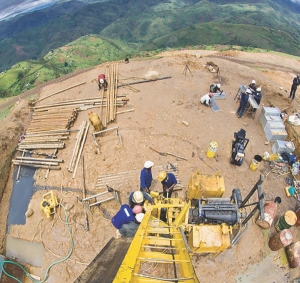
The dog days of August haven’t slowed down the pace of mining deals in mineral-rich Democratic Republic of the Congo (DRC).
The war-torn country — where atrocities continue in the east, along its border with Rwanda — made positive steps towards igniting an economic renaissance in early August by getting closer to finishing its much-delayed mining contract review.
But as with most news that comes out of the DRC, the latest round was a mixed bag for Western miners.
For AngloGold Ashanti (AU-N, AGD-L), Banro (BAA-T, BAA-X), Mwana Africa (MWA-L, MWNAF-O), and Gold Fields (GFI-N, GFI-J), the news was good, as the government approved their mining contracts.
That good news, no doubt, underlined the wisdom of Randgold Resources (GOLD-Q , RRS-L) and AngloGold’s $546-million bid for Moto Goldmines (MGL-T, MTOGF-O), which controls the gold-rich Moto portion of the Kilo-Moto gold belt in northeastern DRC.
Surprisingly, perhaps, the positive news of the mining contract approvals failed to inspire a market rally around the awarded companies.
Since the day before the news was released on Aug. 5, Banro shares have fallen 10% to $2.30; AngloGold Ashanti’s shares 10% to US$35.69; Gold Fields shares 8% to US$11.58; and Randgold shares 8% to $57.38. Only Mwana has been able to buck the downward trend, gaining 7% to 6.25. Mwana, however, is also the most diversified of the group in terms of metal plays.
The fall-off in price of the gold-focused companies coincided with a 2% decrease in the price of gold over the same period.
The mining contract review was launched in 2007 in an attempt to correct any bad deals stuck in the chaos of the 1998- 2003 DRC civil war.
And while news associated with the review was not as good for Vancouver-based First Quantum Minerals (FM-T, FQVLF-O), analysts say the company is strong enough to weather the storm.
In early August, an official from the DRC’s Mines Ministry said the company’s mining contract at the Kolwezi copper mine would be cancelled because the project was not put into production on time, as outlined in the original agreement signed by Kolwezi’s former owner Adastra back in 2004. First Quantum acquired Adastra in 2006 for $273 million.
While First Quantum president Clive Newall says the company has had phone conversations with the government over the issue, he says no official notification has come from the government.
“We have nothing to respond to until we receive notification,” Newall said of the issue on a conference call. “I can’t comment on what we might or might not do. . . we have to keep this thing private for the moment and we will let you know as soon as we can.”
Newall did say the company’s legal counsel has assured it that First Quantum has not breached the original contract in any way.
Fortunately for First Quantum, the market hasn’t deemed the roughly 23,000 tonnes of copper per year that Kolwezi was slated to produce starting next year as overly significant when compared with the 320,000 tonnes of copper the company is on track to produce this year.
With only 78 million shares outstanding and a proven track record for operating in central Africa, First Quantum has shown remarkable market cap growth of late.
Desjardins Securities analyst John Hughes says the company has grabbed the mantle as the TSX’s best pure copper play — fulfilling a role similar to that of Freeport-McMoRan Copper & Gold (FCX-N) in the U. S.
“First Quantum has another $20 to go on its share price before it starts to reflect US$3-per-pound copper,” Hughes says. He has set his target price for First Quantum at $98.65 per share.
The company’s second-quarter financials support Hughes’ bullishness. First Quantum’s earnings per share of $1.31 beat the Street’s expectation of $1.15 per share — and that was with a non-cash $37- million loss taken out due to its hedge book.
The company’s hedge book should be closed by the end of the year.
Still, whether it was bad news from the DRC or simply profit-taking, First Quantum’s shares were off 10% on the announcement of the cancellation.
Two other base metal miners being watched closely by market observers in the DRC are Freeport and Lundin Mining (LUN-T, LUNMF-O).
The two companies are part owners, along with DRC state-run Gcamines, in the massive Tenke Fungurume copper project.
Government officials in early August said no decision had been made on the contract but that the matter had to be resolved within two months.
Officials in the past have said the government wants to return to the original contract signed between the government and Lundin back in 1996. That contract gave Gcamines a 45% stake and came with a $250-million signing bonus to the government.
The deal was amended in 2005, reducing the signing bonus to $100 million and Gcamines’ stake to 17.5%. But with those reductions came a 30% corporate tax rate, a 2.5% royalty and a 1% export tax. The net result of the changes should mean more cash flowing into government coffers than in the original deal.
As currently configured, Freeport has a 57.75% stake in Tenke, with Lundin holding 24.75% and Gcamines picking up the rest.
As two of the largest mining projects in the country, getting deals done on Tenke and Kolwezi will be more difficult as the government angles to get as much as it can without killing the projects all together.
The Chinese presence in the region is another factor to bear in mind. It is no secret that the Chinese government covets the DRC’s mineral assets, especially its base metals. It is currently in the process of a massive infrastructure buildup in the country, spending some US$9 billion with the understanding that it will gain access to some of the country’s deposits in return.
At presstime, Freeport’s shares were trading at US$61.72 apiece, down 4% from the US$64.50 it touched before news of the mining review was released. Lundin shares were up 8% over the same time span.
But it wasn’t all dour news for copper projects in the country.
Anvil Mining (AVM-T, AVM-A) announced on Aug. 10 that it will be able to restart the development of its Kinsevere copper project thanks to US$200 million in funding.
The money will come from metals trader Trafigura Beheer and puts Anvil in a position to finish the project by late next year.
Anvil touts the deal as a key strategic move, saying that with Trafigura on board, it expects to become a bigger player on the Congo’s base metals scene.
“There’s the expectation that in the fullness of time, Trafigura will get to a 36% position in Anvil and a desire to see Anvil go on to become what it can become in the Congo,” Anvil’s president and chief executive Bill Turner said on conference call.
While Turner admitted that the deal is complex — it involves debt, equity and offtake agreements — he said it was by far the best offer on the table.
It remains to be seen if Anvil shareholders feel the same way.
While the first tranche of equity is being issued to Trafigura without shareholder approval, a vote on the other aspects of the deal will take place at a shareholders’ meeting in October.
And while raising US$200 million for a project in the DRC may seem like a slam dunk, investors might give pause to the amount of control being handed over to Trafigura.
Trafigura will get a life-of-mine offtake agreement for the sale of all products from the Kinsevere mine should the deal be approved and will get to nominate three of seven directors to the Anvil’s board.
The US$100-million equity portion of the deal prices units at $2.20, and they consist of one share and 0.232 of a warrant — a whole warrant giving Trafigura the option to buy shares at $2.75 each for 30 months.
The US$100 million in debt financing being provided by Trafigura can only be tapped into once cash
from the equity financing is used up.
The debt bears interest of LIBOR plus 4%, plus the cost of political risk insurance.
As is generally the rule, the debt financing comes with a hedge book. Anvil says it will hedge enough production to cover principal, interest repayments and operating costs. Details of the hedge book, however, haven’t been finalized.
Stage two of Kinsevere’s development is slated to produce 60,000 tonnes of copper per year from a solvent extraction-electrowinning (SX-EW) facility at an estimated cash cost of US89¢ per lb. of copper.
Anvil expects to begin commissioning the mine in late 2010, with commercial production coming in 2011.
The market applauded the transaction, announced on Aug. 10, sending Anvil’s shares up 16% or 39¢ to $2.77 on 7.9 million shares traded.
The picture on the gold side of mining in the DRC is also coming into clearer focus. Outside of the contract approvals for AngloGold Ashanti, Gold Fields and Banro, a deal for Moto Goldmines was all but sealed in early August.
Moto’s mining contract was one of the first to be approved by the government, allowing it to get a head start in the acquisition game. Things got rolling for Moto in the beginning of June, when Red Back Mining (RBI-T, RBIFF-O) made a $513-million offer for the company.
Red Back is headed by Lukas Lundin, who is also chairman of Lundin Mining, and whose late father, Adolf Lundin, had long been active in the country’s mineral sector.
Despite such deep ties with the Congo, Lukas has been thwarted as of late.
While the development of Tenke Fungurume remains on hold, Red Back’s offer for Moto was outstripped by a superior bid from Randgold Resources and Anglo- Gold Ashanti.
Red Back announced on Aug. 5 that it was withdrawing its bid, likely realizing that Randgold and AngloGold were just too big and well connected in the country to beat.
For its troubles, Red Back did manage to net $15.25 million — which Moto will have to pay as a break fee.
On Aug. 5, the day Red Back announced its withdrawal — its shares climbed 5% or 47¢ to $10.69 on 1.6 million shares traded while Moto’s stock dropped 4% to finish at $4.81.
As for the other key gold junior in the region, Banro, the government’s approval of its mining contract confirms what the company has been saying for many months — mainly that it received word back in February that the government was content with its contract.
Still, the official approval will help the company raise the financing it needs to push ahead on its Twangiza gold mine. Twangiza has a $377-million price tag that goes up to $444 million if Banro funds half the cost of a new hydroelectric power plant, something it is considering.
Twangiza hosts proven and probable reserves of 82 million tonnes grading 1.71 grams gold for 4.54 million oz.
Banro’s founder and current vice-president, Arnold Kondrat, continues to build his position in the country, both through Banro and through Loncor Resources (LN-V, LNRFF-O). Loncor, which recently closed a private placement of 3 million shares at 75¢ apiece for a total of $2.25 million, has gold and platinum exploration grounds 200 km north of the city of Goma, in the eastern DRC.
Loncor shares have had an impressive run during the recent commodity rally, gaining 600% since March 30, to $1.05 from 15¢.
Be the first to comment on "Mining Sector Heats Up In DRC"