
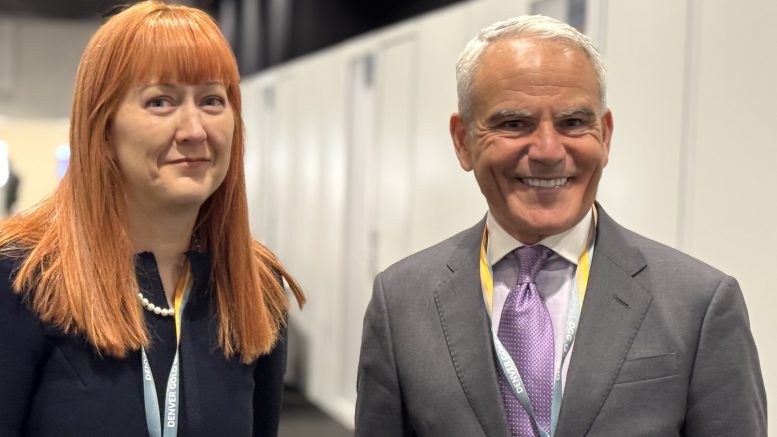
Colorado Springs, Colo. – Gold Royalty (NYSE American: GROY) has started generating free cash flow and is focusing on Quebec’s Abitibi region for its next leg of growth, executive chairman and CEO David Garofalo says.
Cornerstone royalties include Agnico Eagle Mines’ (TSX: AEM; NYSE: AEM) Canadian Malartic Odyssey underground complex in Quebec, plus Iamgold’s (TSX: IMG; NYSE: IAG) Ontario-based Côté and Nevada Gold Mines’ Ren deposit at Goldstrike, which is owned 61.5% by Barrick Gold (TSX: ABX; NYSE: GOLD) and 38.5% by Newmont (NYSE: NEM). The company sees a clear runway to meaningfully higher gold-equivalent ounces (GEOs) through 2030.
“We’re over the hump into free cash flow,” he told The Northern Miner. “Odyssey is a keystone for us.”
Quebec anchor
Gold Royalty’s Quebec weighting is deliberate, Garofalo says. The company holds a 3% net smelter return (NSR) royalty on Odyssey North, most of East Malartic and parts of Odyssey South/Norrie – plus a 1.5% NSR on the nearby Midway project to the east.
At Odyssey, Agnico is transitioning the Canadian Malartic mine from Canada’s largest gold open pit to one of the country’s most consequential underground operations. First ore via ramp from the top of the East Gouldie deposit is expected in the second half of next year, with first ore via the hoisting shaft about 12 months later. A shaft extension and a second shaft are under study to add capacity.
That Quebec backbone fits Gold Royalty’s house view: prioritize tier-one jurisdictions with strong rule of law and contract enforceability. “Our business is a stack of contracts,” Garofalo said. “You want to be where paper is protected.”
Balance sheet first
That buoyant free cash flow will be earmarked first for debt reduction, Garofalo said. A $40-million (C$55.7 million) unsecured convertible debenture, which matures in 2028, will become callable by Gold Royalty in late 2026.
“They’re deeply in the money, so we can effectively force conversion at the end of next year,” he said of the bonds.
The company also expects to repay short-term borrowings – representing about one-third of its $75-million revolving credit facility – out of free cash flow by the end of next year. Garofalo calls the facility Gold Royalty’s “credit card” for quick transactions.
“We expect to be completely debt-free by the end of 2026,” Garofalo said. “At that point we’ll actively contemplate returns of capital, whether buybacks or a dividend – whatever makes most economic sense.”
Gold Royalty’s corporate costs average about $7–8 million a year, while gold-equivalent ounces are projected to grow sharply to 30,000 oz. from already-owned assets. “Our costs are largely fixed,” the CEO said. “As volume grows – and if gold prices cooperate – every incremental dollar drops through.”
Growth drivers
Besides the big growth drivers of Odyssey, Côté and Ren, several smaller contributors are strengthening the base.
Aura Minerals’ (TSX: ORA; Nasdaq: AUGO) Borborema mine in Brazil and Dundee Precious Metals’ (TSX: DPM) Vareš mine in Bosnia and Herzegovina – where Gold Royalty holds a copper stream – have both entered production, with the operators contemplating expansions, Garofalo said.
He also pointed to Orla Mining’s (TSX: OLA) South Railroad project in Nevada, which is advancing through permitting, and to organic royalty-generation successes such as Blackrock Silver’s (TSXV: BRC; US-OTC: BKRRF) Tonopah West, which Gold Royalty staked in 2021 and farmed out last year for cash plus a royalty.
“That could be in production before the end of the decade – warp speed by mining standards,” he said.
Why royalties
Garofalo calls the royalty model “free optionality”: top-line NSR exposure fully paid with no capital calls, direct leverage to the gold price and operator-funded growth.
He cites roughly $200 million per year of exploration on ground covered by Gold Royalty’s agreements in recent years – spending that the company doesn’t fund – alongside the model’s scalability.
Even with about 14 employees, Gold Royalty can manage hundreds of assets across the Americas, smoothing risk without diluting upside. “There’s no practical cap on how many royalties you can manage with a small team, as opposed to a major that can only manage effectively a set number of mines.”
Consolidation
The royalty space remains fragmented and periodically ripe for consolidation when equity markets reward scale. That’s a playbook Gold Royalty followed in 2021 by rolling up peer Ely Gold Royalties, to add the Ren royalty package and a larger U.S. pipeline, and merging with Abitibi Royalties and Golden Valley Mines to secure its cornerstone Quebec exposure at Canadian Malartic/Odyssey – all of which bolstered near-term cash flow and scale.
While the company remains more than 90% gold-focused, it is comfortable in polymetallic systems such as gold-copper porphyries and volcanogenic massive sulphide camps, where its team has deep operating experience.
“We have royalties in three of the five biggest producing gold mines in North America,” Garofalo said. “So, we have a foundational, cornerstone element to our portfolio that’s really the envy of our peers in the small-cap universe and it means we’ll have an annuity from those assets for decades to come.”
Be the first to comment on "Mining Forum Americas: Garofalo’s Gold Royalty the ‘envy of our peers’"