
The phones have been ringing off the hook at Blanchard & Co., the biggest bullion dealer in the United States as investors buy up gold coins and bars like never before amidst the market meltdown.
The increase has come from both new and existing clients with business five times busier than normal, says Blanchard’s vice-president of economic research, David Beahm.
“We always see an uptick when people are looking for safe assets but we’ve never seen anything like this before,” said Beahm from his office in New Orleans, La. “Investors are incredibly nervous about what’s going on in the market and they realize that gold is a safe haven.”
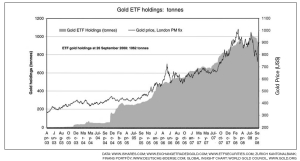
Investors have never had as much money in gold exchange-traded funds (ETFs) either. According to the London, U. K.-based World Gold Council, gold holdings in ETFs grew to a record-setting 1,062 tonnes as of Sept. 26.
Jill Leyland, WGC economic adviser, says the rise in oil and other commodities made people worry about inflation, prompting smaller investors to buy coins and ETFs as a dollar hedge and an inflation hedge.
“It’s an easier way for retail investors to get into the market,” Leyland says. “Even when the crisis is resolved, it’s going to have a horrendous impact on government budgets, so all this is going to lead to more people being aware of the value of safe havens.”
The U. S. Mint is having trouble keeping up with the demand, temporarily suspending sales of its American Buffalo 24-karat, 1-oz. gold coins on Sept. 26 and American Eagle gold coins in August after the spike in demand depleted inventories.
Clients can still purchase physical gold according to the price of the day, but Beahm says it’s taking up to a week for delivery instead of the usual two days.
He likens the current situation to the stock market crash of 1987. “People are pulling their money out of paper assets and putting it in tangible assets.”
But Jon Nadler, a senior analyst at Kitco Bullion Dealers in Montreal, says that while the volume is similar, the transactions are going both ways, with more buying and selling.
“There’s no comparison to what happened in 1980 and 1987 or Y2K,” Nadler says. “This is not a one-way street where people are lining up at 5 a. m. to clear out the vaults of the bullion dealer; that panic has not manifested itself yet.”
The gold price has been on a roller-coaster ride falling from above US$900 an oz. at the end of July to as low as US$740 on Sept. 11, back up to the US$900-level at the end of September.
“Volatility on that scale will motivate people to jump in,” Nadler says. “But we are not going to go out and say this is the end of the world.”
But that was a few days before the US$700-billion bailout package, expected to restore liquidity and confidence in the financial sector, was rejected by the U. S. Congress — sending stock markets around the world into a tailspin. In response to the rejection, Nadler commented on the surge in gold, up US$25 to US$903 per oz. “(Gold has) stepped into its safe-haven combat boots as the lone standout in precious metals today.”
But gold fell US$22 in New York the next morning to US$880 an oz. as stocks rebounded. Nadler says this shows investors know the financial crisis will eventually subside and that there will be a reduced need for safe-haven holdings.
“There is fear and loathing all over Main Street, Wall Street, and Capitol Hill but there are also those who are calling this tempest one of teapot-sized magnitude,” he wrote in his daily commentary.
Still, the fundamentals for gold will remain strong, Leyland says.
“Supply is constrained, mine output has stagnated, central banks are selling less of it, so we haven’t got as much coming on to the market,” he says. “We’ve had this longer-term trend of investors picking up gold more over the last few years.”
Beahm also expects people will continue buying physical gold from Blanchard. “I think a lot of it has to do with nobody knows what’s behind the closed door. . . We don’t know who’s going to be around on Monday.”
Leyland says investors first started to get back into gold at the turn of the last decade over concerns about debt, the weakening dollar and declining stock exchanges. Leyland says the subprime mortgage crisis that hit in August 2007 encouraged even more people to turn to gold.
“That eventually pushed gold up over US$1,000 per oz. in March,” Leyland explains.
The gold price retreated, but then fear of a global slowdown mounted as commodity prices fell and the dollar grew stronger this summer. Leyland says only certain investors exited gold at that time. “The more short-term speculative investors bailed out,” Leyland says. “That was when the price fell under US$800.”
The low price sparked interest from jewelry buyers in India and the Middle East, Leyland says, followed by a spike in demand for coins in the U. S. after major entities such as Lehman Brothers and American Insurance Group went bust.
And it’s agreed across the board that the interest in buying physical gold will continue while many are forecasting gold will again top US$1,000 per oz. before the end of the year — but only temporarily.
“There could be this jitters-induced spike,” Nadler says. “You could see the four digits before this year closes out, it’s not impossible, but it would have to take something bigger than what we’ve had thus far.”
Be the first to comment on "Market jitters set off gold-buying frenzy"