
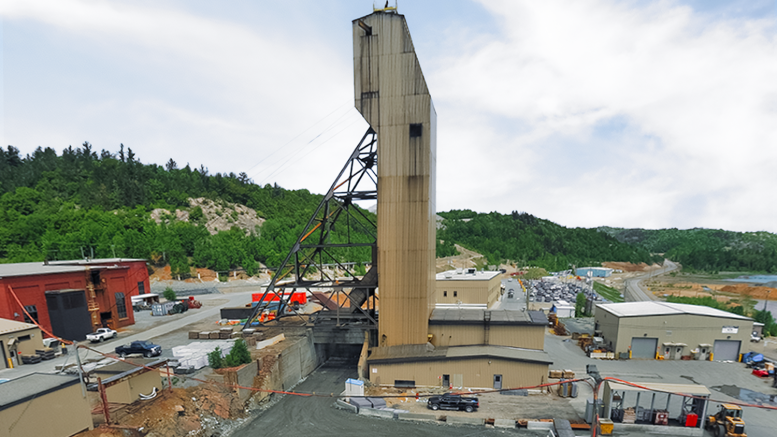
Magna Mining (TSXV: NICU; US-OTC: MGMNF) is reporting more strong assays from drilling at its historic Levack nickel-copper mine near Sudbury, Ont., reinforcing the high-grade potential of the footwall deposit first discovered in 2005.
Results from about 135 to 155 metres from the surface include hole MLV-25-21, Magna said this week. It returned 2.3% nickel, 0.7% copper and 0.3 gram platinum, palladium and gold per tonne over 28 metres, including 3.3% nickel, 1% copper and 0.5 gram platinum-palladium-gold per tonne over 12.4 metres.
“Drilling in this area will provide the data required to advance the Levack restart study and provide appropriate drill density to support the higher level of geological confidence required for our upcoming mineral resource estimate,” Dave King, senior vice-president for exploration and geoscience, said in a release. “There are significant areas of wide, high grade nickel mineralization at shallow depths remaining at the Levack mine.”
Shares in Magna Mining gained 9.8% this week to $1.90 apiece on Thursday, valuing the company at $395 million. They’ve traded in a 52-week range of 68¢ to $1.96.
A restart may be in the works for Levack as global demand for nickel strengthens, driven by stainless steel production and the accelerating shift to electric vehicles fed from stable jurisdictions such as Canada. The trend is prompting producers to reassess past-producing mines with established infrastructure, as higher long-term price forecasts and improved extraction technology make previously uneconomic deposits viable again.
Drills on site
Magna has two surface diamond drills operating on site. One is completing near surface infill and metallurgical holes on the No. 1 and No. 2 and Main zones. The second drill is exploring the footwall environment between the #3 nickel-copper zone and the Morrison copper-PGE deposit. A third underground drill will be added by year end to test a downdip, on-strike area below the No. 3 zone.
Underground drilling plans to also follow up on the east side of the Fecunis fault, where historical hole FNX21200 intersected 33.4% copper, 0.9% nickel and 23.9 grams over 0.2 metre. This area is interpreted as potentially having a vertical vein system, subparallel to the Fecunis fault.
Historical records show Levack produced about 60 million tons (54.4 million tonnes) of ore between 1937 and 1997, averaging grades of around 1.3% copper, 2% nickel and 1.5 grams per tonne of platinum group metals plus gold. In its modern-era production stage, Levack delivered 411,000 tonnes of ore grading roughly 0.5% copper and 1.3% nickel during its commercial operation from 2006 to 2008.
Besides Levack, Magna has three more permitted mining projects – Crean Hill, Podolsky and Shakespeare. Magna also operates the McCreedy West mine adjacent to Levack and the two underground developments are connected via haulage drift on the 1600 level.
Magna anticipates producing between 4.7 million and 5.6 million lb. payable copper equivalent per quarter in this year’s second half, the company said last month. It’s based on planned ore sales of 80,000 to 92,000 tonnes and grades that improve to 3.8–4.4% in the fourth quarter from 2.9–3.4% now.
Be the first to comment on "Magna cuts 2.3% nickel near Sudbury"