
Since optioning the Quinchia gold project in Colombia in May, Tiger Gold has updated historical resources to Canada’s NI 43-101 standards, published a preliminary economic assessment, raised over $23 million and kicked off a 10,000-metre drill program. A listing on the Toronto Venture Exchange is expected in the coming weeks.
“We’ve done a lot of heavy lifting and now we want to focus on drilling to work towards a better understanding of the geology,” says CEO Robert Vallis. “There is something at depth feeding all of this and we need to get some geology questions answered about the genesis of these deposits to better understand the scope, scale and potential of the resources.”
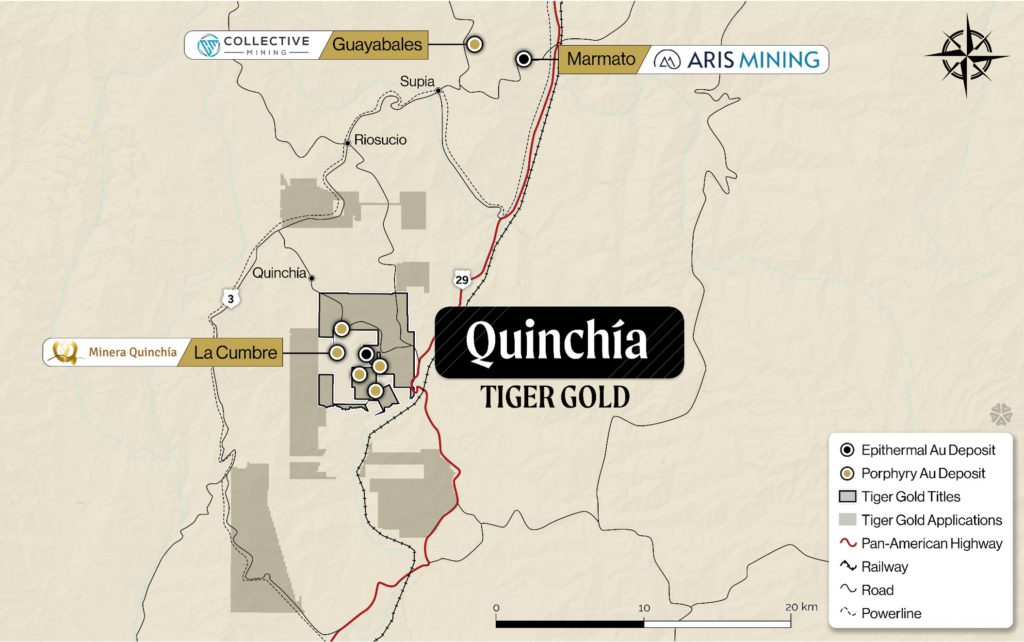
The project lies in Colombia’s Mid-Cauca region, a prolific porphyry belt that hosts several multi-million-ounce gold and copper projects, including Aris Mining’s (TSX: ARIS; NYSE-A: ARMN) Marmato mine and Collective Mining’s (TSX: CNL; NYSE: CNL) Guayables project, about 20 km from Quinchia.
Tiger Gold will focus on resource definition, extension and discovery drilling in two successive 10,000-metre programs over the next 12 months. Each campaign will have up to three drills turning under the guidance of exploration manager Cesar Garcia. The former senior geologist at AngloGold Ashanti (NYSE: AU) was part of the team in 2017 that discovered the 7 million oz. gold (across measured, indicated and inferred resources) Nuevo Chaquiro project, a copper-gold-molybdenum porphyry deposit, about 60 km southeast of Medellin.
Tiger Gold is also working with consulting senior geologist Ivor Jones, who has worked for many companies including, as the Qualifed Person for Continental Gold at the Buritica mine, Pretium Resources and Snowden and is a consulting geologist for Collective Mining at the Guayables project. “He has good knowledge of the region’s geology and is quite confident that we have potential for similar types of discoveries,” Vallis says.
Significantly all three of Quinchia’s known deposits – Miraflores, Tesorito and Dos Quebradas – run to surface. Miraflores and Tesorito are adjacent deposits and form the basis of the 2025 PEA. Dos Quebradas lies 2 km to the north.

In the initial 10,000-metre program, the first step will be to de-risk and expand Tesorito, an open-pittable deposit hosting 104 million inferred tonnes averaging 0.47 gram gold per tonne and 0.58 gram silver per tonne for 1.57 million oz. contained gold and 1.96 million oz. silver.
The goal is to upgrade the resource to the measured and indicated category through infill drilling. Additional work may include extension drilling to depth with deeper holes to depths of up to 1,200 metres.
“There is a high-grade core at Tesorito that goes to surface,” says Vallis. “We already know Tesorito’s metallurgy indicates it’s sensitive to grade. So even an incremental increase in grade means a material increase in recovery and free cash flow generation.”

At Miraflores, which received permits last year for underground construction and operation, drilling will test potential extension of the mineral resource at depth, including evaluating a second boiling horizon – where precious metals concentrate – as predicted by the geological model.
Miraflores was originally discovered and drilled by AngloGold Ashanti (NYSE: AU) and B2Gold (TSX: BTO; NYSE: BTG) in separate programs from 2005 to 2007. The deposit, about 1 km from Tiger Gold’s proposed PEA plant, contains 6.1 million measured and indicated tonnes grading 2.62 grams gold and 2.28 grams silver for contained metal of 510,000 oz. gold and 440,000 oz. silver.

The company also plans to evaluate the resource potential at two adjoining targets – Ceibal and Chuscal. The targets are adjacent to Tesorito and within 2 km of the proposed PEA plant and show promising upside.
Previous exploration at Ceibal returned 586 metres grading 0.51 gram gold from surface, including 14.1 metres of 1.02 grams gold. Ceibal also has copper. “That has us intrigued and points to potentially deeper porphyry systems,” Vallis says.
Chuscal has yet to be drilled but surface exploration suggests a massive, mineralized footprint.
“We don’t know if it’s one deposit and connected at depth with the adjacent deposits or another separate porphyry deposit,” he says. “What excites us is that Quinchía overall shows strong evidence for both temporal periodicity and a tight cluster of porphyry centres. That combination suggests a large, long-lived magmatic system with meaningful metal potential, so you can see why we’re excited to answer these big questions.”
The company will drill Dos Quebradas next year.
“Our exploration team is excited about the potential of Dos Quebradas and we look forward to working on this deposit and historical resources in 2026,” Vallis says.
The deposit, about 2 km northwest of Tesorito and Miraflores, has a historical JORC-compliant (Australian rules) resource of 20.2 million inferred tonnes grading 0.71 gram gold for 459,000 ounces.
Checking boxes
Vallis, who as a former executive at Yamana Gold and Barrick Mining (TSX: ABX; NYSE: B), has spent decades evaluating and acquiring projects, says Quinchia appeals to producers because it has multiple deposits that are within close proximity and could be developed in smaller capital stages with a centralized plant in a hub-and-spokes model.
“Once you’ve got the first stage of production operating, you’re essentially self-funding successive expansions,” he says. “That is rare and to find it is significant.”
He also points to a consistent environment geographically for operating year-round, good surrounding key infrastructure due to Quinchia’s proximity to other mining projects and abundant local skilled labour. The project also doesn’t require unconventional mining or processing methods. Having Miraflores already permitted, he adds, is a huge advantage.
“That means that the entire footprint has been largely vetted for not having any significant restrictive environmental aspects,” he says. “That is relatively scarce, not only in Colombia but any jurisdiction.”
It may also make permitting subsequent deposits a modification to the initial permit, much faster. “The permit modification tract accelerates subsequent permitting processes but still follows a well-established and rigorous work standard,” he notes.
PEA results
The PEA is the first study to pull both the Miraflores and Tesorito deposits together into a single development report. Quinchia has a base case post-tax net present value (NPV) of $534 million (C$750 million) at a 5% discount rate with a 21% internal rate of return (IRR) and a 3.8-year payback using a gold price of $2,650 per oz. according to the PEA.
Initial capital costs are pegged at $480 million with sustaining capital of $219 million and all-in sustaining costs of $1,340 per oz. over the mine’s life. It targets production of 140,000 oz. annually over its first five years.
Next steps
In addition to drilling, Tiger Gold is prioritizing relationship-building in the region. The project’s previous owners, LCL, began the process over two years ago and won the 2022 Colombian Gold Symposium’s Environmental Social and Governance Award for its efforts. The company built strong relationships with the community that Tiger will be continuing to support.
“Restarting community and formal engagement programs with indigenous and community stakeholders through a thorough and comprehensive ESG program to grow relations and expand sustainable partnerships is our top priority for the project.” Vallis says.
The preceding Joint Venture Article is PROMOTED CONTENT sponsored by Tiger Gold and produced in co-operation with The Northern Miner. Visit: www.tigergold.com for more information.
Be the first to comment on "JV Article: Tiger Gold’s drills roar to life in Colombia"