
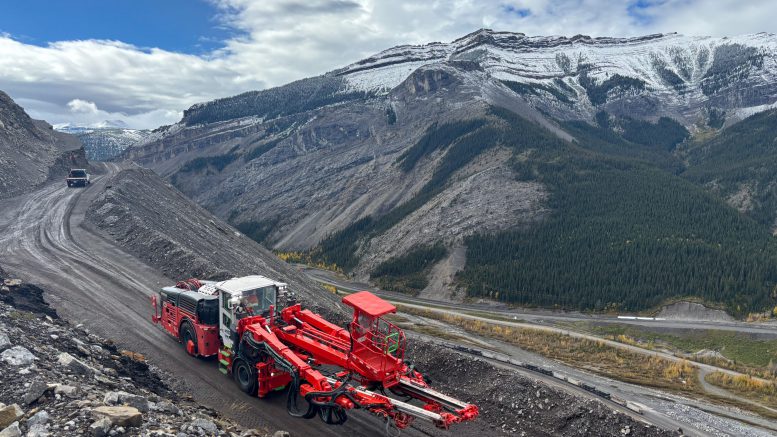
With equipment mobilization now underway and development contracts awarded, the Cadomin project is advancing underground limestone mining in Alberta – not by returning to old methods but by pushing forward with next-generation automation, instrumentation and a Sandvik fleet.
While Cadomin’s early 20th-century history was coal, the new project is focused on underground limestone extraction. The joint venture between DMC Mining Services, Amalgamated Mining Group (AMG) and Sandvik Mining aims to deliver a high-productivity underground limestone mine that redefines efficiency and safety in one of Canada’s most challenging geological settings, the Rocky Mountains.
At stake is not only limestone output but credibility: can machines that move literal mountains in moments, equipped with advanced automation and real-time diagnostics, outperform legacy operations and prove viable in a politically sensitive sector? For Sandvik, the project aligns with its broader strategy to deepen long-term support across Canada.
“Our partnership in supporting the Cadomin mine operations team and their development mining contractor, DMC, with the delivery of a new underground mining fleet, reflects Sandvik’s broader vision of long-term commitment to Canadian mining,” Sandvik Vice-President Peter Corcoran said. “It provides us the opportunity to expand our technical expertise and aftermarket support across Western Canada, ensuring the successful and productive deployment of equipment at Cadomin.”
Forgotten backdrop
Mining in Cadomin began in 1917 with the Cadomin Coal Co. and expanded to include four underground mines plus a surface operation that started around 1944. At its peak, the area supplied high-grade steam coal to the Canadian rail network, supporting a population of more than 1,500. By 1952, however, declining demand and the switch to diesel locomotives brought production to a halt.
The geology that once challenged early coal miners remains complex. Today’s target is bedded carbonate (limestone) units in the deformed foothills, where strata can be steeply pitched, folded and faulted – conditions that demand a sophisticated approach to ground control and drilling. While Cadomin stands as a relic of Alberta’s coal past, the new project is focused on limestone, applying modern, technology-driven underground mining methods.
In July, DMC mobilized the development contract for Cadomin. The company is responsible for underground engineering and development, the construction of ramps and drifts, surface and underground facilities and ventilation systems – all designed for a potential half-century of limestone mining.
“The key challenge is ensuring a well-suited design that will fulfil the client’s needs for the future 50-year mine life, which has potential for extension,” DMC President and Managing Director Michal Jezioro said.
Edmonton-based AMG provides a crucial logistical advantage. From its main facility, the company can stage equipment, maintain inventories and deploy support personnel at short notice.
“The ability to be onsite within three hours is definitely an advantage for both parties,” AMG President of Mining and Tunneling Colin Elson said. “We will inventory all levels of support here at our main facility in Edmonton and ensure we have our team ready at all times.”
Elson also noted the significance of supporting a project close to home.
“It’s great to be an Alberta company supporting such a great Alberta project,” he said. “The irony is that this is the first underground operation that we have supported in our own back yard, as our business takes us anywhere from Australia to Greenland but never right at home.”
Sandvik is also keen on the local aspect. The company’s investment in local technicians, training programs and maintenance practices is key to “helping both the mine operations team and DMC optimize performance, build local capability and secure sustainable value from their Sandvik equipment,” Corcoran said.
Automation and advantage
At the core of the operations is a Sandvik underground fleet, starting with DT922i jumbos and DS512i bolter, which are already on site. These i-series (intelligent) machines feature automated drilling systems, onboard diagnostics, and data-driven controls that adjust drilling pressure and rotation in real time.
The DT922i jumbos can automatically execute pre-programmed drilling patterns, optimizing hole placement and depth with minimal operator intervention. The DS512i bolter brings automation to ground support, with precise bolt alignment, torque monitoring, and digital logging of each installation for quality assurance.
Loaders and haul trucks round out the fleet, designed for continuous operation with digital payload monitoring, cycle optimization, and automatic traction control to improve efficiency and extend component life. Compared with older, mixed-equipment fleets, the unified Sandvik system simplifies maintenance, standardizes training, and enhances operational consistency. For DMC, that reliability is crucial.
“Proactive maintenance is at the heart of DMC development projects,” Jezioro said. “An intensive planned preventative maintenance scheme will be in place, with optimized spares storage on site and in the Alberta region.”
Through AMG’s Edmonton facility, parts and service can be dispatched within hours. Jezioro added that “the combined efforts of AMG and Sandvik have enabled the rapid mobilization of equipment and materials into the region, ensuring the project remains on schedule.”
Because Alberta has little existing underground mining infrastructure, local capability and technical training are essential to success. Sandvik’s role in providing training and aftermarket support bridges that gap, ensuring equipment is not only delivered but sustained.
Challenges and mitigation
Operating underground in the Alberta Rockies presents seasonal and technical challenges. Temperatures can swing sharply, groundwater inflows are unpredictable, and geological faults complicate development. Jezioro confirmed that all equipment will be fit out with winter packages to withstand sub-zero conditions.
Ventilation design must consider all equipment usage and the working environment. Water management and ground control strategies must evolve as the mine deepens, while maintaining safety and efficiency standards.
To strengthen safety, DMC is establishing an underground mine rescue team, the only one operating now in the area. The initiative ensures emergency response capability and exemplifies the company’s proactive safety philosophy.
The project also faces regulatory and environmental scrutiny typical of underground mining in the Rockies. Approvals and oversight emphasize water quality, karst and groundwater management, dust and noise control, wildlife habitat and progressive reclamation.
Community stakeholders and environmental groups continue to monitor developments closely, underlining the need for transparent environmental management throughout construction and operations.
Cadomin could redefine expectations for how underground mining is executed in Canada. The integration of advanced automation, unified fleet management and local technical infrastructure points towards a more efficient, data-driven model of operation.
For Sandvik, the project is a proving ground for its latest generation of equipment and remote-monitoring systems. AMG sees the value of localized support in an industry often stretched by distance and logistics. DMC’s aim is to showcase engineering discipline and safety leadership.
The collaboration between these three companies – contractor, supplier and original equipment manufacturer – illustrates a shift toward partnerships built around integration rather than simple procurement. Each partner’s expertise reinforces the others’, producing a cohesive, responsive system designed for longevity and productivity.
Outlook and significance
Mobilization at Cadomin marks a symbolic and practical turning point. The first shipments of Sandvik equipment are being staged for underground development and construction of critical infrastructure is underway. Over the coming months, DMC will execute all the site development and construction, while AMG coordinates logistics and Sandvik continues technical support.
Once underground operations begin, the mine will transition from development to steady-state production. Performance data from the fleet will inform predictive maintenance schedules and optimize face-advance rates – helping validate the investment in intelligent mining systems.
Cadomin could serve as a blueprint for responsible, high-technology underground limestone mine in Western Canada. By combining automation, safety improvements, and regional supply strength, the project hints at new possibilities in today’s mining landscape.
For a region once left behind, it could see a new era underground. As Sandvik’s Corcoran noted, the partnership reflects more than equipment supply.
“It represents a long-term commitment to Canadian mining and a concerted effort to create sustainable value from the Sandvik equipment.”
The preceding Joint Venture Article is PROMOTED CONTENT sponsored by Sandvik and produced in cooperation with The Northern Miner. Visit https://www.home.sandvik for more information.
Be the first to comment on "JV Article: Sandvik’s underground revival at Cadomin "