
Ivanhoe Mines (TSX: IVN; US-OTC: IVPAF) announced on Thursday that it has made a copper discovery in Kazakhstan warranting follow-up probing.
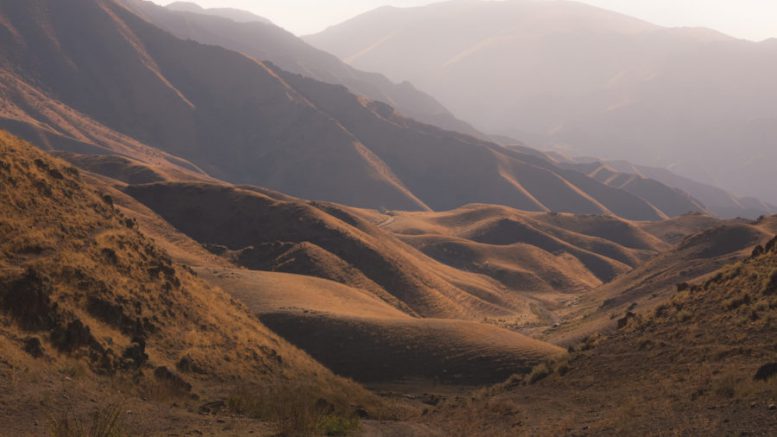
The new copper discovery at its exploration joint venture in the Chu-Sarysu Basin resulted from fieldwork on the Merke licence. It is located in the southern part of the basin and includes a 36-km-long stratigraphic trend, with multiple samples returning between 1-5% copper.
While clearly not an economic occurrence in isolation, Ivanhoe’s team considers the copper mineralization — an outcrop on surface with an approximate 20-metre thick zone — to be “significant” as it strongly supports the thesis that mineralization is structurally controlled, with faults and fractures acting as conduits for copper-bearing fluids into a package of folded sedimentary carbonate rocks.
The Canadian miner, alongside unlisted and UK-based partner Pallas Resources, is exploring a prospective land package of over 16,000 sq. km, across seven projects. The landholding, according to Ivanhoe, represents one of the largest exploratory holdings in Kazakhstan and is estimated to be seven times bigger than its Western Forelands project in the Democratic Republic of the Congo.
Structure mapping
The joint venture plans to follow up on this discovery by mapping these structures in detail, supported by high-resolution magnetic surveys to trace them at depth, and by evaluating basement contacts and fault systems as potential fluid pathways.
Shares of Ivanhoe declined 3% to $12.09 on Thursday afternoon in Toronto, giving the Vancouver-based copper miner a market capitalization of $16.4 billion.
The entire Chu-Sarysu Basin, according to Ivanhoe, is ranked as the world’s third-largest sediment-hosted copper basin, after the Central African Copperbelt and European Kupferschiefer, hosting 27 million tonnes of known copper. The area hosts the world-class Dzhezkazgan deposit, which has been continuously mined for over a century.
Underexplored region
The United States Geological Survey (USGS) estimates that there remains approximately 25 million tonnes of undiscovered copper in the basin. Despite its significant prospectivity, greenfield exploration has largely been neglected across the entire region for over 40 years.
Kazakhstan as a whole has also been largely underexplored, even with its geological potential and status as a world-leading producer of uranium. S&P Global estimates that over the past 15 years, only $100 million has been spent annually on exploration in the country, far less than other major mining jurisdictions.
With that in mind, Ivanhoe and privately held Pallas teamed up in late 2024 to explore the 16,000 km² land package in Chu-Sarysu, leveraging the former’s exploration success in Congo and the latter’s experience in Kazakhstan. Ivanhoe is expected to sole-fund up to $18.7 million over the first two years, and can elect to earn into all seven projects under the JV, up to 80%, for a maximum consideration of $115 million over four years.
Drilling underway
Ivanhoe also said that a 15,000-metre drill campaign has commenced in the western section of the joint venture’s land package on the Glubokoe licence, located several hundred kilometres north of the Merke licence.
The first drill hole is expected to test the potential extensions of mineralization first noted in a Soviet-era stratigraphic hole drilled in the 1980s, which intersected three separate copper-bearing intervals over 26 metres, the company said.
The initial drill holes in the 2025 campaign are expected to be between 800-1,000 metres deep, and will assist with calibrating the results with historic and newly acquired geophysical datasets. This in turn will inform the stratigraphic and facies models, as well as help identify drill targets for the remainder of drill program, it added.
Be the first to comment on "Ivanhoe makes copper discovery in Kazakhstan"