
Eight years of patience and perseverance in China are finally starting to pay off for
Based in Toronto and led by President and CEO James Moore, Inter-Citic has been focusing exclusively on minerals in China. The company is backed by two wealthy Asian families: the Hos, of Macao’s banking world, and the Lees, of Hong Kong’s Henderson Group.
Canadian geological engineer David Wahl joined Inter-Citic in January 2003 as vice-president of mineral-project development, and the remaining officers include: accountant Lou Pasubio, CFO; geochemist Zhang Xiping, vice-president of the Beijing office; and retired geologist Liu Quanqing, vice-president of special projects. Former Noranda exploration geologist Garth Pierce has just joined Inter-Citic as vice-president of exploration.
The board consists of: Moore; lawyer Mark Frederick, acting chairman; Hong Kong investment dealer Carlos Ho; Taipei-based industrialist Sherman Hong (who, with his family, owns 3 million shares); British Columbia-based accountant Peter Tang; and Scott Dorey, a vice-president of Lehman Brothers.
Furthermore, Inter-Citic has assembled an intriguing advisory committee made up of: mining engineer Harry Burgess; former Ontario mines minister Chris Hodgson; New York-based investment banker, metals trader and licensed surgeon Henry Jarecki (who owns 2.5 million shares); Hemlo co-discoverer Donald McKinnon; and Lakefield Research gold metallurgist Rene Jackman.
Consulting engineer George Cargill is involved with Inter-Citic as an independent “qualified person,” and has prepared technical reports on the two new Chinese gold projects, which encompassed, among other sources, geophysical work compiled and analyzed by Toronto-based consultants Paterson, Grant & Watson.
During the period 2000-03, while it dabbled in e-commerce, Inter-Citic (then known as Inter-Citic Mineral Technologies) operated a small rare-earths facility in eastern China. The plant produced cerium, lanthanum and neodymium, and employed more than 100 people. However, rare-metals markets were difficult, and operations were suspended last July and written-down to the tune of C$3.8 million.
In 2002, Inter-Citic briefly teamed with Cominco and U.K.-based ZincOx Resources to study the viability of developing the Lanping zinc-lead deposit in Yunnan province, but the project was abandoned in mid-2003.
While the company’s unqualified successes in China were few in those first seven years, Moore says the period gave the company time to establish a Beijing office, gain credibility, and create the personal relationships that are so critical to doing business in China.
“We wet our feet on a few different avenues in China, but most of all we spent a lot of time getting to know the people who are active and important in the mining business in China,” says Moore. “That’s a fundamental way that we’ve distinguished ourselves as a company. It’s one thing to be simply shown a project in China and look at it based on its technical merits; it’s another to determine that you can actually do business with your partner. That takes a lot of time and sensitivity. Patience is critical.”
A watershed moment for Inter-Citic came in July 2003, when it entered into separate agreements to explore two promising grassroots gold projects in China: Dachang, in northeastern Qinghai province, and Zalantun, in the northern portion of Inner Mongolia. Binding contracts for both projects were signed in December 2003.
Dachang
Inter-Citic signed a joint-venture agreement with the provincial government-owned Qinghai Geological Survey Institute (QGSI) for the Dachang gold project, near the headwaters of the Yellow River, 350 km southeast of the regional centre of Golmud in west-central China.
To earn an 83% interest, Inter-Citic must spend C$5.2 million on exploration over three years and pay C$1.6 million in cash on receipt of a mining licence. An additional 7% interest can be acquired once a prefeasibility study is completed. The remaining interest is carried by QGSI.
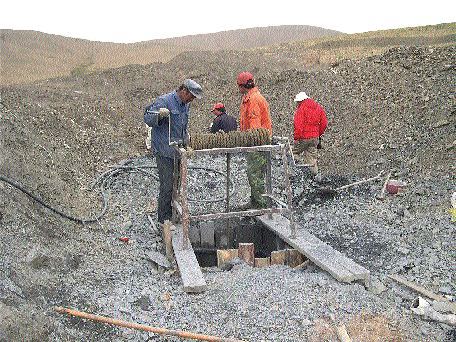
The land at Dachang is flat, rocky, barren, and subject to permafrost. The site is currently only accessible between about May to November by gravel road. Helicopter access is not feasible, owing to the project’s 4,600-metre elevation.
The property spans 219 sq. km and hosts prospective areas of gold mineralization, where artisanal miners have been active for centuries.
“The gold that they took out of there, . . . it’s just amazing,” says Wahl. “It’s such a tremendously large system; that is what’s impressive. You can walk for ten kilometres and still be within the same anomalous zone.”
During the 1960s, ’70s, and ’90s, the QGSI carried out regional geochemical and geological mapping over the property and identified seven large gold-in-soil anomalies. Within one of these, two highly anomalous zones were defined by a 0.24-gram gold contour covering 2 sq. km.
More recently, the QGSI followed up with programs of geological mapping, trenching and drilling that defined 28 gold-bearing zones within one of the seven geochemical anomalies, dubbed prosaically “Anomaly No. 1.”
These 28 gold zones extend 5 km within the 20-sq-km anomaly, are typically 5-7 metres wide, and grade an average of 7 grams gold per tonne.
The host rock is mostly Triassic sandstone and siltstone, and regional thrust faults seem to have created the plumbing system for the gold-bearing solutions. Gold is associated with silica, pyrite, arsenopyrite and other sulphides.
The gold-mineralized material has proved highly refractory in cyanidation tests, but Inter-Citic hopes that a high grade will allow for an economic recovery process — something Lakefield Research will be exploring further for the company.
Meanwhile, Cargill Consulting Geologists reviewed QGSI’s data late last year and estimated that Dachang hosts an inferred, Carlin-style resource of 5.7 million tonnes grading 7 grams gold, or 1.3 million oz., according to 43-101 standards.
Cargill’s estimate did not include results from the QGSI’s 2003 exploration program at Dachang, which had focused on tightening up drill spacing to 150 metres on only three gold zones within Anomaly no. 1. That program comprised 3,600 metres in 31 holes, the sinking of ten 13-metre-deep prospecting shafts, and 2.5 km of trenching.
QGSI analyzed the samples to ISO 9000 standards at its laboratories in Xining, the capital of Qinghai province, and the results, released in January, confirmed the past positive exploration results. The assays included a few stellar intercepts such as 5.3 grams gold over 58 metres (44 metres true width, from 20 metres down-hole) in hole ZK-11101, and Inter-Citic characterized the drill results as “extremely encouraging.”
To date at Dachang, only 6,000 metres of drilling and 20 km of trenching have ever been completed, and mineralization has been probed only to a maximum depth of 200 metres.
This year at Dachang, Inter-Citic plans to complete a $2.5-million program consisting of 15,000 metres of drilling (using imported Canadian rigs), geophysical surveying, and a baseline environmental study. Plans also call for the resource estimate to be revised.
A field camp is set to open at Dachang in early May, with drilling slated to begin in August.
Zalantun
Inter-Citic can acquire an 85% stake in the Zalantun gold project from the Beijing Institute of Geology for Mineral Resources (BIGM), China’s only national geological institute, by spending C$2.4 million on exploration over three years. If Inter-Citic exercises an option to acquire a further 5% stake, BIGM’s remaining 10% stake will be carried.
Situated 80 km northwest of the city of Zalantun, the Zalantun property covers 1,900 sq. km of the Tianshan-Hinggan geological domain along China’s northern border, at the junction of the Altaids belt and the Yanshanian volcano-plutonic belt. A key, 125-sq.-km portion of the property hosts nine individual targets BIGM identified in prospecting work dating back to the early 1950s.
The style of gold-copper-silver porphyry mineralization at Zalantun is said to be analogous to the El Indio-Pascua Lama belt in Chile and Argentina, with intense and pervasive hydrothermal alteration.
This year at Zalantun, Inter-Citic intends to begin field work aimed at identifying targets to be drilled in the fourth quarter. It will be the first time the property is subjected to drilling.
Meanwhile, the company plans to continue evaluating other exploration and mining assets in China.
Recently signed separate agreements give Inter-Citic a right of first refusal on any future QGSI- or BIGM-owned projects that are made available to foreign investors.
“We want to go into areas where China wants us to be,” says Moore. “Oftentimes, those are in some of the poorer or less-developed provinces — areas where there hasn’t been as great a need for the federal government to fund development of the mining industry.”
He notes that Qinghai province has not been a big priority with the federal government in the past, owing to its marginal economy and population of only 5 million people in an area the size of France.
But that attitude has changed, says Moore. “They [the government] desperately want to develop mining out in Qinghai, and we’re going to help them do it. In that regard, it’s a great partnership and a situation that can work.”
Inter-Citic now has C$4 million in cash and no debt, thanks to several private placements of shares and warrants, as well as a conversion of convertible debentures into shares and warrants.
The number of outstanding shares stands at 39 million, or 45.1 million fully diluted. With shares last trading at $1, Inter-Citic’s market capitalization is C$39 million.
The largest shareholder, and the only one above 10%, is Hong Kongbased Main Eagle, with 5 million shares.
Moore says various financiers have shown an interest in adding to Inter-Citic’s treasury, and that another financing could occur in the coming months.
“We’re excited about what we’re doing over there,” says Moore. “We’re determined to set up an absolutely first-class exploration program in China.”
Be the first to comment on "Inter-Citic finds a little Nevada in China’s Qinghai province"