
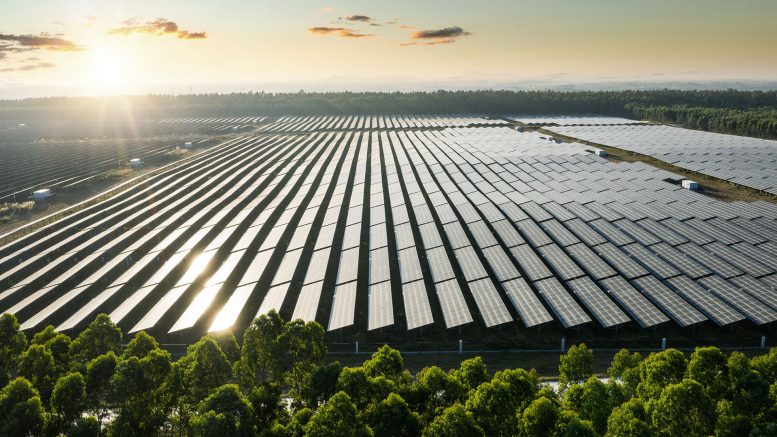
Austria-based mid-tier renewable energy developer RP Global has started building its first German solar project near a “death strip” on the former Cold War border with East Germany.
The 50 MW (peak) photovoltaic park at Harbke, about 100 km east of Hanover is repurposing a long-worked coal mine dump. Developed in collaboration with Traunstein, Germany-based engineering, procurement and construction contractor MaxSolar after a rigorous approvals process, the first stage ties into two existing power lines that cross the Wulfersdorf dump. The existing infrastructure in Saxony-Anhalt’s Börde district, about 200 km west of Berlin, allows for a direct grid connection without the need for new corridors.
Harbke produced lignite since 1909 and shut in 1989. Documented raw lignite output totals about 93.2 million tonnes between 1922–26 and 1953–89, which can be firmly accounted for.
After the Second World War, its open-cast mine was divided to supply power on both sides of the border dividing Germany’s former east and west. Today, the Börde district promotes solar expansion and serves as one of five model municipalities in Germany’s Global Sustainable Municipality initiative.
RP Global says construction planning preserves protected features of the former border strip, including the “Kolonnenweg” patrol road and it is evaluating an expansion.
Sustainable use
Building on a disturbed area reduces land-use conflicts, the project proponents said.
The district aims to integrate the U.N.’s 2030 Agenda and its 17 Sustainable Development Goals into local administration. Officials view conversion of legacy coal assets to renewables as a practical step toward those goals and regional energy security.
Access to the project follows the former “death strip,” where the former German Democratic Republic once maintained fortifications. The Kolonnenweg – a listed historical monument – borders the site. RP Global says transport routes and staging areas have been designed to avoid damage to protected elements, with monitoring during deliveries of major components.
Groundworks have begun on the former Wulfersdorf dump. The company says further capacity is being considered, but provided no schedule or size details.
Future stages would likely leverage the established grid interconnection and the site’s remaining disturbed land.
Be the first to comment on "German ‘death strip’ solar project breaks ground"