
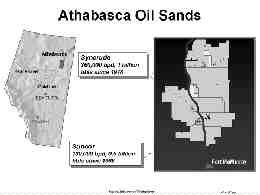
For companies developing Alberta’s oil sands, the numbers just keep getting better: cash costs are down 50% from a decade ago; oil prices have doubled in the past two years; and demand for new sources of oil to feed the hungry U.S. market is growing as the supply of conventional crude shrinks.
As a result, producers are pouring an additional $33 billion into the gooey, oil-coated sands that were once considered too technically challenging to exploit at a profit.
The latest to up the ante is
Other major investments designed to exploit the 48,300-sq.-km resource in northern Alberta include:
–
– $6 billion worth of upgrades by oil sands veteran
– the $3.5-billion Athabasca project, ownership of which is shared by
This massive cash infusion is expected to keep the oil sands alive and kicking for decades to come. The oil sands contain the equivalent of 300 billion barrels of crude oil, or about 40 years worth of North American consumption — not bad for a resource that sat in the ground, acknowledged but unwanted, for almost a century after a Geological Survey of Canada employee correctly predicted that “when the hour of development comes, [the oil sands resource] will, I believe, prove to be one of the wonders of northern Canada.”
The origin of the oil sands is still open to debate, but the prevailing theory suggests that underground pressure squeezed the oil out of highly organic Cretaceous shales and into the sands of the McMurray formation. The sands average 10.5% bitumen, which, in turn, contains 50-60% oil, 35% resins and 15-25% asphaltenes. An estimated 1.7 trillion barrels of bitumen are available, of which more than 300 billion barrels can be recovered and upgraded to light crude using current technology.
But the “hour” of development has stretched into a few decades. Although the first wells — 24 in total — were sunk in the early 1900s, it wasn’t until 1967 that Great Canadian Oil Sands, a predecessor of Suncor, opened the first productive operation. For many years following the Great Canadian debut, operations were plagued with technical problems, high costs and equipment breakdowns. In the late 1980s, both main players — Suncor and Syncrude — were struggling to make a profit.
As is so often the case in the mining business, the turning point came with the introduction of better technology.
Instead of mining surface sand with massive bucket-wheels and then transporting it to the extraction plant by conveyor belts that were prone to breakdowns, producers switched to heavy trucks and shovels for mining and slurry pipelines for transport. The use of trucks that could work independently cut costs and significantly reduced downtime. Likewise, pipelines proved to be less costly, more reliable and more energy-efficient than conveyor belts.
As a result, the cost of producing a barrel of surface-mined oil from the tarry sands dropped from $24 in the 1980s to about $12 today and is forecast to fall even further, to the $8-10 range, in the near future. This means that even if the price of oil drops significantly from current levels of US$25-30, the oil sands will remain profitable.
Steam injection
Most of the oil production to date has been mined from surface deposits. Now a new wave of technological advancement that uses steam injection and horizontal wells promises to unlock deeper deposits that represent about 93% of the remaining resource. Steam injection at high temperatures and pressures liquefies the bitumen enough to allow the producers to pump it to surface through vertical shafts.
“This technology is still in its infancy, though there are quite a few operations out there now that have proven it works and are making money using it,” says William Almdal, director of the regional infrastructure working group for the Athabasca oil sands developers and a former president of the Canadian Institute of Mining, Metallurgy and Petroleum. He says using steam injection to heat the oil can be tricky because any gaps in the cap rock provide an escape route for the heat, while layers of water can act as a heat sink.
Still, companies are betting billions of dollars that steam injection, and other in situ technologies, such as fireflooding and electrovolatization, will unlock the wealth of the deeper sands. For example, Gulf Canada is using steam injection to gain access to sands 400 metres below the surface at its Surmont project.
The process works like this:
– first, a pair of parallel horizontal wells are drilled into the formation, one on top of the other;
– next, steam is injected from the top well into the oil sands, mobilizing the bitumen and allowing it to flow by gravity into the well below;
– finally, the heated oil and condensed steam captured in the bottom well are pumped to the surface for further processing.
Using this method, Gulf expects to recover 5-7.5 million barrels from the Surmont resource, enough to support a 100,000 barrel-per-day operation for 150-200 years. A commercial development decision is pending.
But with big development come big risks. In the case of the oil sands, the risks range from rising greenhouse gas emissions to the uncertainty of market support for billion-dollar projects with long lead times between initial investment and the first cash flow.
All of the projects are under fire from environmental organizations, including Greenpeace, because they threaten to escalate Canada’s greenhouse gas emissions at a time when the country is struggling to meet targets on climate change.
Under the Kyoto Protocol, Canada has agreed to cut greenhouse gas emissions by 6% from 1990 levels — or about 26% from current levels — by 2012. But total greenhouse gas emissions caused by the extracting and processing of bitumen from the oils sands are expected to increase significantly — representing as much as 25% of Canada’s projected increases — as production doubles over the next decade.
Greenpeace has focused its oil sands attack on Suncor, which is developing the Millennium project, north of Fort McMurray, Alta. Last year, activists blocked the shipment of a coker on its way from Edmonton to the site for two hours. “While Suncor says they recognize the threat of climate change, they are in fact investing billions of dollars to increase dirty oil production and greenhouse gas emissions,” says Steven Guilbeault, climate change campaigner for Greenpeace Canada.
The developers are responding to the charges. Over the past five years, they have invested 30 of every dollar on technologies to improve environmental performance, says Almdal. By 2010, annual sulphur dioxide emissions will drop 50% from their 1995 levels, while carbon dioxide emissions per barrel will decline 45% from 1990 levels. Although absolute carbon dioxide levels will increase along with increased production, Almdal says the oil sands projects still compare favourably with conventional oil production on a life cycle basis.
“What we’re doing is replacing oil that can no longer be produced by conventional means,” he explains. “On a life-cycle basis, the oil sands can compete with oil producers anywhere for total greenhouse emissions, from the time the oil is sitting in the ground to the time it’s being used in your gas tank.”
Be the first to comment on "Higher prices, lower costs turn oil sands into gravy train"