
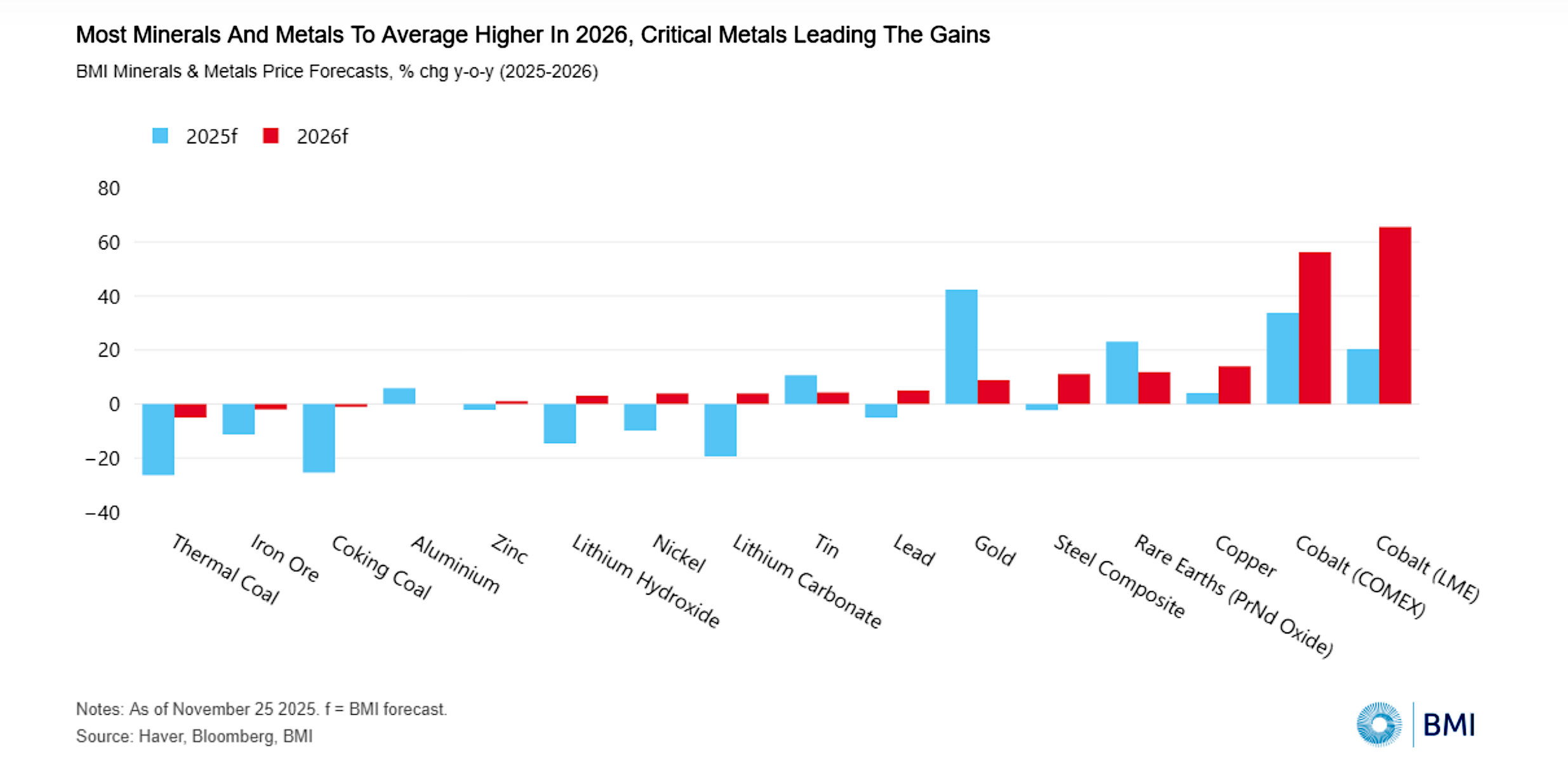
Most mineral and metal prices should edge higher in 2026 as net-zero demand, tighter supply and an intensifying global race for resources offset persistent weakness in China’s property sector, BMI, a unit of Fitch Solutions, says in a new report.
BMI describes a “cautiously optimistic” price environment next year in its outlook, with easing tariff uncertainties and robust demand from sectors tied to decarbonization underpinning the market.
China’s property slump will continue to weigh on base metals, limiting price gains even as supply remains tight, BMI said.
For precious metals, BMI forecasts that gold will average higher in 2026 than in 2025, but says prices are likely to ease late in the year as global monetary easing slows and the U.S. Federal Reserve ends its rate-cutting cycle.
Industrial policy will remain the main tool for securing critical minerals in 2026, BMI says, with most of the action centred in the European Union and the United States. Governments are pursuing a twin-track strategy of expanding domestic mining and processing capacity while locking in overseas supply through investment, strategic partnerships and offtake deals.
China will double down on its own strategy to reinforce its dominance across critical mineral value chains, according to the outlook. Beijing is expected to accelerate exploration, expand targeted capacity in battery and rare earth minerals and promote greener manufacturing, while deepening ties with resource-rich economies under clearer outbound investment rules. Recent tariffs and rare earth export controls show protectionist leverage will stay central.
M&As strong
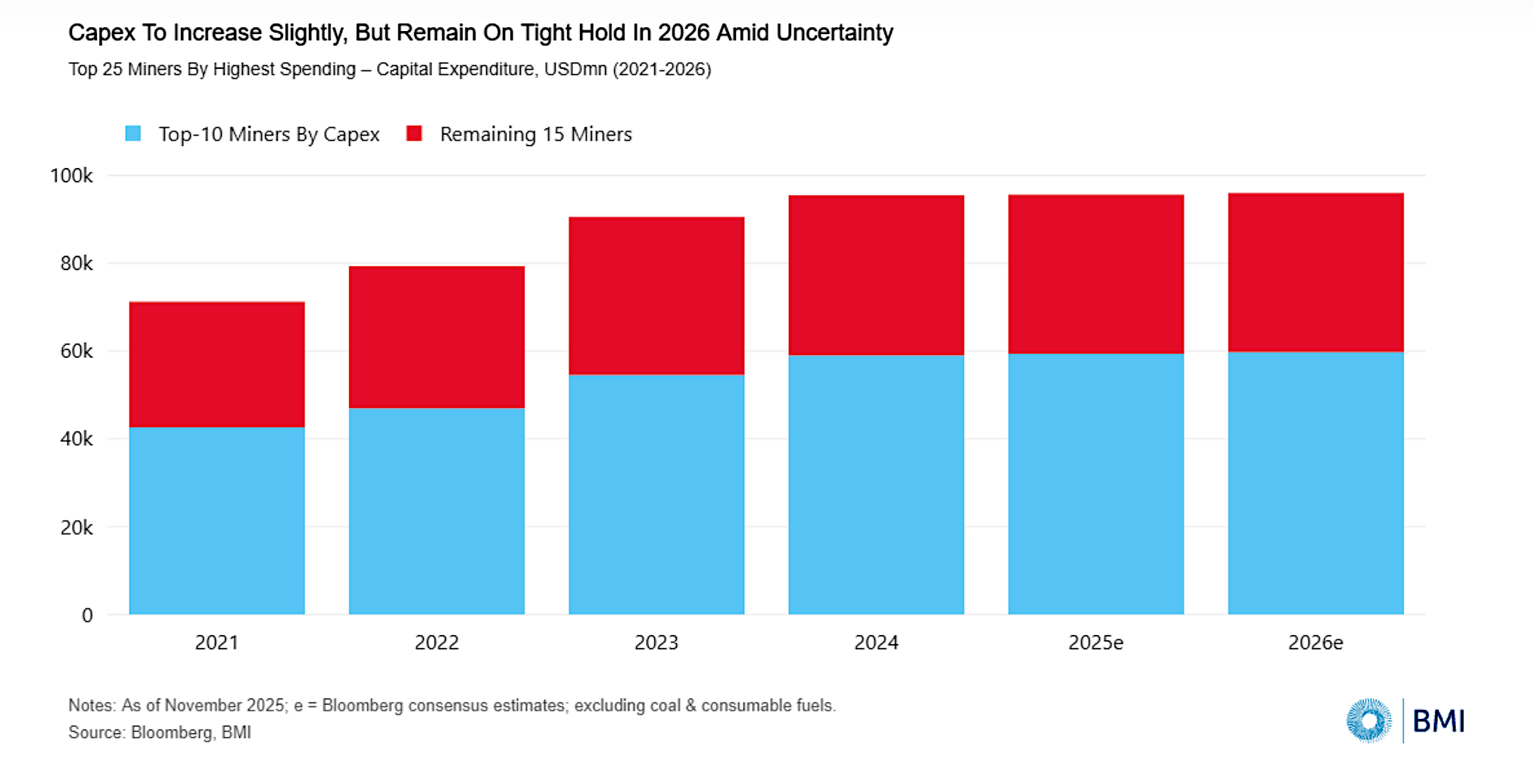
The competition for energy transition inputs will keep merger and acquisition activity robust into 2026, BMI forecasts. Miners and metals producers are set to prioritize deals that increase exposure to copper, lithium and rare earth elements. Large capital-spending projects will remain on the agenda, though staged and brownfield developments are gaining favour as firms try to manage cost pressures and policy uncertainty.
BMI also sees continued investment flowing into frontier markets next year, despite persistent concerns over resource nationalism. Governments and local populations, particularly in Africa, now have greater awareness and bargaining power over their mineral endowments. Miners will have limited room to resist these policy shifts.
Partnerships between mining projects and technology, automotive and aerospace firms are expected to deepen next year. BMI notes that supply bottlenecks threaten growth in artificial intelligence, robotics and defence, giving downstream manufacturers strong incentives to secure materials at the mine site.
Taken together, BMI’s outlook suggests 2026 will be defined less by runaway price gains and more by strategic positioning, with industrial policy, critical minerals competition and shifting bargaining power in frontier markets shaping where capital flows next in the global mining industry.
Be the first to comment on "Global scramble to lift minerals prices in 2026: Fitch"