
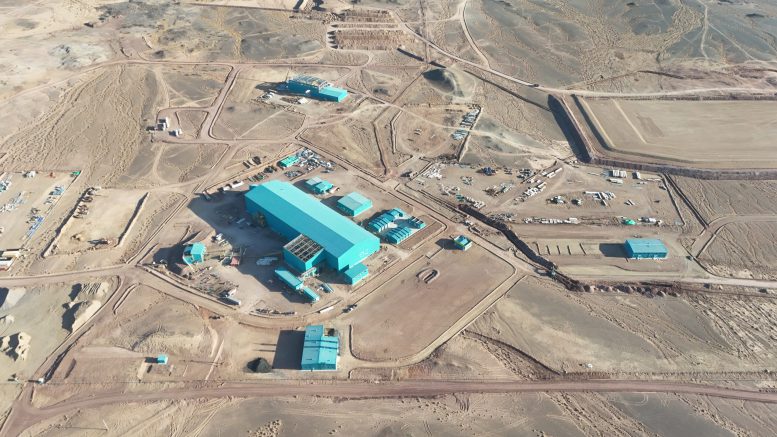
Canada’s Erdene Resource Development (TSX: ERD) is working to turn its new Bayan Khundii open-pit gold mine in Mongolia into the anchor of a future minerals district that will one day produce several metals, CEO Peter Akerley says.
Erdene poured first gold at Bayan Khundii in September – about 10 years after the first exploration hole was drilled – and expects to achieve nameplate production by the end of the month. The operation has been designed to process 650,000 tonnes of ore and produce 85,000 oz. of gold per year.
“We see Bayan Khundii as a foundation to build out a new multi-mine, multi-commodity district,” Aekerley told The Northern Miner in an interview Thursday. “It has tremendous room for expansion. Perhaps we can even add a heap leach facility to expand the plant.”
The Bayan Khundii milestone underscores building momentum in Mongolia’s gold sector and complements a copper industry centred around Rio Tinto’s (ASX, NYSE,, LSE: RIO) Oyu Tolgoi mine that’s pushing the country towards mid-tier producer status in Asia.
Located about 980 km southwest of the Mongolian capital, Ulaanbaatar, and less than 200 km from the Chinese border, Bayan Khundii is hosted within a very large hydrothermal alteration system.
Although they are defined as different deposits, Bayan Khundii and the nearby Dark Horse and Ulaan targets “are all one large hydrothermal system,” Akerley says. “We are looking at 10 or 12 km of interconnected structures where we are tracing gold mineralization.”
High grade
Bayan Khundii boasts one of the highest gold grades in the world. It has proven and probable reserves of 3.8 million tonnes grading 3.8 grams gold per tonne and 1.7 grams silver for contained metal of 464,900 oz. gold and 220,500 oz. silver, according to an August 2023 resource.
Current reserves provide for a six-year mine life – a figure that the company is working to extend, having identified more than 20 prospects in the region. These include the Zuun Mod molybdenum-copper project and the Tereg Uul copper target, just kilometres from Oyu Tolgoi.
Erdene’s Mongolian unit is planning to spend about $9 million on exploration in 2026, Akerley says. That’s triple the 2025 budget.
“There’s a substantial low hanging fruit right around the pit,” he says. “The pit was defined at $1,800 gold. To the west, with the higher gold price and with exploration, we see significant exploration opportunities – perhaps to the tune of 150,000 to 200,000 oz. within open-pittable depths.”
Joint venture
Bayan Khundii is operated by Erdene Mongol, the company’s 50-50 joint venture with state-owned Mongolian Mining Corporation (MMC). Erdene and its partner spent about $115 million to build the mine and its processing plant, which together employ about 500 people.
Picking MMC as a partner “wasn’t just to bring mining expertise and money,” Akerley says. “They are part of a conglomerate that brings all the elements you would need to build a mineral district, and they are aligned with us in that thinking. Their sister company brought in a power line 240 km from the Chinese border accessing the inner Mongolian power supply. You wouldn’t do that for a six-year mine life.”
About 35 km east of Bayan Khundii sits Zuun Mod, which Akerley calls “perhaps the largest undeveloped molybdenum copper project in Asia.”
Zuun Mod holds 271 million measured and indicated tonnes grading 0.06% molybdenum and 0.06% copper for contained metal of 334 million lb. molybdenum and 384 million lb. copper, according to a September 2025 resource. It also has inferred resources of 269 million tonnes grading 0.05% molybdenum and 0.06% copper for contained metal of 300 million lb. molybdenum and 351 million lb. copper.
“With about 630 million lb. of molybdenum, at current prices we are sitting on about $10 billion of metal in situ,” Akerley says. Zuun Mod “also has a copper porphyry discovery that we will continue to explore. I can’t say exactly the date, [but] that will be a mine in the future, and a very large molybdenum supplier into China.”
Copper belt
A geologist by training, Akerley first travelled to Mongolia when the former communist country opened to foreign investment in the late 1990s.
He was eager to explore what he thought was one of the great copper belts in the world.
“Maybe fortuitously, the industry came to a crashing halt in 1998-99 due to the Asian financial crisis and people contracted their operations for exploration,” he says. “That gave me an opportunity to seek out investors to explore Mongolia.”
After Akerley put together a group of private investors in 2002, Erdene went public in 2004. The stock, which has more than doubled this year, rose 3.8% to C$7.58 Friday afternoon in Toronto, giving the company a market value of about C$467 million ($338 million).
“It’s been heads down, methodical exploration that’s allowed us to discover large copper-gold deposits in Mongolia,” he says. “It took a bit of time, but we’re at a point where I can say we found what we went looking for. We have production and there’s more to come.”

Be the first to comment on "Erdene CEO sees Mongolia gold mine anchoring district"