
Open-pit mining, heap leaching planned for Kisladag
Vancouver — With its debt now under control and production expected to rise from the Sao Bento mine in Brazil,
The junior’s Turkish adventure began in 1996, when it acquired the overseas gold projects of South Africa’s Gencor through a share-for-asset swap. The assets included 21 exploration and development projects in Turkey. Gencor later merged with Gold Fields of South Africa to form
At the time of the Gencor deal, Eldorado was producing 50,000 oz. gold per year from its La Colorada open-pit, heap-leach mine in Mexico and getting ready to start up the smaller, joint-ventured Trinidad mine in the same country. Last year, the company produced 102,841 oz. gold from its sole operating mine: Sao Bento in Brazil.
With several advanced gold projects in Turkey, Elodrado envisions considerable production growth in the coming years.
Of Eldorado’s Turkey assets, Kisladag has garnished the most attention, owing to the discovery of a 6.7-million-oz. porphyry gold resource.
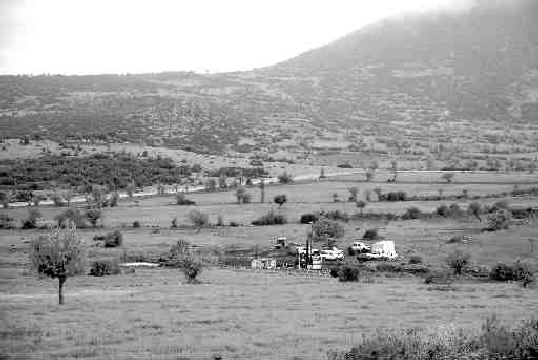
The deposit is in the west-central part of the country in moderately hilly terrain some 30 km southwest of the provincial capital of Usak. It was acquired in February 1997 following satellite imagery work that identified two large-scale alteration systems.
Early stream-sediment and soil sampling, along with an induced-polarization geophysical survey, helped define a gold anomaly measuring 1,200 by 600 metres along the northern slope of the 12-sq.-km Gokgoz Tepe alteration zone. Initial trenching revealed a 0.8-gram gold envelope averaging 200-250 metres in width and extending along a strike length of 400 metres. Shallow percussion drilling in the fall of 1997 confirmed gold values of 0.7-1.5 grams per tonne beneath the trenches to a depth of 50 metres.
By the end of 1998, Eldorado tested the anomaly with six diamond drill holes totalling 1,060 metres. All six intersected zones of gold mineralization within quartz-alunite-tourmaline altered andesite flows and pyroclastics, overprinted by several phases of quartz stockwork and breccias. Three of the holes bottomed in mineralization at a depth of 250 metres. Results ranged from 115.7 metres grading 1.19 grams to 250.4 metres of 1.77 grams.
Based on the results of 6,065 metres of additional core drilling in 22 holes in 1999 and a 29-hole, 7,600-metre reverse-circulation program in 2000, Kisladag was estimated to contain a resource of 6.7 million oz. The measured and indicated portion stands at 126 million tonnes grading 1.2 grams, equivalent to 4.8 million oz. The estimate is based on a cutoff grade of 0.4 gram gold per tonne. A further 1.8 million oz. are contained in an inferred 55.5 million tonnes grading 1.03 grams.
The 750-by-500-metre deposit remains open at depth. One hole, drilled to 420 metres of depth, bottomed in mineralization. The eastern part of the deposit contains a crescent-shaped, higher-grade zone in excess of 3 grams, with a strike length exceeding 300 metres and a width varying from 40 to 120 metres.
A coarsely porphyritic latite that has undergone extensive hydrothermal alteration hosts most of the gold mineralization. An early potassic phase of alteration has been overprinted by later quartz-tourmaline and advanced argillic alteration. Gold is associated with multiple phases of tourmaline-pyrite, pyrite and quartz-pyrite veining plus brecciation, and is accompanied by minor amounts of zinc and molybdenum.
Oxidation in the deposit varies from east to west, extending a few metres in the west to 40-50 metres in the east. About 20.6 million tonnes of the measured and indicated resource are oxide, the remainder being sulphide.
Metallurgical tests on the oxide and sulphide material suggest both are amenable to heap leaching. At moderate crush sizes of 7-10 mm, gold recoveries in the range of 80% can be achieved in the oxides, with recoveries in the sulphides estimated at a much lower 57%.
Eldorado has considered various approaches to developing Kisladag. A May 2001 prefeasibility study by Kilborn Engineering Pacific proposed an open-pit, heap-leach operation capable of producing more than 103,600 oz. annually over a mine life of 11.5 years.
The mine design was based on a 10,000-tonne-per-day (3.4-million-tonne-per-year) operation and proven and probable reserves of 39.7 million tonnes grading 1.44 grams, or 1.8 million contained ounces, with a stripping ratio pegged at 0.51-to-1.
Devalued lira
Eldorado had Kilborn prepared an addendum to the study to reflect changes in economic conditions in Turkey following a 55% devaluation of the lira. The updated study reduced the project’s capital cost estimate by 37%, to US$29.6 million from a previous US$47.4 million. Sustaining capital, however, increased to US$17.3 million from US$13.3 million. Based on a gold price of US$275 per oz., the aftertax internal rate of return is now estimated at 32%. The net present value is US$38.7 million at a discount rate of 8%.
The company is in the midst of a 3,400-metre drill program to test the northern and southern flanks of the Kisladag porphyry system. Crews will drill eight holes to depths of up to 450 metres, and results will be incorporated into an updated resource estimate, to be released in May. In addition, Eldorado will conduct a 4,000-metre program of infill drilling during the third quarter. All the drilling is part of a feasibility study, to be released in 2002.
About 6 km to the southwest, a 4-hole program of reverse-circulation drilling returned up to 8.2% copper over 5 metres at the Sayacik target. The 2001 program tested 35% of a 3-km-long silver-in-soil geochemical anomaly. Holes 1 and 2 tested the north side of the target, and both cut more than 250 metres of argillic-altered rocks containing only elevated silver-lead mineralization.
Holes 3 and 4 tested the western side of the anomaly and yielded only anomalous silver-lead values. However, hole 3 cut a north-northeasterly trending fault structure which returned 8.2% copper over 5 metres from a down-hole depth of 37.5 metres, followed by 137 metres grading 0.1% copper.
“The results confirm the validity of Sayacik as a target of further exploration,” says Paul Wright, Eldorado’s chief executive officer.
Other projects
– Kaymaz — Eldorado also holds that Kaymaz gold deposit on the Anatolian Plateau in west central Turkey, 72 km east of the provincial capital of Eskisehir.
– Efemcukuru — This 30 sq.-km project, which has entered the permitting stage, is near the coast of western Turkey, some 20 km from Izmir. Efemcukuru hosts reserves of 1.9 million tonnes grading 13.14 grams gold.
Gold mineralization is hosted in a sequence of deformed and altered marine sediments and associated ophiolites. A 1997 feasibility study pegged minable reserves at 799,000 tonnes grading 6.77 grams gold. The reserves can be mined by open-pit methods, with annual production over a 7-to-8-year mine life projected at 25,000 oz. Cash operating cost would be under US$200 per oz.
– Kucukdere — This wholly owned property lies near the west coast of Turkey, some 110 km north of the coastal city of Izmir. Resources stand at 1.4 million tonnes grading 6.43 grams gold. Gold mineralization is hosted in andesitic porphyry occurring in a series of quartz-carbonate veins. So far, five vein zones have been identified; these consist of lenses and pods which extend over nearly 4 km.
Gold mineralization is hosted by the 2-km-long Kestane Beleni vein structure. The vein consists of quartz and quartz rhodonite, with locally abundant sulphide mineralization. Results from drilling in 1996-97 suggest the mineralization extends to a depth of at least 300 metres. The top 100 metres of the vein show secondary enrichment.
Eldorado tabled a net loss of US$3.9 million (or US4 per share) in 2001, compared with a profit of US$1.1 million (US1 per share) in 2000. Cash flow from operating activities b
etween the two periods rose to US$13 million (US13 per share) from US$4.6 million (6 per share).
Be the first to comment on "Eldorado Gold eyes production in Turkey"