
The Star diamond project in Saskatchewan is at a critical evaluation stage.
“The biggest challenge in evaluating the Fort la Corne kimberlite field has been the problem of measuring a complex, low-grade resource buried beneath more than a hundred metres of glacial till,” wrote John Kaiser, publisher of the Kaiser Bottom-Fishing Report, after completing a site visit to the project last fall. “De Beers, Kensington and Cameco have spent more than twenty million dollars over the past decade assessing the sixty-nine kimberlite bodies on their adjacent property, and still are not sure whether they are dealing with a geological curiosity or a world-class diamond deposit.”
The Fort la Corne kimberlite field, in the province’s east-central region, comprises at least 70 known kimberlite bodies, ranging from 2.7 to 250 hectares in surface area and individually containing anywhere from 3 to 675 million tonnes in mass. “The Fort la Corne kimberlites have a scale similar to that of low-grade porphyry deposits, except that the value part of the equation remains elusive,” states Kaiser.
The diamondiferous bodies are laterally extensive, stacked, sub-horizontal lenses of crater facies volcaniclastic kimberlite that range up to 2,000 metres in diameter. Limited drilling has revealed that many of the bodies are around 100 metres thick, with an irregular, peripheral apron narrowing to a thickness of 30 metres. The roots, or feeder systems, to these bodies remained a mystery until only quite recently when Shore confirmed the Star kimberlite was rooted by a major feeder pipe.
The diamond-bearing kimberlites in the Fort la Corne region consist primarily of pyroclastic deposits, which are interlayered with Lower Cretaceous marine, marginal marine and continental sediments. The bodies were emplaced near the edge of the Western Canadian Interior Seaway during cycles of marine transgression and regression. The kimberlites formed during a marine transgression in a 2-stage process involving initial excavation of shallow, but wide craters followed by the infilling of xenolith-poor, sub-aerial, primary pyroclastics kimberlite. Each body is composed of contrasting types of kimberlite reflecting different volcanic histories. The entire area is masked by up to 120 metres of glacial till.
The Star kimberlite occurs at the southern end of the main Fort la Corne trend, 60 km east of Prince Albert. Shore owns all of the 46-sq-km project, which ties on to the southern boundary of the area shared by
Shore discovered the Star kimberlite in the fall of 1996 while drill-testing the stronger, sub-circular features of a complex magnetic anomaly measuring over 2 by 1.5 km in the northwest corner of the property. Three NQ-size (4.8 cm. in diameter) core holes were drilled into this feature, and all intersected kimberlite over thicknesses ranging from 22 to 85 metres. In total, 179 microdiamonds exceeding a bottom-size sieve cutoff of 0.08 mm were recovered from 465 kg of sampled kimberlite, including nine stones measuring 0.5 mm in at least one dimension. The largest diamond had a maximum dimension of 1.62 mm.
A second circular anomaly, 1 km out to the east, was tested with two holes. Despite cutting more than 200 metres of kimberlite, the eastern holes returned only five micros from a 552-kg sample taken from one of the holes.
Shore returned in 1997 to drill two PQ-size (8.5-cm diameter) core holes near the site of hole 96-3, which had yielded 81 micros, including eight of the larger stones, from a 202-kg sample. These two holes produced 983 kg of kimberlite sample, which was processed using caustic fusion analysis to recover all the stones. In total, 749 microdiamonds were recovered, including 67 larger stones measuring greater than 0.5 mm in at least one dimension. The largest stone measured 2 mm in one dimension.
About 91% of the recovered diamond parcel was clear, with no inclusions, and 81% exhibited good crystal shape in the form of octahedrons and dodecahedrons. Some 2% of the stones showed some colour, including a clear yellow.
In the early part of 2000, Shore completed 16 core holes (15 NQ and 1PQ) during a first round of delineation drilling on Star, intercepting pyroclastic kimberlite sequences over a 1.5-by-1-km area. The kimberlite intercepts ranged from 14.9 to 140 metres in thickness, beneath an overburden cover of 75-110 metres. The drilling tested both magnetic high and low features of the Star anomaly. The 15 NQ-size holes, treated by caustic fusion methods, delivered 320 microdiamonds exceeding a bottom-stone cutoff of 0.15 mm; included among these were 76 larger stones greater than 0.5 mm in one dimension.
PQ-size hole 16 was positioned between holes 4 and 7, where the main kimberlitic zone had thickened considerably, with the objective of taking a larger sample. A 751-kg sample, representing a 144-metre kimberlite section, held 203 microdiamonds. Forty-four of the diamonds recovered from hole 16 were larger than 0.5 mm in at least one dimension, and 10 stones were at least 1 mm. The largest stone recovered was a 2-mm fragment weighing just over 0.04 carat.
A review of the drilling and geophysical data showed the Star kimberlite thickening towards the west, indicating the likelihood of a feeder system. Shore’s hole 20 provided the first real evidence of an underlying root system to the Fort la Corne kimberlites. The hole intersected 539 metres of kimberlite before shutting down while still in kimberlite at a depth of 627 metres, close to the limits of drill rig. Large amounts of brecciated dolomite wallrock or xenoliths were encountered near the bottom of the hole. Thin section work identified diatreme facies in samples from the bottom 350 metres of the hole.
A 625-kg sample taken from the top 312 metres of kimberlite returned 171 microdiamonds, including 46 stones exceeding 0.5 mm in one dimension. Fifteen of the these diamonds measured at least 1 mm in one dimension and accounted for 0.27 carat in weight. The four largest stones recovered from hole 20 measured 1.49 by 1.41 by 1.29 mm, 1.52 by 1.25 by 1.15 mm, 1.49 by 1.33 by 0.94 mm, and 1.46 by 1.27 by 0.96 mm.
Shore has since completed 37 widely spaced core holes in the Star kimberlite. According to preliminary estimates, the Star body averages a thickness of 88 metres across a surface area of 4 sq. km and exceeds 500 million tonnes, based on a 30-metre cutoff. Caustic fusion analysis on 4,258 kg of split core from 23 delineation holes drilled in 2000 and 2001 yielded 1,175 microdiamonds weighing 1.379 carats, including 265 stones exceeding 0.5 mm in one direction.
In the fall of 2001, Shore drilled a single large-diameter (61-cm) reverse- circulation (RC) hole into the Star kimberlite, 50 metres southeast of hole 20, to test the potential for commercial-size stones. The hole intersected 192 metres of kimberlite to a depth of 296 metres, before stopping because of mechanical failure. From the 82.7 tonnes of recovered kimberlite chips, 183 diamonds larger than 1.1-mm square mesh screen were recovered, with a total weight of 8.52 carats. The implied grade of the mini-bulk sample is 10.3 carats per 100 tonnes. The largest diamonds recovered were fragments weighing 0.638 and 0.402 carat.
By comparison, the largest diamond recovered to date by the FalC joint venture of De Beers-Kensington-Cameco is a 10.23-carat stone. It was found during the 2002 bulk-sample drilling program on the neighbouring 140-141 kimberlite body, which sits just 3 km
northwest of Star. Although the large, 10.23-carat dodecahedral aggregate stone is described as complex and partially resorbed, with evidence of internal twinning and local concentrations of inclusions, it clearly shows the potential for kimberlites to be big-carat stones. A 3.33-carat diamond had previously been recovered from a 2001 large-diameter drill hole on the 140-141 kimberlite. De Beers valued this stone at US$390 per carat. The next two largest stones retrieved were 1.53 and 1.08 carats.
The Star kimberlite is a multi-phase body consisting of a series of airfall pyroclastic horizons. Most of the kimberlite is composed of in situ bedded olivine crystal tuffs, with lesser amounts of reworked volcaniclastic kimberlite. The kimberlites erupted into the Cretaceous sediments of the Mannville and Lower Colorado groups. Several kimberlitic lithofacies can be distinguished according to grain size, style, alteration, abundance, and the presence of olivine macrocrysts.
The Star kimberlite was one of several Fort la Corne kimberlites selected by the government-sponsored Targeted Geoscience Initiative program for analysis regarding its emplacement history. All available drill core was lithologically analyzed. Geochemical investigations, including uranium-lead dating on perovskite fractions and whole-rock geochemistry, have been used to characterize and distinguish the eruptive history of Star. These results, along with two-dimensional and three-dimensional seismic studies and down-hole geophysical data, confirm that the Star body is a multi-eruptive complex with at least four phases of kimberlite and two or more feeder vents.
After hiring AMEC E&C Services and ACA Howe to examine the microdiamond distribution across the Star kimberlite and confirm the suitability of a bulk-sampling site, Shore elected to sink an underground exploration shaft with horizontal crosscuts to recover a 25,000-tonne bulk sample and at least 3,000 carats for evaluation purposes and grade-modelling. At an estimated cost of $8 million, the development of a single exploration shaft and associated facilities was considered to be more economic, and easier to complete, than either the drilling of large-diameter RC holes from surface or the excavation of an open pit. The drilling of the single mini-bulk sample RC hole had raised a number of unanswered questions regarding kimberlite recovery and stone breakage.
Shaft-sinking
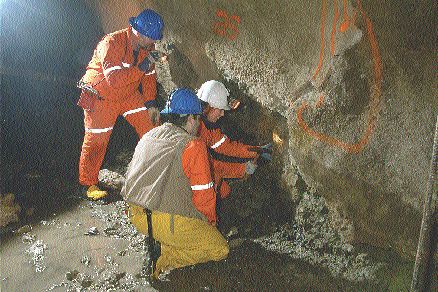
Thyssen Mining Construction began sinking a 4.5-metre diameter shaft in early July 2003 in the vicinity of the large-diameter, mini-bulk-sample RC hole. Kaiser notes that the shaft is within only 100 metres of the property boundary with De Beers-Kensington-Cameco, and that the western half of the Star kimberlite could extend on to the FalC ground as the diatreme feeder of Star straddles the boundary.
The shaft has been completed to 250 metres below surface, intersecting the sediment-kimberlite interface at a depth of 107 metres. It was believed that about 5,000 tonnes of kimberlite would be recovered from the shaft-sinking and that the remaining 20,000 tonnes would be mined from crosscuts driven laterally out in easterly directions from the 173- and 235-metre levels. By mid-May, more than 9,000 tonnes of kimberlite had been mined.
The kimberlite is being processed on-site in a 10-tonne-per-hour dense-media-separation plant designed and constructed by Bateman Engineering. The plant has treated more than 6,700 wet tonnes of kimberlite since it was commissioned in February. Some of the early batches processed were greater than 1,000 tonnes, but batch sizes are now limited to 300 tonnes in order to assess the different phases of kimberlite with greater accuracy. Most sample batches will represent 10-metre sections of kimberlite.
Plant concentrates from six sample batches have been shipped to an off-site laboratory for diamond recovery. Tailings are also being shipped to an independent mineral processing lab to audit for any free and locked diamonds remaining at a bottom-size cutoff of 0.85 mm. Shore hopes to have the first of the diamond results from the early batches in hand for the company’s annual shareholder meeting on June 24.
“Validation of the play will not come overnight,” warns Kaiser. “The real value of the initial five-thousand tonnes extracted through shaft-sinking will be the information furnished about the relationship between petrography, microdiamonds and macrodiamond content in the various lithologies of the Star kimberlite. Although the Star kimberlite does not seem quite as complex as the billion-tonne 140-141 kimberlite on Kensington’s property, it also is not one thick, homogenous pancake.”
Be the first to comment on "Curiosity grows over Fort la Corne kimberlite field"