
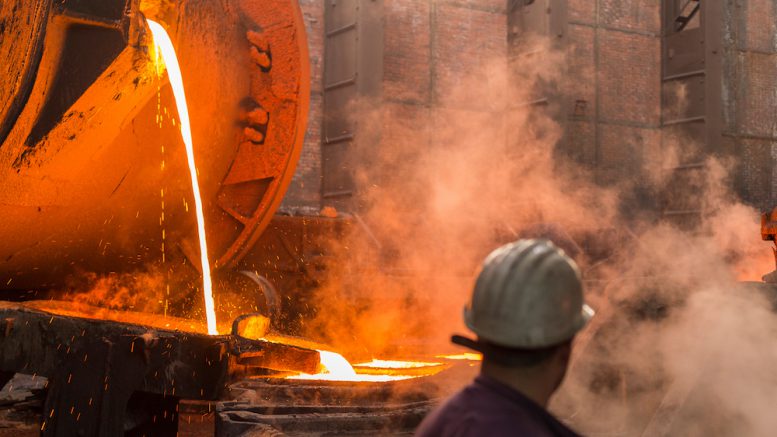
Activity at copper smelters in China rose to an all-time high in March as buyers of the red metal increased purchases following a price slump, according to Earth-1, which monitors the furnaces from space.
Inactive capacity fell by 1.1% to just 3.9% of total capacity, resulting in a record active capacity reading of 10.73 million tonnes per year, about 775,000 tonnes higher than a year ago, London-based Earth-1 said in an undated release.
“At a regional level, smelting in East and South Central China saw gains of 3.3% and 1.7%, so that activity in these important hubs is now 4.3% and 6.9% stronger respectively than a year ago,” the company said. “This speaks to the improvement in downstream activity in recent weeks, as demand recovers following a ‘buyer’s strike’ in response to record high copper prices in January that has also seen imports from the international market slump.”
It also looks like conflict has knocked out Iran’s two copper smelters, the 280,000-tonne-per-year Sarchesmeh and the 120,000-tonne-per-year Khatoon Abad. The former has been offline since March 28 with the latter appearing to shutter in the first week of April, Earth-1 said.
“While it is not unusual for both plants to go down for routine maintenance, in previous years these have tended towards the third quarter.”
Nickel also up
Global nickel smelting rose to a 10-month high in March, consistent with rising industrial activity during spring in the planet’s industrial north, Earth-1 said in a separate release.
The percentage of the world’s capacity registered as inactive fell to 12.3%, its lowest level since last May. Indonesia was at the forefront of the improvement, with its inactive capacity series falling by 2.3% to just 11%, a full 8% lower than January’s seven-year high.
“It is worth noting that the increases in sulphuric acid prices due to the war in Iran are unlikely to result in an imminent downturn in production for any of these [Class 1 nickel and ferronickel] end-use products,” Earth-1 said. “The high pressure acid leach plants that are most impacted predominantly produce an intermediate mixed-hydroxide for use in EV batteries.”
Earth-1 analyzes satellite data of infra-red and visible bands with computer vision and machine learning techniques to detect and measure operational signatures like heat and emissions at each smelting site. The results cover about 80% of the world’s smelting capacity.
Be the first to comment on "China copper smelters hit record, space satellites show"