
Central banks remained firm buyers of gold in January even as prices were skyrocketing to records — though the institutions’ appetite for bullion could face a stern test amid rising geopolitical tensions in the Middle East.
After hitting an all-time high of nearly $5,600 an oz. earlier this year, gold has come under pressure in recent weeks as elevated energy prices from the ongoing Middle East war sparked fears of global inflation and reduced expectations of lower interest rates — a scenario that hurts the safe-haven metal.
At the same time, official-sector demand remains resilient in the first few months, according to the World Gold Council, which forecasts central banks will purchase about 850 tonnes of gold in 2026 — almost the same as last year.
Early trends
Countries such as China and Kazakhstan remained active buyers in 2026, extending a multi-year trend of strong official demand, while countries like Indonesia and Malaysia have also turned into buyers after a long hiatus, WGC data shows.
“A phenomenon we’ve been seeing in the last few months is new central banks, or central banks that have been inactive or absent from the gold market for a long time, entering the gold market,” Shaokai Fan, global head of world banks for the WGC, said on Tuesday.
“I think that might be a trend that will continue into 2026,” Fan added.
Sustained buying
The buying momentum seen this year follows a sustained wave of purchases in 2025, when central banks again ranked among the largest sources of gold demand globally. Total official-sector buying reached about 863 tonnes for the year, according to WGC, slightly below the record levels of 2022–2023 but still historically strong.
Based on WGC data, analysts at investing research platform BestBrokers compiled the top buyers of gold in 2025 (shown below):
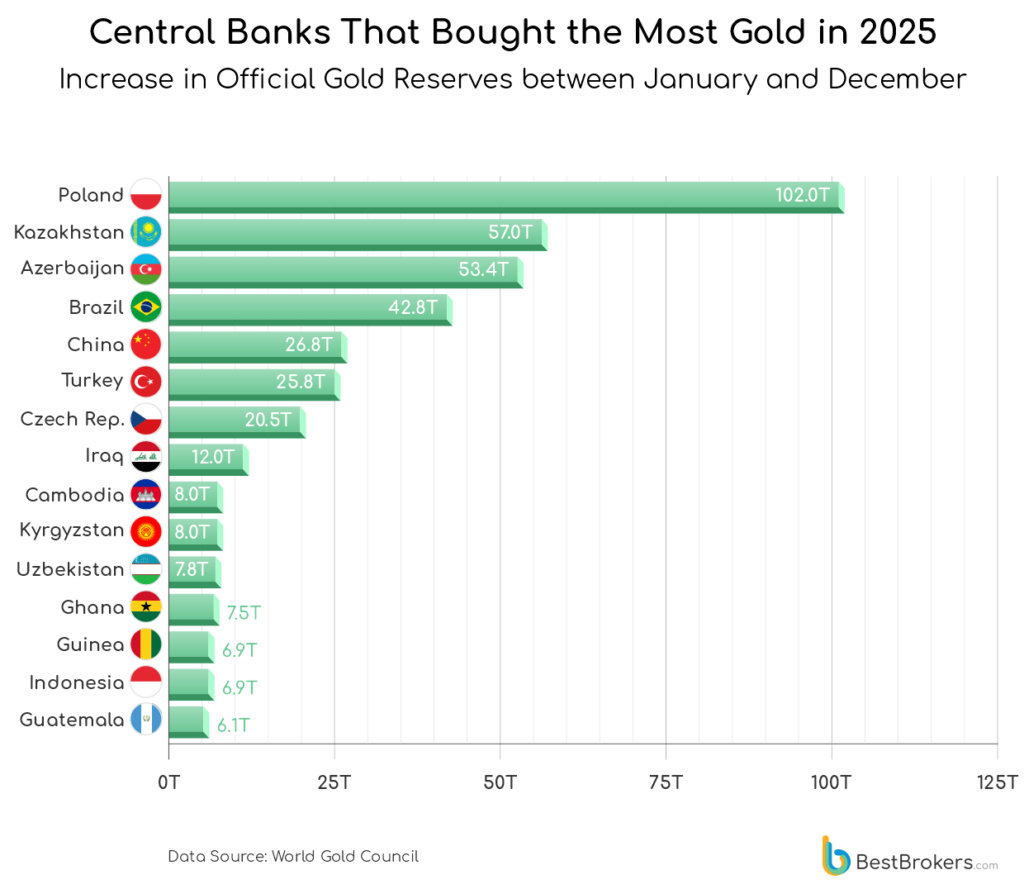
Poland emerged as the standout buyer, adding more than 80 tonnes to its reserves, while Kazakhstan and Brazil also posted significant increases. China and Turkey continued to accumulate gold as well, albeit at a slower pace compared to prior years.
The buying spree comes amid a broader trend that has seen central banks collectively add large quantities of gold since 2020, helping drive prices higher and reinforcing bullion’s role as a strategic reserve asset.
Analysts point to a combination of factors behind the trend, including geopolitical uncertainty, concerns over currency debasement and a desire among emerging economies to reduce reliance on the United States dollar.
Who holds the most gold today
Despite the surge in buying from emerging markets, global gold reserves remain heavily concentrated among advanced economies.
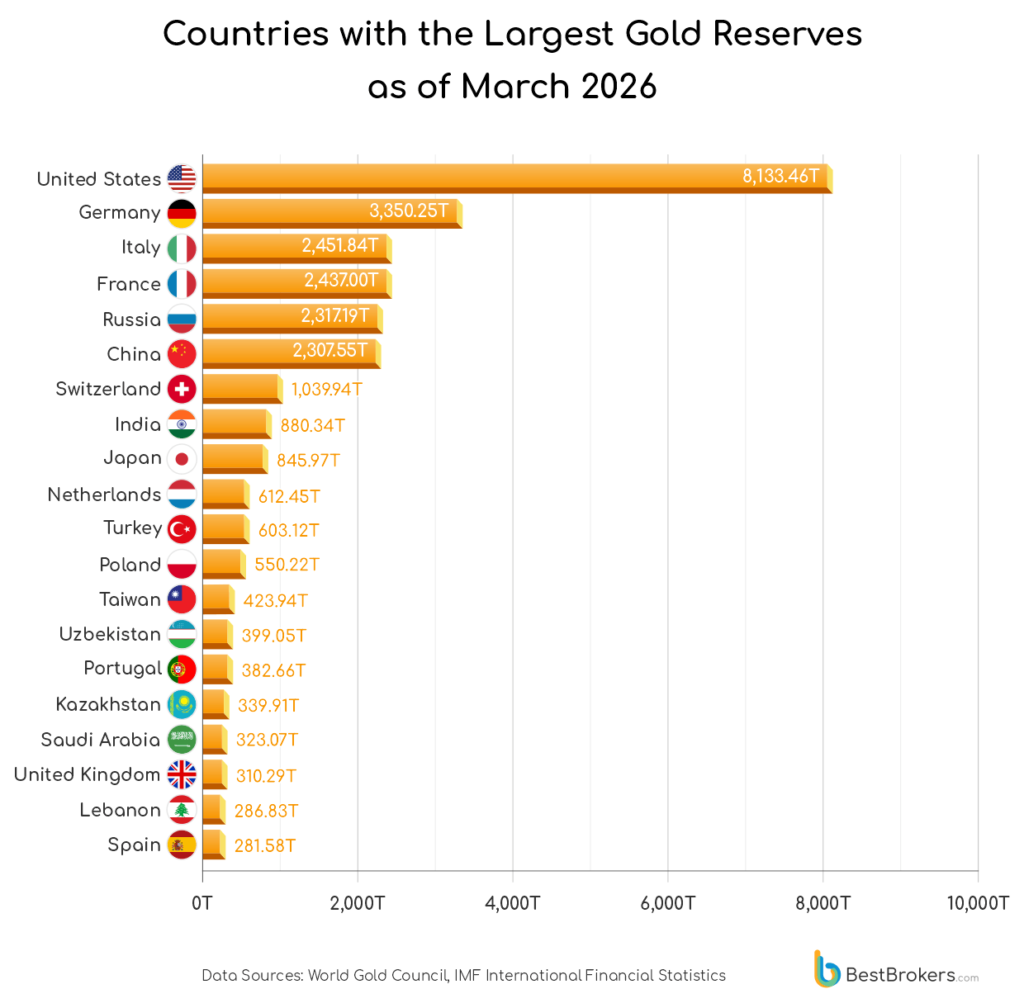
The U.S. continues to hold by far the largest stockpile, with more than 8,100 tonnes of gold, followed by Germany at roughly 3,350 tonnes. Italy and France rank next, each holding around 2,400–2,450 tonnes, while Russia and China have built reserves exceeding 2,300 tonnes apiece.
Other major holders include Switzerland, India and Japan, each with several hundred tonnes of gold in their central bank reserves.
Collectively, the U.S. and European nations still account for a dominant share of global gold holdings, though emerging markets have been steadily increasing their positions over the past decade.
Short-term uncertainty
However, as some analysts have pointed out, the war in the Middle East may have forced some states to sell some of their gold to shore up foreign exchange reserves amid elevated oil prices — even if the underlying fundamentals of holding the metal remain intact.
“Gold’s recent plunge marks a dramatic shift in investor sentiment, with the metal facing one of its sharpest weekly declines and edging toward bear-market territory,” said Alan Goldberg, lead data analyst at BestBrokers.
“While some market participants view this as a temporary correction following record highs in early 2026, others warn that volatility could persist, testing central banks’ appetite for continued accumulation,” he added.
“It’s too early to see if the same phenomenon has occurred with this month’s rout,” WGC’s Fan said.




Be the first to comment on "Central banks’ gold buying momentum carries into 2026"