
Canagold Resources (TSX: CCM) surged on Monday after releasing results of a feasibility study for its New Polaris project in British Columbia, outlining a low-cost underground gold operation with total production of over 800,000 oz. over an 8.3-year life.
The estimated preproduction capital expenditures are $183 million (C$250 million), while its all-in sustaining cost (AISC) over the life of mine is pegged at $1,247 per payable oz. of gold.
Under the base case gold price scenario of $2,500 per oz., the project has a post-tax net present value (at a 5% discount rate) of C$425 million, with an internal rate of return of 31% and payback period of 2.4 years. At a spot price of $3,300 per oz., the net present value would nearly double to C$793 million, with a 47% internal rate of return and shorter payback of 1.7 years.
“The feasibility study results demonstrate exceptional economics, low capex and low AISC for the New Polaris project,” Canagold CEO Catalin Kilofliski said in a news release. “Even at a $2,500 gold price, the projected cash flow and economics are outstanding.”
Shares of Canagold closed 10% higher in Toronto on Monday at C38¢ apiece, its highest in nearly a month, for a market capitalization of C$70.7 million. It’s traded in a 52-week range of C25¢ to C40¢.
Past producer
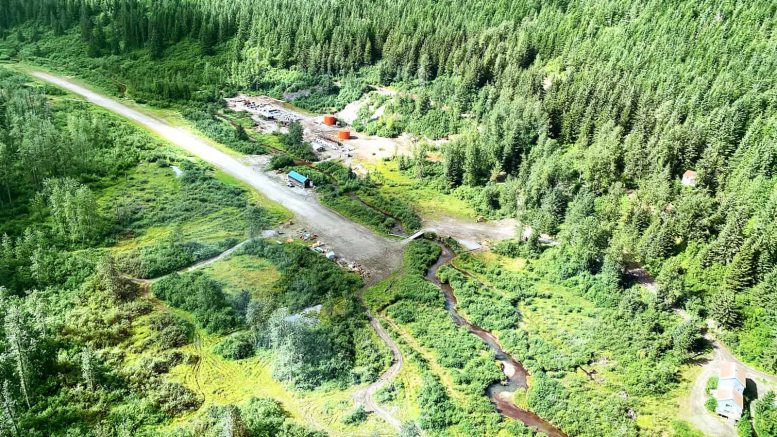
The New Polaris is situated 100 km south of Atlin, northwestern B.C., and 60 km northeast of Juneau, Alaska, on the west bank of the Tulsequah River. It is the site of a past-producing mine that operated for two periods between 1938 and 1951. Then known as Polaris Taku, the mine produced 232,000 oz. gold from 691,000 tonnes of ore grading 11.9 grams per tonne.
After its closure, the mill was used to process gold for Cominco’s nearby deposit until 1957. By then, about 15,796 metres of underground development and 3,747 metres of raise development had been completed at New Polaris.
The site then lay dormant for 30 years until exploration resumed in 1988. Canagold acquired New Polaris in 1992 and has since drilled 241 holes totaling 64,000 metres of core, outlining significant new ore below and beyond the old mine workings.
As highlighted in the news release, the New Polaris project remains subject to regulatory approvals, including a consent decision by the Taku River Tlingit First Nation and an environmental assessment certificate issued by the British Columbia government.
Antimony potential
The deposit also has 5,630 indicated tonnes of antimony grading 0.6%, the company said. About 5,173 tonnes of the metal is included in the feasibility mine plans, but it left out details on its economics. The company plans metallurgical tests for producing a high-grade antimony-gold concentrate, and to assess the feasibility of on-site refining.
Antimony, a lesser-known metal, has risen in significance for its critical role in various high-tech industries such as defence, renewable energy and semiconductors. Miners at New Polaris were aware of on the site as early as the 1940s.
Despite its widespread use, the production of antimony is heavily concentrated, with China controlling 80% of the world’s processing capacity. North America, meanwhile, has not had any mine production in years, and is at risk of being shut out from the global supply chain.
Be the first to comment on "Canagold soars on New Polaris feasibility in BC"