
Beaver Creek, Colo. – Flush crypto firms and gold miners are driving industry M&A in a competitive market where the number of discoveries has slid by more than half, this year’s Precious Metals Summit heard.
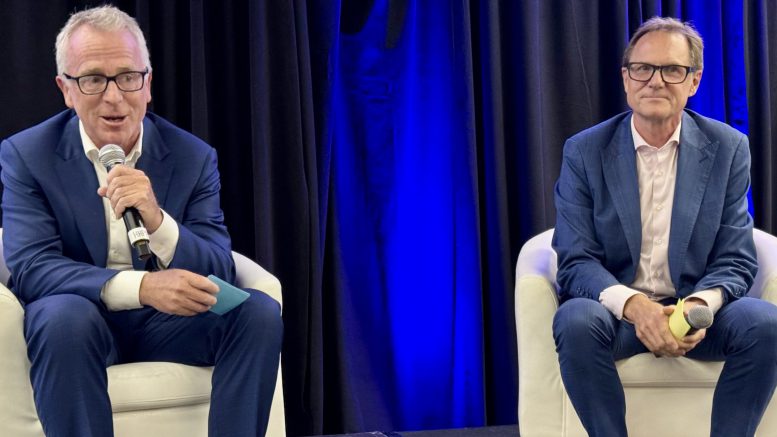
Hong Kong-based Tether, the company behind USDT, the world’s largest U.S.-dollar-pegged stablecoin (digital tokens backed by short-term Treasuries), is investing $100 million (C$138.5 million) in equities of streaming companies. New York hedge funds and cryptocurrency firms are investing $30 million or $50 million into mining projects, Michael Gray, partner at Vancouver-based Agentis Capital Mining Partners, said on a panel with Peter Bell, managing director of research at Canaccord Genuity.
“We’re seeing flows of capital from big sources,” Gray said. “The velocity of capital has really changed in the last three to six months.”
In past gold bull markets, influential financiers like Eric Sprott often validated junior projects and drew in capital. Today, with producers flush from record bullion prices and crypto firms also benefiting from non-dollar investors, the balance is shifting. Buyers now have the cash to drive deals, paying larger premiums for world-class projects they need to replace reserves while largely ignoring weaker assets, even at discounted prices.
Fast capital
Meantime, explorers reported just three new finds in the past 12 months of more than one million oz. gold, down from an average of seven in 2013, the analysts said.
Add a market that only reliably invests in the rare projects with drill hits of more than 250 grams gold per metre and you have a bull market inflated by record bullion prices where capital can accrue fast, but ounces are scarce.
“It does feel like an exceptionally upbeat period,” Bell, a former Newmont (TSX: NGT; NYSE: NEM) geologist and hedge‑fund manager, told the conference. He described new retail enthusiasm – right down to an anecdote of a Muskoka dock builder who could rattle off junior company names and drill details.
“It’s the kind of interest you wouldn’t have seen a couple of years ago,” Bell said. “People are going from not being in the sector to being right in the most-risky part.”
Complexity
Bell’s data show that drill results with more than 250 gram-metres of gold consistently spark short-term share price gains, while weaker intercepts produce random reactions. But he cautions that high-grade hits don’t guarantee a mine. Deposits that have gone into production since 2020 occupy the same grade-tonnage space as those still stranded. What separates them is complexity – whether the geology, metallurgy and geometry can be quickly drilled into a coherent resource.
For investors, Bell argues that a ≥250 gram-metre result should be seen as a trading signal rather than a mine plan. The stronger long-term indicator is when discoveries can be drilled rapidly into a resource, suggesting continuity and simplicity in the mineralization.
“The more an operation is run efficiently, like a factory, the more profitable it’s likely to be,” he said.
Complexity also shows up in financing. Bell noted that projects needing layered deals like streams and convertibles often signal deeper challenges, while top-tier projects attract simpler, cheaper equity.
Bigger budgets from new investors, Gray argued, change the geology. They support fewer drip‑feed drill programs and more bold step‑outs and deep drill tests that could mean more “shots on goal,” he said.
Companies can sustain the momentum from a big discovery with steady assay releases, clear updates and site access for investors, Gray said. His data show explorers averaged equity gains of 365% in year one and 80% in year two post-discovery, before performance tapered in later years.
Scarcity
If one theme shapes M&A, it’s scarcity. There is only a handful of tier‑one or near-tier‑one gold projects worldwide. These are the kind capable of producing roughly 300,000 oz. a year for 15 years – the lower half of the all‑in sustaining cost curve of less than $1,000 per oz. where seniors focus their shopping.
“They are rare. They are scarce,” Gray said.
Single‑asset producers holding such large-scale projects have delivered outsize equity gains over the last year, outpacing junior indexes, gold and even Bitcoin.
In Gray’s sample, tier-one gold companies averaged equity gains of 140% over 12 months, versus 98% for Bitcoin, 42% for the VanEck Junior Gold Miners Exchange Traded Fund (GDXJ), 42% for bullion and 16% for the S&P 500.
Higher gold prices could expand the list of tier-one projects by allowing miners to take in broader, lower-grade zones where ore geometry supports bulk mining, Gray said. But calculations show exploration costs $800 million for every million ounces of gold discovered. With major producers tilting toward large open pits in top jurisdictions, the shopping list remains short and competition fierce.
“We’ve seen a pretty steady pace of decent holes,” Bell said of the multi‑year run of drill results. “But it takes a lot of money to make these things happen and you want to be in the right things, not the wrong things.”
Be the first to comment on "Beaver Creek: Crypto joins gold windfall in M&A race"