
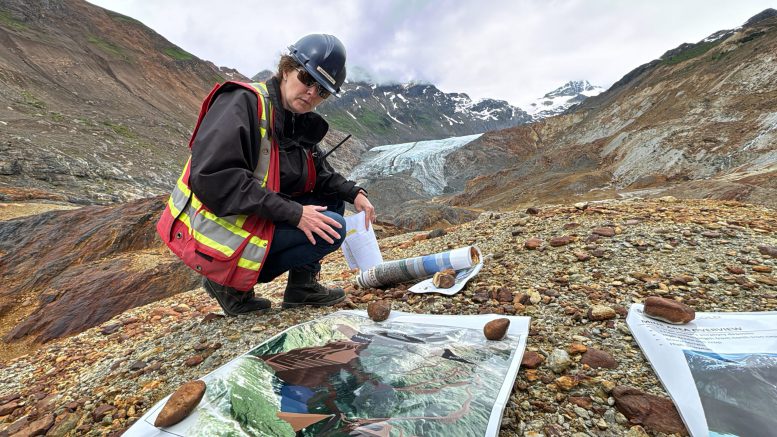
British Columbia’s Golden Triangle, despite its remoteness and rough terrain, is thriving thanks to a mining revival, attracting both exploration minnows and major miners.
The prospective region is about 500 km long and stretches from Stewart to the Stikine River in the northwest. It has some of the largest undeveloped gold, silver and copper reserves in the world and is benefiting from new infrastructure investments. Governments are also pushing to speed up mining projects through development and complete them faster.
B.C. committed this month to “seize the potential in the northwest.” Premier David Eby said his government aims to align industry, First Nations and conservation interests. B.C.’s Critical Minerals Minister Jagrup Brar told The Northern Miner that the plan aims to align provincial and federal reviews. He mentioned the goal is “one project, one review.” Brar also said the government wants to pursue trade agreements that focus on B.C.’s minerals and metals.
The region has a rich history. Over 150 mines have operated here since the late 19th century and today it accounts for around three-quarters of Canada’s known copper reserves.
The Golden Triangle sits along the Alaska border and touches near Galore Creek on its northeast point. It includes producing operations such as Newmont’s (NYSE: NEM, TSX: NGT) Brucejack and Red Chris mines, as well as advanced projects like Ascot Resources’ (TSX: AOT; US-OTC: AOTVF) Premier site and Seabridge Gold’s (TSX: SEA; NYSE: SA) KSM. Teck Resources (TSX: TECK.A/TECK.B, NYSE: TECK) also holds its Schaft Creek development joint venture with Copper Fox Metals (TSXV: CUU; US-OTC: CPFXF).
Big project
The crown jewel of the Golden Triangle is Seabridge Gold’s (TSX: SEA; NYSE: SA) Kerr-Sulphurets-Mitchell (KSM) project. This $6.4-billion (C$8.8-billion) endeavour is one of the largest undeveloped copper-gold projects in the world.
The company keeps pushing the project forward, despite a legal challenge to the ‘substantially started’ designation from the B.C. government last year. The government confirmed that the project’s environmental assessment certificate, issued in 2014, is valid for the mine’s entire lifespan.
The company aims to open a strategic $100 million financing this year to be used for critical data collection to finalize a bankable feasibility study, CEO Rudi Fronk said.
“Power is key,” he said in an interview. “B.C. Hydro’s commitment of 245 megawatts, expected by late 2026, significantly de-risks KSM.”
The gold spot price enhances the project’s attractiveness.
“KSM’s net asset value at current metal prices now exceeds $23 billion, yet our market value is under 10% of that,” Fronk said, highlighting the investment potential awaiting market recognition.
Critical infrastructure
Last year, the federal and provincial governments promised C$195 million ($142 million) for vital infrastructure upgrades. This funding will improve Highways 37, 37A and 51. Changes include wider shoulders, chain-up zones, pull-outs and Wi-Fi access along an 800-km stretch.
The improvements support critical minerals supply chains and could generate 3,000 construction-phase jobs. Another C$60 million from Ottawa will strengthen power and road connectivity, further easing logistical hurdles.
New regulations now require earlier talks with First Nations. B.C.’s Mineral Claims Consultation Framework mandates Indigenous consultation during claim staking. The provincial government also focused on speeding up critical mineral projects. This move aims to diversify trade and reduce the effects of U.S. tariffs.
Eskay update
Another leader of the region’s revival, and spending C$713 million to re-open by 2027 one of the world’s former highest-grade gold mines is Skeena Gold & Silver (TSX: SKE; NYSE: SKE). Recent government investment in the region is “a pivotal moment for our critical minerals industry,” CEO Randy Reichert said.
The Vancouver-based Skeena is pushing hard for production at Eskay Creek as it’s now fully focused on construction.
“We’ve already begun major pre-construction activities, with permits and long-lead items secured well ahead of schedule,” Reichert told The Northern Miner.
Silver upside
Meanwhile, focused on the region’s silver potential, Dolly Varden Silver (TSXV: DV; US-OTC: DOLLF) CEO Shawn Khunkhun excitedly described the Kitsault Valley’s Wolf deposit near Alice Arm as “a unicorn”.
The high-grade primary silver deposit is unusual in the silver mining world, Khunkhun said, since the metal is typically produced as a by-product. Recent drilling expanded Wolf’s footprint, including a highlight hit of 379 grams silver per tonne over 21 metres.
The company also encountered exceptional gold grades at its Homestake deposit, returning the strong result of 12 metres at 35 grams gold per tonne.
Dolly Varden’s strategic uplisting on the NYSE American, along with focused acquisitions, helped it grow its landholdings to 1,000 square kilometres. This includes the historic Porter Idaho mine.
“We made highly accretive deals, increasing our resource base significantly with minimal dilution,” Khunkhun noted, underlining the company’s capital markets strategy.
New potential
For Goliath Resources (TSX: GOT), almost every hole of the 100,000 metres drilled at the Surebet discovery has returned gold, CEO Roger Rosmus said in a recent video. The company started drilling another 38,000 metres in May.
Goliath is thought to be redefining exploration paradigms at its Golddigger property. Recent results at Surebet include intersecting a feeder dyke assaying 14.35 metres at 6.31 grams gold-equivalent per tonne. The discovery of visible gold within previously overlooked Eocene feeder dykes is transformative, the company said on June 23.
“This is a robust, district-scale mineralizing system, dramatically expanding our understanding of gold distribution in the Golden Triangle,” Rosmus said.
Be the first to comment on "BC’s Golden Triangle taps gov’t investment, new rules"