
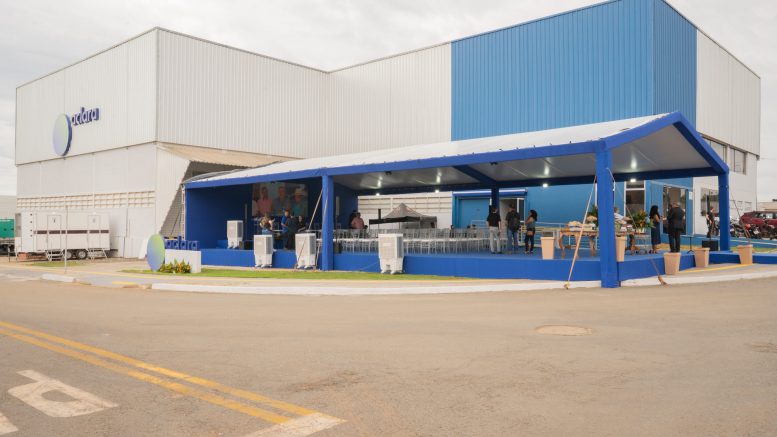
Aclara Resources (TSX: ARA) announced on Monday the inauguration of its semi-industrial heavy rare earth pilot plant in Brazil, which it will use to test the production of dysprosium and terbium from ionic clay extracted from its Carina project in the central state of Goiás.
The ceremony was attended by key government authorities from Goiás and the municipality of Nova Roma, as well as representatives from federal agencies and international embassies.
The government officials expressed their full support for the project’s streamlined development, recognizing its strategic potential to position Goiás as a global centre for sustainable production of heavy rare earths, particularly dysprosium and terbium, stated Aclara in a press release.
“Our heavy rare earth production, dysprosium and terbium, will be essential for establishing a reliable and alternative supply chain for the permanent magnets used in electric vehicles, wind turbines, robotics and other advanced technologies,” Aclara CEO Ramón Barúa said.
‘5M-EV potential’
Barúa also highlighted that the Carina project’s future production of these key elements “will enable the fabrication of approximately five million electric vehicles per year, positioning Goiás at the forefront in the global energy transition.”
At the Aparecida de Goiânia pilot plant, the company expects to process about 200 tonnes of clay material from the Carina project, resulting in estimated production of 150 kg of heavy rare earth carbonates.
The process flowsheet incorporated several optimizations that focused on increasing efficiency, reducing costs and improving the purity of the final product, Aclara said. This optimized approach builds on its previous piloting efforts in Chile, where it processed 25 tonnes of clay from the Carina project.
Aclara Resources’ stock traded flat on Monday morning at C75¢ apiece, for a market capitalization of $163.3 million.
“With an estimated investment of R$2.8 billion (C$685 million), the project will create thousands of jobs and position our state as a leader in the production of rare earths – strategic minerals for the future of clean technologies such as electric vehicles and wind energy,” Daniel Vilela, Vice Governor of the State of Goiás, said.
The plant’s inauguration adds to momentum in the rare earths space for Brazil, where last month an updated study found Meteoric Resources’ (ASX: MEI) Caldeira project in neighbouring Minas Gerais state hosts the largest ionic adsorption clay (IAC) deposit in the world by tonnage and grade. Most rare earths deposits worldwide are of the IAC-hosted variety, including Aclara’s Carina project and Serra Verde’s Pela Ema mine, also in Goias. That is also true for China, which possesses most of the globe’s rare earths and dominates their processing.
Production by 2028
The facility represents a key step in advancing the Carina project towards production by 2028. The project is currently in its permitting stage, with Aclara aiming to submit its environmental impact assessment in the middle of this year. Later in the year, the company plans to complete a pre-feasibility study, followed by feasibility study next year. To fund that work, Aclara raised US$25 million through a private placement last year.
The Carina project hosts about 298 million inferred tonnes grading 1,452 parts per million TREO (total rare earth oxides). This would support annual production of 191 tonnes of dysprosium and terbium, representing about 13% of China’s official production in 2023, Aclara estimates.
To further enhance its product value, the company is also looking to build a rare earths separation plant in the United States. This facility will process mixed rare earth carbonates sourced from its resource projects, separating them into pure individual rare earth oxides. Last November, Aclara announced a collaboration with the U.S. Department of Commerce’s International Trade Administration to find the best location for the plant.
Additionally, through a joint venture with Chile’s CAP, Alcara is advancing its alloy-making capabilities to convert these refined oxides into the alloys needed for fabricating permanent magnets.
Be the first to comment on "Aclara opens heavy rare earths pilot plant in Brazil"